Market Intelligence for E-Commerce: China & APAC
Make pricing, product, and market-entry decisions on what APAC shoppers actually buy.
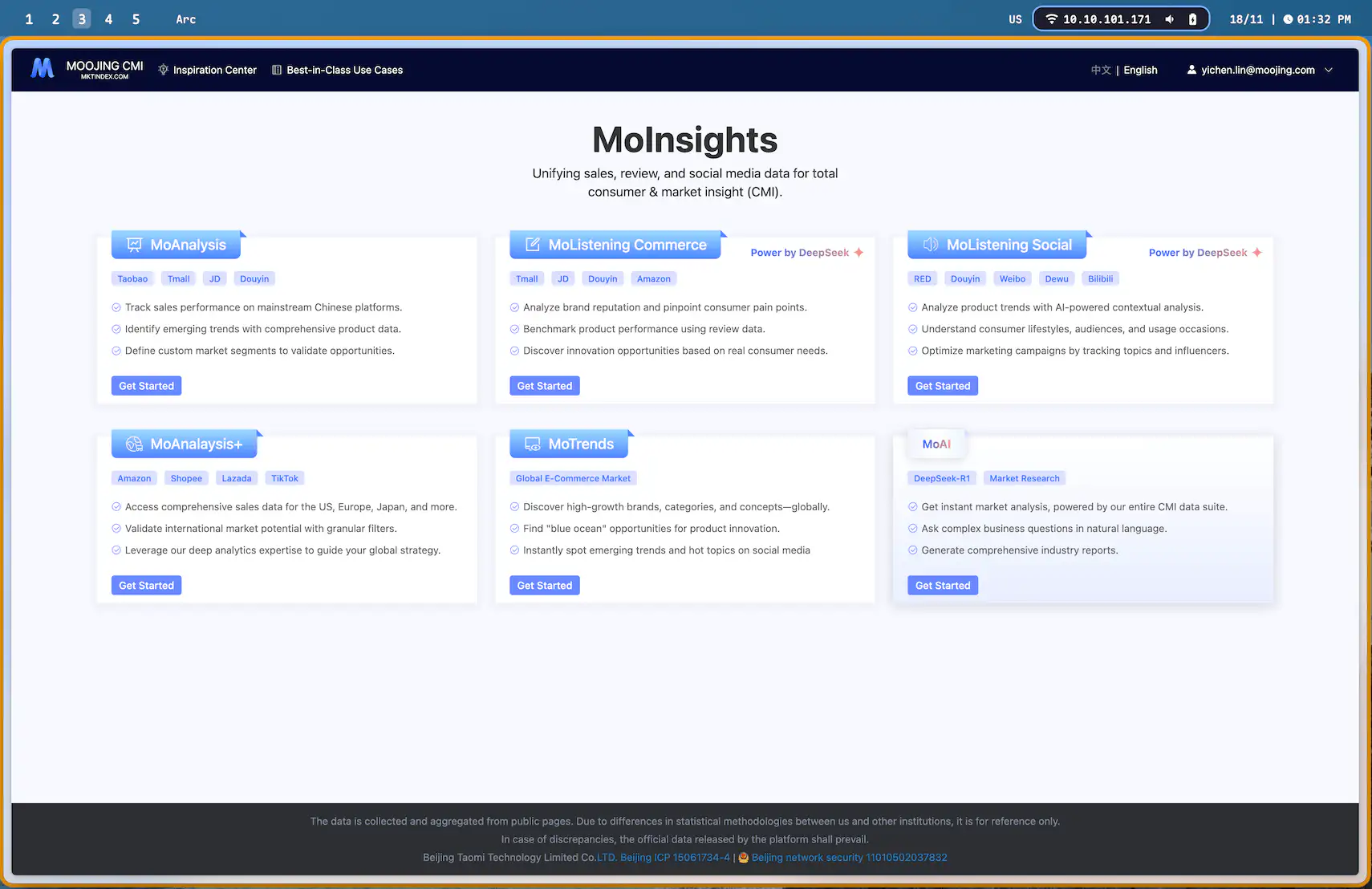
What is Market Intelligence?
Market intelligence is the systematic collection, analysis, and interpretation of data about a market — its size, growth rate, competitive landscape, customer behaviour, and underlying trends — to inform strategic and operational decisions.
For e-commerce specifically, market intelligence pulls from four primary data streams: transactional data (what's selling, at what price, in what volume); review data (what customers say after buying); social data (how people discuss brands and categories before buying); and trend data (where category, attribute, and price-point share is shifting).
The discipline is distinct from traditional market research, which typically relies on surveys and panels with longer cycle times. Market intelligence emphasises continuous, observed signals — what consumers actually do — rather than self-reported intent. In e-commerce, this means analysing SKU-level sales weekly, observing sentiment shifts as they happen, and detecting category movements before they show up in quarterly reports.
Enterprise teams use market intelligence to size opportunities, benchmark performance against competitors, validate product decisions, and time market entries. The quality of decisions depends directly on the breadth, depth, and freshness of the underlying data — which is why source coverage and methodology transparency matter more than dashboard polish.
The Four Pillars of E-Commerce Market Intelligence
A complete market intelligence picture combines four data streams — each answers different questions, and together they cover the full purchase journey.
Sales Analysis
Who's winning at SKU level. Analyse sales volume, revenue, pricing, and market share across major e-commerce platforms — by brand, category, and price tier.
Consumer Review Analysis
What customers say after buying. Extract pain points, sentiment shifts, and product attributes from reviews across major marketplaces.
Social Listening
How brands and categories are discussed before purchase. Analyse sentiment, share of voice, and KOL/KOC effectiveness across 10+ social platforms.
Trend Forecasting
Where share is shifting, weeks before quarterly reports surface it. Search-signal blends, social-signal blends, and sales-pattern triangulation.
What Separates Reliable Market Intelligence from the Rest
Not all market intelligence is equal. When evaluating providers, these five criteria separate signal from noise — regardless of brand, dashboard, or pitch.
-
Methodology transparency. Reliable providers publish how data is collected, what's included, what's excluded, and how it's normalised. If a methodology page doesn't exist or is generic, treat the dashboard with caution.
-
Historical depth. Year-over-year analysis requires multi-year data. Ask how far back the data goes for each platform — not just the headline market — and whether older data uses the same methodology.
-
Update cadence. Match the cadence to the decision. Weekly competitive moves need weekly data; annual planning tolerates monthly. Fresher data isn't always better, but stale data is always worse.
-
Coverage breadth. A platform missing from coverage is a blind spot. Confirm marketplace and social platform lists explicitly — and check that coverage extends through the markets you actually sell in.
-
Use-case fit. The same dataset can be useful for category sizing and useless for SKU benchmarking, depending on granularity. Define your specific question first, then evaluate.
For a longer evaluation guide, see How to evaluate market intelligence providers →
Who Uses Market Intelligence?
Market intelligence is decision infrastructure. The people running the decisions vary by team — but the questions they answer are remarkably consistent.
Brand & Marketing
- Where is our share shifting?
- Which channels are working for our category?
- How is sentiment shifting on our brand?
- Where is share of voice concentrated?
Product & R&D
- What pain points appear in reviews of similar products?
- Which product attributes are gaining traction?
- What price points is the market converging on?
- Which features should we ship next?
Investment & M&A
- Is the target's reported growth supported by sales data?
- What is the category trajectory over 3-5 years?
- How concentrated is the competitive set?
- What downside scenarios show up in early signals?

Built on Verified Methodology
Moojing has been collecting Chinese e-commerce data since 2016, with methodology designed for analyst-grade use. Every dataset documents its sources, collection cadence, normalisation rules, and known limitations. SKU-level sales data is reconciled across platforms; review data is sentiment-classified with auditable confidence scores; social data attribution traces back to source posts.
Enterprise clients in finance, consulting, and FMCG depend on this data for high-stakes decisions — which is why methodology transparency is foundational, not optional.
Frequently Asked Questions
Common questions about market intelligence for e-commerce.
Market research typically refers to commissioned studies — surveys, panels, focus groups — that capture self-reported intent. Market intelligence emphasises continuous, observed signals: actual purchase data, real reviews, real social conversations. The two are complementary; market intelligence is faster and broader, market research goes deeper on specific questions.
E-commerce market intelligence typically covers SKU-level sales analysis (volumes, prices, market share), consumer review analysis (sentiment, pain points, product attributes), social listening (brand mentions, share of voice, KOL/KOC effectiveness), and trend forecasting (category and attribute movements over time).
Update cadence depends on data type. Sales data is typically refreshed weekly or monthly, reviews are added as they are posted (effectively continuous), and trend reports are usually quarterly. Match the cadence to your decision speed.
Moojing covers 30+ e-commerce and social platforms across 20+ countries, with deepest coverage in China (China coverage going back to 2016) and expanding coverage across Southeast Asia, Japan, Korea, and beyond.
Methodology transparency is the foundation. Source-level coverage is documented per platform; sales data is cross-checked against multiple signal sources where available; sentiment classification is auditable; sample data is provided to enterprise clients before purchase. See the full research methodology page for details.
Brand and marketing teams use it for share analysis and competitive research; product and R&D teams use it for opportunity sizing and feature decisions; investment and M&A teams use it for diligence and category forecasting; consulting firms use it as research infrastructure for client engagements.
Yes. Moojing platforms support Excel and CSV export at the SKU, brand, category, and aggregate levels, with API access available for enterprise integrations.
Five criteria matter: methodology transparency, historical depth, update cadence, coverage breadth, and use-case fit. See the evaluation section on this page for a longer treatment.
See the Data Behind the Decisions
Request a sample of our market intelligence data — covering your category, your platforms, your markets.