Subsidy Season: How National Incentives Powered China's Campus 3C Upgrade in 2025
 By Jotham Lim
6 min read
By Jotham Lim
6 min read
Executive Summary#
Get the Full Report: Download the complete analysis for detailed data, methodology, and pages of insights.
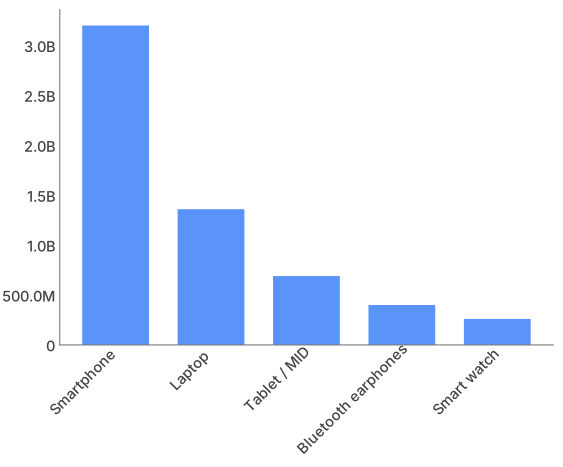
In China's 2025 back-to-school season, a national subsidy of up to 15% on 3C devices turned a routine campus refresh into a full-scale upgrade cycle — and the timing signal was unmistakable: February 2025 laptop spend ran +12% above the single-month peak of Double 11 2024. This Tmall Campus (天猫校园) × Moojing deep dive examines how the "tens-of-billions" national-subsidy programme, layered onto genuine academic demand, concentrated a college-student device upgrade into the first quarter of 2025. Smartphones led campus 3C spend at CN¥ 3.20B (US$ 444M), with laptops close behind the category's growth story at CN¥ 1.36B (US$ 189M). Behind the headline numbers is a clear behavioural pattern: subsidy provided the nudge, but learning needs, gaming, AI curiosity, and creative hobbies decided which device landed in the cart.
A Subsidy That Reset the Buying Calendar#
The 2025 campus 3C story begins with policy. A national subsidy offering up to 15% off qualifying 3C devices — the widely-referenced "tens-of-billions" national-subsidy programme — arrived in time to reshape when, not just whether, students upgraded. Devices that might have been bought across a spread-out spring instead concentrated into a Q1 2025 upgrade peak.
The sharpest evidence sits in the laptop category. Laptop consumption in February 2025 ran +12% above the single-month sales of Double 11 2024 — remarkable given that Double 11 is the calendar's marquee shopping moment. When an off-peak February outpaces the year's biggest promotional event, the pull-forward effect of the subsidy is doing the work. For category planners, that inversion is the single clearest read on how much a well-timed incentive can move a student budget.
Crucially, the subsidy did not manufacture demand out of nothing. It accelerated purchases students were already contemplating, lowering the threshold on higher-specification devices and making a genuine upgrade — rather than a like-for-like replacement — the rational choice. The result was a season where premium tiers, not entry models, captured the campus wallet.
Smartphones and laptops anchor campus 3C spend
Smartphones: The Category Students Talked About Most#
Smartphones were the centre of gravity for campus 3C, both in spend and in conversation. The category drew 36.7% of 3C social mentions and 43.2% of interactions — comfortably the most-discussed device on campus. That attention translated into CN¥ 3.20B of student GMV.
Within smartphones, Apple led spend at CN¥ 1.63B — more than the next four brands combined — with the iPhone 16 Pro Max standing out as a top new-device pick. Xiaomi followed at CN¥ 0.44B, with the REDMI K80 a favourite among value-focused upgraders, and vivo contributed CN¥ 0.35B. Huawei added CN¥ 0.31B, matched by a striking CN¥ 0.31B flowing to second-hand devices — a reminder that campus demand is layered rather than uniform.
That second-hand pool tells its own story. Older models such as the iPhone 5s and iPhone XS regained attention among students, prized less for raw performance than for a retro-photography aesthetic that plays well on lifestyle-sharing feeds. It is a neat illustration of how a "core" device category picks up scenario-driven demand: the same student who wants a flagship for daily use may add a vintage handset purely for its creative look.
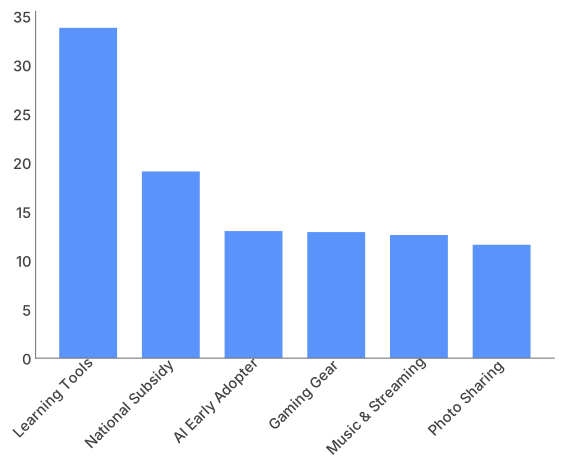
Learning tools drive the campus 3C decision
Core Demand Plus Scenario: Why Students Actually Bought#
The purchase-trigger data reframes the subsidy's role. Learning Tools led every other motivation at 33.8% — academic need is the core driver, the reason a device is required in the first place. National Subsidy followed at 19.1%, confirming its importance as an accelerant without displacing genuine study demand. From there the triggers fan out into scenarios: AI Early Adopter at 13.0%, Gaming Gear at 12.9%, Music & Streaming at 12.6%, Photo Sharing at 11.6%, and Recommendation at 11.4%.
Read together, these signals describe a "core + scenario-driven" demand structure. The core is academic: more than 47% of students use laptops for academic work, and a performance upgrade is the top replacement reason, cited by 45%. Layered on top are the scenarios that decide which device wins — the gaming rig, the AI study companion, the camera for content, the earphones for focused revision. Subsidy lowered the price barrier; these scenarios chose the product.
The AI thread is worth isolating. AI-powered products gained clear traction across efficiency, tutoring, editing, and writing use cases, and AI-tool penetration reached roughly 40% among laptop users. For a cohort defining its study and creative habits, an AI-capable device is fast becoming a baseline expectation rather than a novelty — a durable demand driver that outlasts any single subsidy window.
Laptops and Audio: Performance and Focus#
Laptops carried the season's most concentrated brand story. Lenovo led spend at CN¥ 0.80B — more than all other listed brands combined — with its Legion (Y/R) gaming and entertainment line the standout upgrade pick. ASUS followed at CN¥ 0.15B, Apple at CN¥ 0.099B, Mechrevo at CN¥ 0.096B, and Huawei at CN¥ 0.048B. Gaming and entertainment laptops set the tone: the same machine that handles coursework doubles as the dorm's entertainment hub, and students upgraded for the performance headroom to do both well.
Audio rounded out the scenario story. Bluetooth earphones led earphone mention share at 65.2%, and more than 60% of students said noise-cancellation helps them focus — a direct link between a lifestyle accessory and the academic core. Together with the laptop data, it reinforces the season's central lesson: campus 3C purchases sit at the intersection of study necessity and everyday scenario, and the brands that won spoke to both at once.
What This Means for Campus 3C Strategy#
For brand and category teams, the 2025 campus season offers a clean playbook. First, timing is leverage: a subsidy that shifted February laptop spend +12% above Double 11 shows how much a well-placed incentive can compress a buying window — plan inventory and campaigns around the policy calendar, not just the promotional one. Second, lead with the core: Learning Tools at 33.8% means academic use is the argument that opens the sale, with subsidy and scenario benefits as reinforcement. Third, build for the scenarios that convert — AI capability, gaming performance, creative imaging, and focus-friendly audio — because those are what decide between two subsidised options. The full report carries this lens across the campus season; the companion articles below extend it into self-care and fashion.
About the Data#
Source: Tmall Campus (天猫校园) × Moojing. E-commerce figures from the Tmall Campus Marketing Data Center; social-listening from Moojing's proprietary CMI coverage across leading short-video and lifestyle-sharing platforms. Q1 2025 (Jan–Mar). Highest-engagement category/brand pools per theme, not a full census; excludes offline retail and B2B/wholesale. Currency at 2025 avg ≈ CN¥ 7.2/US$.
More from This Report#
Explore the rest of the China Back-to-School 2025 series:
Download the Full Report#
Get the complete analysis with detailed data, methodology, and additional insights.
Download the College Student Back-to-School Season Consumption Report
This content adheres to Moojing's editorial standards .


