China's Online Bedding Market Hits CN¥ 46 Billion in H1 2024: Price Polarization Reshapes Competition
 By Jotham Lim
5 min read
By Jotham Lim
5 min read
Newer data: China's Bedding Market: Online Sales Hit CN¥ 116.4B in 2025
Executive Summary#
China's online bedding market reached CN¥ 46.01 billion in H1 2024, up 11.9% year-on-year (YoY), and beneath that growth the structure of the market is changing. Content-led commerce gained share, while price tiers moved apart: value products (CN¥ 0-100) and premium products (CN¥ 1,000+) both gained share at the expense of the mid-range. At the same time, a demographic shift is under way, as young women aged 21-30 are becoming the market's most engaged consumer segment and are driving demand for premium materials and personalised designs. For brands, the data points to a clear strategy. They should choose a position at the value end or the premium end, align their channel strategy with it, and invest in the consumer segments that will shape bedding purchases over the next decade.
Market Overview: CN¥ 46 Billion in Online Sales#
China's online bedding market kept growing strongly through H1 2024, reaching CN¥ 46.01 billion across four leading Chinese marketplaces. Bedding is a daily essential with steady replacement demand, and it has benefited as online shopping habits have matured, since consumers are increasingly comfortable buying textiles online without seeing them first.
Content-led commerce gained share of the market, as livestream selling and short-video product seeding proved especially effective for textiles. Bedding is a visual category in which consumers want to see the texture and colour of the fabric and how it looks in a bedroom before they buy.
Price Polarization: The Squeeze on Mid-Range#
The price structure of the bedding market is splitting towards both ends. The value tier (CN¥ 0-100) grew from 20.0% to 23.0% of total sales, a gain of 3.0 percentage points and the largest shift anywhere in the price range, while the premium tier (CN¥ 1,000+) grew from 12.4% to 13.4%.
Sub-Category Winners: Bedding Sets Lead, Cooling Mats Surge#
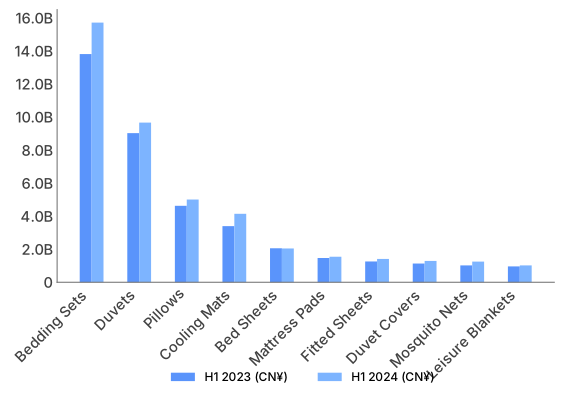
The order of sub-categories did not change, with bedding sets at CN¥ 15.71 billion, up 13.8% YoY, duvets at CN¥ 9.66 billion, up 7.1%, and pillows at CN¥ 5.01 billion, up 8.2%. These three core categories together account for over 66% of total market sales.
Bedding sets dominate at CN¥ 15.7 billion; cooling mats show strong +22% seasonal growth
Consumer Shift: Young Women and Lower-Tier Cities#
Social media analysis shows a clear demographic shift. The female share of engagement with bedding content rose to 49.5%, close to parity, and the 21-25 age group grew from 9.1% to 10.3% while the 26-30 group grew from 14.3% to 15.4%, adding 2.3 percentage points together. These Gen Z and young Millennial consumers are moving into homes of their own, and we believe they are a growing source of demand.
By city tier, new Tier 1 cities gained 0.9 percentage points (25.5% to 26.4%) while the share from Tier 1 cities fell by 1.2 percentage points. We believe this spread reflects the rising aspirations of the middle class in second-tier markets, where housing takes a smaller part of disposable income and leaves more to spend on the home.
Nearly half (49.7%) of all bedding purchases in H1 2024 were driven by the wish for "better quality" rather than simple replacement, up from 47.9% in H1 2023. When half of all purchases are made to improve quality, brands that present their products as a real improvement in quality of life can charge premium prices and make buyers less sensitive to price.
Materials and Features: Cotton Leads, Innovation at the Margins#
Minimalist or simple styles lead by a wide margin both in sales on a leading marketplace (CN¥ 511 million) and in social media voice, which reflects the mainstream move towards clean home aesthetics. Pure cotton remains the most popular material, at CN¥ 4.93 billion in sales on the same marketplace. Emerging materials such as soy fibre, memory foam, goose down and milk fibre are growing in ways that point to future opportunities for premiumisation.
Among functional features, skin-friendly and soft attributes lead social media discussion (38.1 million posts), while breathable and cooling features are growing fastest, driven by summer conditions. Machine-washable bedding (CN¥ 800 million) has become a basic requirement for brands targeting consumers aged 21-35.
What This Means for Brands#
The data points to five strategic priorities. First, brands should choose a price position: value brands should compete on volume through content-led commerce, while premium brands should invest in telling the story of their materials on marketplaces where shoppers search and compare brands. Second, they should align promotional calendars with the 618 and Double 11 festivals, which bring the highest sales peaks of the year. Third, they should target women aged 21-30 with modern design and accessible premium pricing. Fourth, they should develop French-inspired or contemporary Chinese (guofeng) collections to get ahead of emerging demand for those styles. Fifth, they should address product odour and size discrepancies, the pain points that remain the main sources of negative feedback across the category.
About the Data#
This analysis is based on Moojing Market Intelligence (魔镜洞察) data covering four leading Chinese e-commerce marketplaces, including content-led commerce. Data covers January-June 2024 with year-on-year comparisons to the equivalent period in 2023.
Download the Full Report#
Download the full China Bedding Products Market H1 2024 report
This content adheres to Moojing's editorial standards .


