China's Online Dermatological Drugs Market Hits CN¥ 5.69B as E-Prescriptions Reshape Channel Mix
 By Jotham Lim
5 min read
By Jotham Lim
5 min read
Executive Summary#
China's online dermatological drugs market reached CN¥ 5.69 billion in 2023 (+2.8% YoY), with January-July 2024 accelerating to +20.4% YoY as e-prescription policies and growing consumer comfort with online pharmaceutical purchases reshape the channel landscape[1]. The global dermatological drugs market is projected to reach US$ 71.66 billion by 2029 (9.67% CAGR), while China's domestic market hit CN¥ 25.7 billion in 2023, with the online share tripling from 7.5% to 17.9% over five years. This analysis examines the market's structural transformation, the capabilities that define a credible pharmaceutical channel, and the emerging RX opportunity that is redefining pharmaceutical e-commerce in China.
Download Full Report#
Get the complete analysis with additional data on dermatitis-eczema deep-dive, cross-border pharmaceutical trends, pet medication market, and category-level competitive intelligence.
Download the Full Q3 2024 Dermatological Drugs Market Whitepaper -->
Online Channel Triples Its Share in Five Years#
China's online dermatological drug channel grew from CN¥ 1.5 billion (7.5% of total) in 2018 to CN¥ 4.6 billion (17.9%) in 2023, a compound annual growth rate of approximately 25%[1]. Projections indicate online sales will reach CN¥ 8.9 billion (26.5% of total) by 2027, confirming that the inflection point in pharmaceutical e-commerce has passed.
The offline channel maintained modest growth from CN¥ 18.6 billion to CN¥ 21.1 billion over the same period, indicating that online growth captures both incremental demand and redistributes existing purchases. For pharmaceutical companies, this demands a dual-channel strategy: maintaining offline pharmacy presence while investing heavily in e-commerce capabilities.
Online channels' share of China's dermatological drug market tripled from 7.5% in 2018 to 17.9% in 2023, and is projected to reach 26.5% by 2027
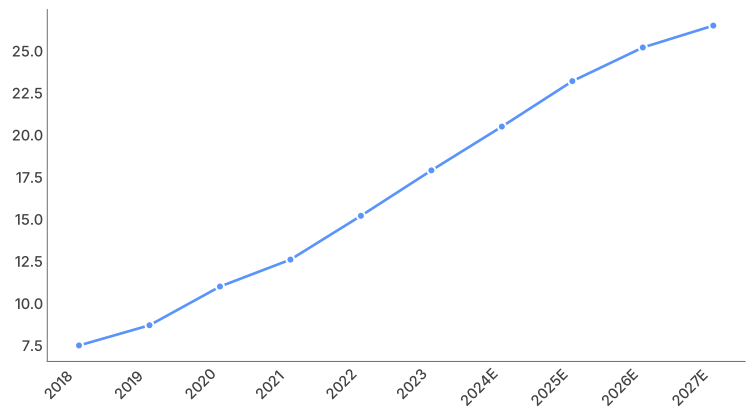
The projected 18% growth rate for online channels, set against offline growth of 3-4% a year, creates a clear imperative for brands to build digital-first distribution strategies. The shift is structural rather than cyclical: each year of the forecast window adds share to the online channel, and none of it is recovered by the offline base.
The RX Prescription Opportunity#
Prescription drug share rose to 28.7% in January-July 2024, up from 27.4% in 2023[1]. This trend is driven by government prescription outflow policies redirecting prescriptions from hospital pharmacies to retail and online channels, and growing acceptance of online prescribing for chronic dermatological conditions such as eczema, psoriasis, and atopic dermatitis.
The full-year 2023 market reached CN¥ 5.69 billion with 119 million units sold, while January-July 2024 alone hit CN¥ 3.86 billion (+20.4% YoY), signaling continued acceleration. The 20.4% growth, a sharp increase from the 2.8% recorded in full-year 2023, suggests that a new wave of online pharmaceutical adoption is underway.
Prescription drugs accounted for 28.7% of online dermatological drug sales in January-July 2024, up from 27.4% in 2023
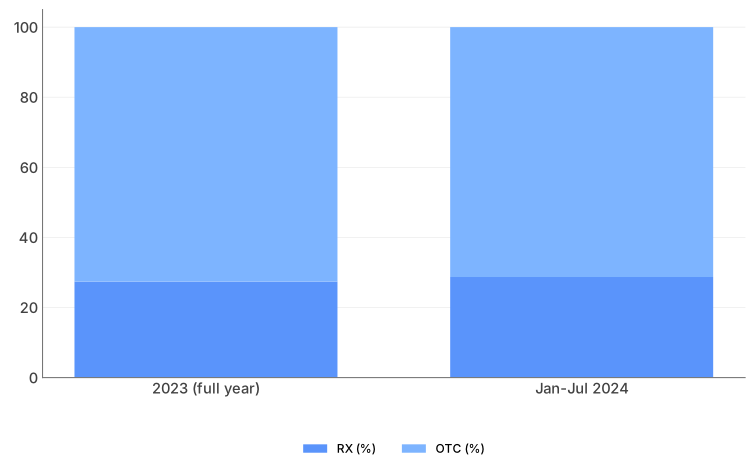
For pharmaceutical companies, the rising RX share represents an opportunity to capture higher-value prescriptions online, particularly for chronic conditions requiring ongoing medication management. It also changes what an online listing has to do: an OTC topical can be sold on packaging and price, while a prescription product has to be sold through a compliant consultation flow that most consumer-goods playbooks do not contain.
What Wins Online: Fulfilment Capability and Content-Led Discovery#
Online dermatological drug demand is being redistributed by capability rather than by catalogue breadth[1]. By 2024, three requirements defined a credible pharmaceutical channel in China, and all three were operational rather than commercial.
Prescription-capable infrastructure. Selling RX dermatology online requires licensed-pharmacist review, e-prescription handling, and auditable dispensing records. Channels that built this capability early are the ones positioned to absorb the prescription volume that outflow policy is moving out of hospital pharmacies. It is also the hardest of the three to add later, because it is a regulatory qualification and cannot be built as a feature.
Pharmacy-grade fulfilment. Dermatological medication is bought under symptom pressure: a flare of eczema or an insect bite does not wait for a three-day delivery window. Same-day and sub-hour medicine delivery, cold-chain handling where the formulation requires it, and self-operated pharmacy networks that hold stock physically close to the buyer have become the operational floor rather than a point of differentiation.
Content-led discovery for OTC. Content commerce has opened a genuinely new route into over-the-counter dermatology, where the purchase is triggered by a described symptom rather than a searched brand name. It is the newest of the three routes and the one still being built out, and it favours products whose benefit can be demonstrated visually in a short format.
The practical read for pharmaceutical companies is that channel strategy has become an operations question. Listing coverage is quick to buy; prescription qualification, delivery speed, and a content function that can talk about symptoms without over-claiming are not, and they are what determine which channels a category's growth actually lands in.
Cross-border Drugs Reach CN¥ 370 Million#
The cross-border dermatological drugs segment reached CN¥ 370 million in January-July 2024 (+12% YoY), with sales peaking in spring-summer months[1]. Demand concentrates in two product types: minoxidil-based anti-hair-loss treatments, and topical relief for insect bites and stings, which is consistent with the spring-summer peak. Both are bought through the cross-border channels of leading Chinese marketplaces rather than through domestic registration.
This growing cross-border demand signals consumer willingness to seek products not yet registered domestically, creating opportunity for international pharmaceutical companies targeting the Chinese market. It is also a useful leading indicator, because a formulation that sustains cross-border demand has already shown category interest before a registration decision has to be made.
This content adheres to Moojing's editorial standards .


