Indonesia vs Thailand vs Vietnam: Three Beauty Markets, Three Strategies
 By Jotham Lim
6 min read
By Jotham Lim
6 min read
Executive Summary#
Between April 2025 and March 2026, 40--54% of active beauty brands disappeared from Shopee across Indonesia, Thailand, and Vietnam. Yet this is not a story of decline --- it is a story of divergent consolidation. Indonesia is concentrating around a local-brand oligopoly led by Skintific ($84M). Thailand is doubling down on dermocosmetic premiumisation with La Roche-Posay ($33.9M, +90%). Vietnam is the outlier: instead of top-heavy consolidation, its mid-tier specialist brands gained the most share (+15.2pp), keeping the market open for new entrants. Each market demands an entirely different playbook --- and brands applying a single regional strategy will lose in all three [1].
Download Full Report#
Get the complete analysis with brand rankings, skincare deep-dives, and cross-market product benchmarks for all three countries.
The Great Consolidation: 40--54% of Brands Gone in 12 Months#
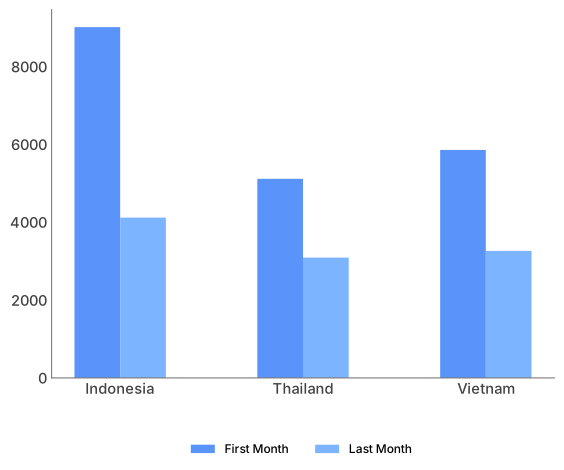
The headline number is stark: across all three markets, active brand counts contracted by 40--54% in a single year. Indonesia experienced the steepest decline, dropping from 9,015 to 4,120 active brands (-54%). Thailand lost 40% (5,117 to 3,093), and Vietnam 44% (5,859 to 3,263).
Active brands contracted 40–54% in 12 months
Indonesia: The Local-Brand Fortress#
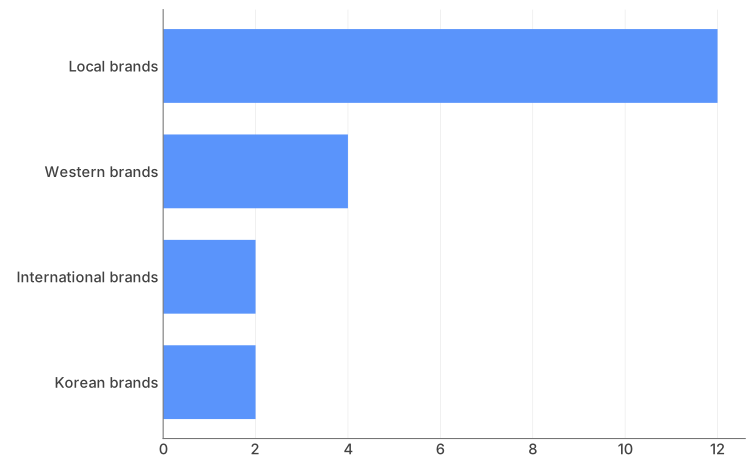
Indonesia's beauty market is the region's largest at $2.02 billion on Shopee, and it is dominated by local brands. Four of the top five brands are Indonesian: Skintific ($84M), GLAD2GLOW ($76.3M, +55%), Wardah ($70.4M), and OMG Oh My Glam ($35.7M, +137%). Of the top 20 brands, 12 are local --- the highest proportion in the region.
Indonesia is local-dominant, Thailand Western-led, Vietnam diversified
Thailand: The Dermocosmetic Kingdom#
Thailand is the smallest of the three markets at $0.89 billion but operates on fundamentally different consumer economics. La Roche-Posay leads at $33.9M (+90%) with an average price of $27.50 --- three to seven times higher than Indonesia's top brands. All three top positions belong to Western dermocosmetic brands: La Roche-Posay, Eucerin ($26.7M), and CeraVe ($22.4M).
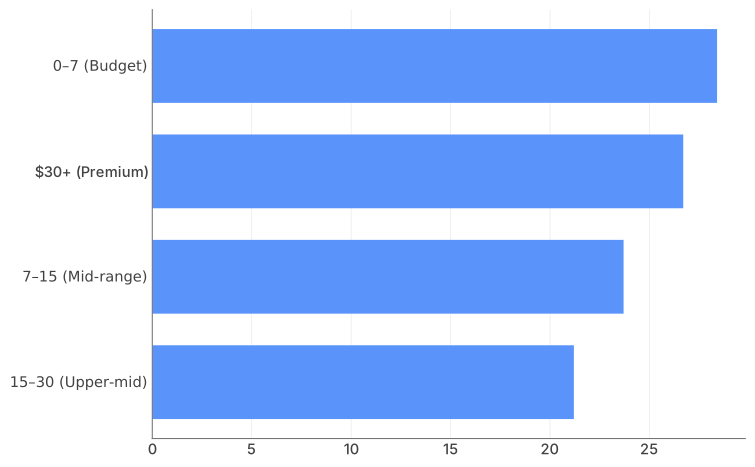
Thailand's premium tier ($30+) accounts for 32.5% of revenue --- the highest in SEA. Consumers willingly pay $60 or more for efficacy-backed products. Eucerin serum at $62 sells 35,000 units without hesitation. The market's trust equation is distinctive: doctor says it's good beats influencer says it's good.
The consolidation pattern is balanced --- top 5 gained +6.7pp of share, and the brand origin split is even (8 local, 8 Western in the top 20). This is not a market where one type of brand is squeezing out others; rather, local and international brands coexist at different price points.
The standout dark horse is La Glace, a Thai local brand that surged from near-zero to $12.1M with +1,275% growth. La Glace demonstrates that Thai consumers will reward local brands that match dermocosmetic-level positioning --- but the trust threshold is high. Entry requires dermatologist endorsement and ingredient-led marketing, not influencer seeding alone.
Vietnam: The Growth Stock with Open Windows#
Vietnam ($1.42 billion) is the most fragmented and the most dynamic. The top 5 brands hold only 8.0% share --- the lowest concentration in the region. L'Oreal Group sweeps the top four positions (L'Oreal Paris, La Roche-Posay, Maybelline, Garnier) with a combined $97.9M, yet even this dominance represents only 33% of top-20 combined revenue.
The critical difference in Vietnam's consolidation: Top 21--100 specialist brands gained +15.2 percentage points --- the largest mid-tier gain in the region --- while Top 5 gained the smallest amount (+4.7pp). Vietnam is not heading toward oligopoly. It is heading toward professional segmentation, where specialist brands carve defensible niches.
Six Korean brands sit in the top 20 --- more than any other market. beplain ($15.1M), d'Alba ($15.1M), rom&nd ($14.1M), 3CE ($13.7M), SKIN1004 ($13.2M), and Klairs ($10.2M) collectively represent K-beauty's most important growth frontier in Southeast Asia.
The most explosive story is YLEE, a Vietnamese local brand that went from near-zero to $11.5M in one year via acne care, priced at $7.40 per product and moving 520,000 units. With 35% of Vietnam's population under 25, teenage acne care is a severely underestimated essential-need category --- not a niche, but a demographic inevitability. Livestream commerce is not a channel but the core growth engine --- Embryolisse surged +2,350% via livestream. Brands that lack livestream capability are effectively forfeiting Vietnam's fastest-growing acquisition channel.
Price Tiers: Three Different Consumer Economies#
The price tier distribution reveals why a single product line cannot serve all three markets.
Thailand commands 33% from premium; Vietnam's mid-range dominates
Market Entry: Three Countries, Three Playbooks#
The data points to three distinct entry strategies, each validated by the breakout brands that succeeded in each market over the past 12 months:
Indonesia ($3--12, Halal + local KOL): The golden rule is affordable, Halal-certified, effective, and localised. Gloow&Be sunscreen at $3.10 sells 540,000 units. The benchmark is mass volume at razor-thin margins, and Halal certification is not optional --- it is a market requirement. Local brand competition is intense, making this a high-volume, low-margin play.
Thailand ($20--60, dermatologist endorsement): The entry ticket demands clinical credibility. Ingredient marketing and dermatologist endorsement are the primary trust signals. The benchmark is La Glace, which achieved +1,275% growth with toner pads positioned on efficacy. Premium pricing is expected, not penalised --- but the trust threshold is the highest in the region.
Vietnam ($5--15, livestream + efficacy): The formula is livestream plus under-$10 pricing plus efficacy promise. YLEE's $7.90 acne products sold 520,000 units from a standing start. For international brands, Vietnamese consumer preferences are the most similar to East Asian markets, and cross-border Shopee provides a low-friction entry point. The window is still open --- but the market moves fast.
Key Takeaways#
- Consolidation is universal but not uniform. Indonesia is top-heavy (local oligopoly), Thailand is balanced (dermocosmetic-led), Vietnam is mid-tier-rising (specialist segmentation). Strategy must match the pattern.
- Price positioning is non-negotiable. Indonesia's sweet spot is $3--12. Thailand demands $20--60 with clinical trust. Vietnam's growth engine is $5--15 with Korean-brand-level quality signalling.
- Vietnam is the last open window. With the lowest top-5 concentration (8.0%) and the strongest mid-tier gains (+15.2pp), Vietnam offers the best entry opportunity --- but it requires livestream capability and rapid execution.
- One regional strategy guarantees failure in at least two markets. Halal in Indonesia, dermatologist endorsement in Thailand, livestream in Vietnam --- each market's growth lever is structurally different.
More from This Report#
About the Data#
[1] All market data from Moojing CMI (Competitive Market Intelligence), tracking Shopee e-commerce across Indonesia, Thailand, and Vietnam. Data period: April 2025 -- March 2026 (trailing 12 months). Revenue figures are estimated GMV in USD using period-average exchange rates. Brand counts, market share, and price tier breakdowns are calculated from Moojing CMI's category tracking framework covering beauty-only sub-categories.
This content adheres to Moojing's editorial standards .
Frequently Asked Questions
Between 40% and 54% of active beauty brands disappeared from the region's leading marketplace in twelve months to March 2026. Indonesia saw the steepest fall, from 9,015 to 4,120 active brands (-54%); Thailand lost 40%, from 5,117 to 3,093; Vietnam 44%, from 5,859 to 3,263. That is not contraction, though — it is consolidation, and it is happening differently in each market. Indonesia is concentrating into a local-brand oligopoly, Thailand is consolidating around dermocosmetic premiumisation, and Vietnam's mid-tier specialists are gaining most. One regional strategy will lose in at least two of the three.
Affordable, halal-certified, effective and localised. Indonesia is the region's largest beauty market at $2.02 billion and the most local-dominant: four of the five largest brands are Indonesian and 12 of the twenty largest are local, the highest proportion in the region. The entry band is $3-12, and the benchmark is mass volume at thin margins — one sunscreen at $3.10 sells 540,000 units. Halal certification is not a marketing point but a market requirement. Local competition is intense, so this is a high-volume, low-margin play rather than a premium one.
Clinical credibility, at prices three to seven times Indonesia's. Thailand is the smallest of the three at $0.89 billion but operates on different consumer economics: the leader is a Western dermocosmetic brand at $33.9M and +90% growth with a $27.50 average price, and all three leading positions belong to Western dermocosmetic names. The premium tier above $30 accounts for 32.5% of revenue, the highest in the region — one serum at $62 moves 35,000 units without resistance. The trust equation is distinctive: a doctor's endorsement beats an influencer's. Consolidation here is balanced rather than top-heavy, with the brand-origin split even at 8 local and 8 Western among the twenty largest. A Thai local brand surged from near-zero to $12.1M at +1,275% by matching dermocosmetic-level positioning, which shows the door is open — but the threshold is dermatologist endorsement and ingredient-led marketing, not seeding.
Because it is consolidating toward segmentation rather than oligopoly. At $1.42 billion, Vietnam has the region's lowest concentration — the five largest brands hold just 8.0% — and the mid-tier is where the gains went: brands ranked 21 to 100 added +15.2 percentage points, the largest mid-tier gain in the region, while the top five added only +4.7. Six Korean brands sit among the twenty largest, more than any other market, making Vietnam K-beauty's most important frontier in the region. The formula is livestream plus sub-$10 pricing plus an efficacy promise: one local acne-care brand went from near-zero to $11.5M at $7.40 a product on 520,000 units, and with 35% of the population under 25, teenage acne care is a demographic inevitability rather than a niche. Livestream is not a channel here but the core growth engine — one brand surged +2,350% through it.


