OWS Earphones Surge as China's Audio Wearables Fragment
 By Quan Wenjun
6 min read
By Quan Wenjun
6 min read
Introduction#
China's wearable audio market changed shape in 2024, as OWS (Open Wearable Stereo) earphones, a category that barely existed three years ago, grew 164.3% on a leading marketplace and overtook bone conduction headphones in sales there. On the same marketplace TWS earphones grew just 5.9%, while sales of bone conduction headphones were lower than a year earlier on every marketplace in our dataset.
We believe these figures show consumers moving from established audio wearables toward OWS earphones. OWS models combine awareness of ambient sound, comfort during long periods of wear and suitability for sport in a way that TWS earphones and bone conduction headphones do not offer at similar prices. This article looks at the growth of OWS sales, the split between ear-hook and clip-on models and the selling points that brands are now competing on, and then at how OWS compares with TWS and bone conduction.
OWS Earphone Sales More Than Doubled in 2024#
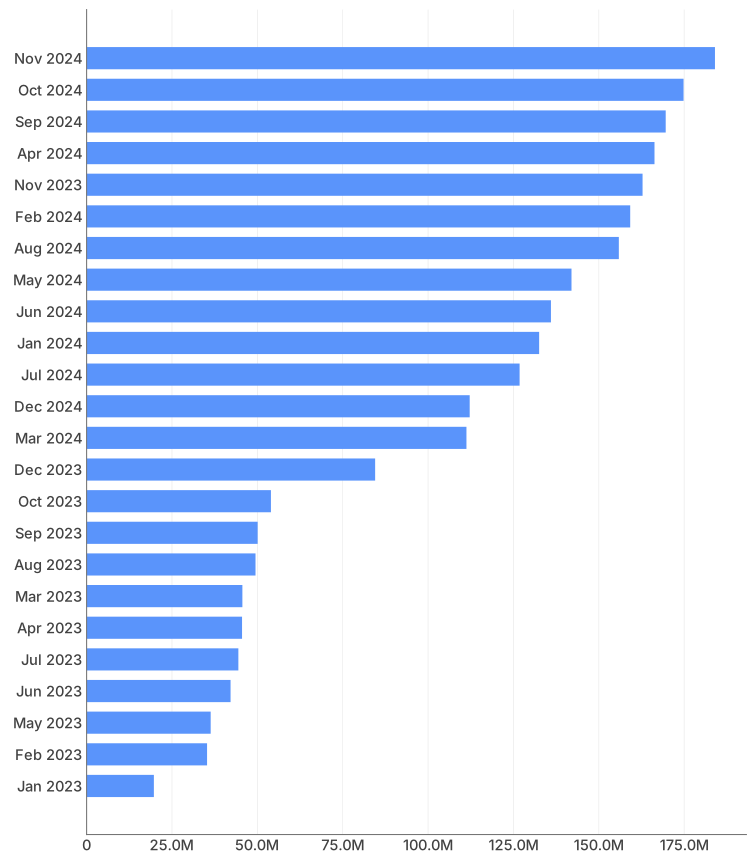
OWS earphones sold 8.43 million units on a leading marketplace in 2024, and sales grew 164.3% over the year, with monthly sales in the second half of 2024 running well above those of the first half of 2023.
Monthly sales of OWS earphones on a leading marketplace, 2023 and 2024, with months ordered by sales
Ear-Hook versus Clip-On: Two Form Factors, Two Markets#
Within the OWS category the two main form factors grew at different speeds in 2024, as ear-hook models grew 77% while clip-on models grew 19%. Ear-hook models are concentrated in the segment priced below CN¥ 200, where brands such as Monster (魔声) and Yuebu (悦步者) compete on price.
The clip-on segment has developed differently. Huawei entered it with a premium clip-on model that combines a light, comfortable fit and premium industrial design with integration into its smartphone ecosystem, while Sanag offers clip-on models at a more moderate price.
Prices in both form factors are split between a budget tier and a premium tier. In the ear-hook segment products priced below CN¥ 200 account for most sales, although premium brands such as Cleer and Shokz (韶音) have built a position in the segment by targeting audiophiles and professional athletes. In the clip-on segment both the budget tier below CN¥ 200, at 38.7% of revenue, and the premium tier above CN¥ 1,200, at 24.9% of revenue, grew, while the mid-range shrank.
What Consumers Want: Sports First, Sound Quality Rising Fast#
The share of product listings that carry each selling point shows where OWS earphone marketing and product development are heading. Sports scenarios appear in 75.7% of listings, which confirms that outdoor activity and fitness remain the main reasons for buying, while the selling points that grew fastest suggest where competition will move next:
- Sound quality: 12.6% penetration, up 69.3% year on year, and the most important emerging differentiator as the category moves beyond basic functionality
- AI and smart features: 15.2% penetration, up 146.2% year on year, reflecting early integration of voice assistants and translation, although for now this is largely a marketing claim and not yet a core capability
- Noise cancellation: 22.2% penetration, up 26.6% year on year, which is a technically difficult feature for open-ear designs and is becoming an important consideration for buyers
- Business scenarios: 2.8% penetration, up 22.8% year on year, an early sign that OWS earphones are moving beyond sport into professional use
The share of listings that mention comfort fell 23.0% over the year, although comfort remains a major concern for consumers. We believe this suggests that comfort is now expected of any credible OWS earphone, so brands are turning to performance to set their products apart.
OWS versus TWS: A Structural Category Shift#
The rise of OWS earphones comes as the TWS earphone market becomes more commoditised and its prices come under pressure. On the leading marketplace discussed above, TWS earphones grew just 5.9% in 2024, and products priced below CN¥ 100 now account for 60% of the TWS market. Apple and Huawei have kept premium positioning by drawing on the ecosystems built around their smartphones.
Bone conduction headphones, the closest competitor to OWS earphones among open-ear designs, came under structural pressure in 2024, with sales lower than a year earlier on every marketplace in our dataset. We believe OWS earphones have taken over much of the appeal of bone conduction, which lay in awareness of ambient sound and comfort, while offering better sound quality at comparable or lower prices.
The wider audio wearable market is splitting into specialised categories. TWS earphones serve noise-isolating, immersive listening, OWS earphones serve people with active lifestyles who want to hear their surroundings, and screen earphones, which grew 315.4% on the same leading marketplace, add a display for visual information.
Outlook: From Growth to Consolidation#
We believe OWS earphones will remain one of the fastest-growing audio wearable categories in 2025, although the sources of their growth will change, and two developments are likely to shape the next phase:
- Sound quality competition: as more tier-one manufacturers enter the category, competition will move from the novelty of the form factor to acoustic performance. Brands that solve the sound leakage that open-ear designs suffer from will be able to command premium positioning.
- Noise cancellation innovation: active noise cancellation remains technically difficult in open-ear form factors, and brands that achieve credible ANC without sealing the ear canal will open up a significant premium segment.
For brands and distributors assessing the OWS opportunity, the data shows a category moving on from its first rapid adoption toward competition on product quality and brand positioning, which is what we would expect of a category that is beginning to mature.
About the Data#
This analysis draws on Moojing Market Intelligence's proprietary e-commerce database and covers full-year 2024 transaction data from leading Chinese marketplaces. The category sales figures in this article refer to one leading marketplace within that set unless stated otherwise.[1] OWS earphone market data includes monthly sales revenue, volume, average selling prices, brand-level sales and selling-point penetration rates. Form-factor segmentation (ear-hook and clip-on) is based on product listing classification. The open-ear audio category classification follows Moojing's standardised taxonomy, which distinguishes OWS, TWS, bone conduction and screen earphones as separate market segments.[2]
More in This Series#
Download Full Report#
Get the complete analysis with 126 charts, brand-level insights across 15 product categories, and AI integration assessment.
This content adheres to Moojing's editorial standards .


