How China's Open-Ear Audio and Action Camera Markets Were Reshaped in 2024
 By Jessie Wang
7 min read
By Jessie Wang
7 min read
#+begin_cta cta-series
More from this report: China's 3C Devices Market 2024: OWS Earphones and Action Cameras Drive a CN¥ 785B Market Forward
#+end_cta
Executive Summary#
Within China's CN¥ 785 billion 3C devices market, two subcategories were the main growth stories of 2024, OWS (open-ear) earphones, which grew 86.2% YoY to CN¥ 6.27 billion, and action cameras, which grew 69.0% YoY to CN¥ 3.11 billion. Both segments grew in a similar way, with domestically designed products expanding the category through AI features and products designed for specific uses, and with marketing built on content. This article looks at the product strategies, design choices and channel dynamics behind the growth of the two categories, drawing on Moojing Market Intelligence data covering mainstream Chinese e-commerce platforms and a leading short-video platform.
OWS Earphones: The +86.2% Surge That Reshaped Audio#
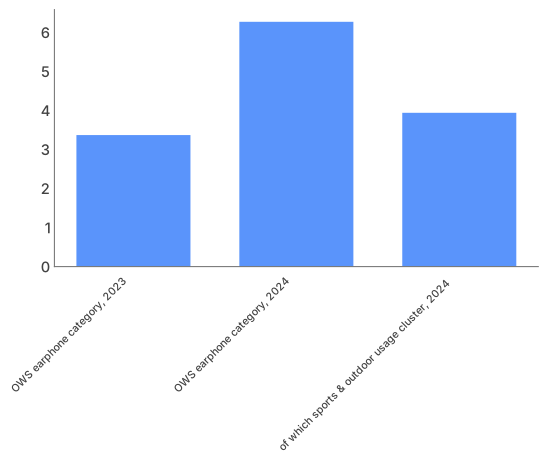
OWS earphones moved from a niche to the mainstream of China's consumer electronics market in 2024. Category sales reached CN¥ 6.27 billion, up from CN¥ 3.37 billion in 2023, and both the average price and the volume rose over the year, which shows that the market grew on new demand and did not depend on discounts.
The FreeClip: A New Form Factor Resets the Category#
Huawei entered the OWS earphone market with the FreeClip in November 2023, at a price well above the category average, in a segment that specialist audio brands had previously defined. We believe its clip-on, non-occluding design is what justified the higher price, because it made the earphone comfortable to wear for hours in settings where sealed in-ear designs are not.
Growth on this scale is rarely spread evenly, and in 2024 it concentrated in newly launched form factors and newly served use cases more than in long-established product lines. Shokz (韶音), a specialist in open-ear audio, has built its range around sports, and we believe the category grew enough in 2024 to make room for both specialist brands and large consumer electronics groups.
China's open-ear earphone category reached CN¥ 6.27 billion in 2024
Three Usage Clusters Define the Market's Future#
The growth of the OWS segment came from three distinct usage clusters, each with its own product requirements and its own successful designs:
Sports and outdoor activity was the largest cluster, with 71.7% market penetration and CN¥ 3.94 billion in sales, and running, cycling, fitness and swimming were the main activities. Shokz's OpenRun Air S803 was designed for swimmers, with a fully sealed, waterproof build, while Cleer's ARC 3 combined AI-powered gesture control with noise cancellation for active users. Sports is the most mature use case, and continued work on durability, waterproofing and biometric features keeps it growing.
Office productivity became the second source of growth, and iFlytek (科大讯飞) is an example of a brand designing for it, with its Spark AI-powered meeting assistant. Its iFLYBUDS Air earbuds offered on-device recording, 31-language translation and AI-generated meeting summaries, features that turn an OWS earphone into a tool for work as well as for listening. iFlytek's marketing used "persona + scenario" storytelling, showing lawyers on business trips, researchers at academic conferences and executives in back-to-back meetings.
AI companionship is the newest cluster. ByteDance launched Ola Friend in October 2024, which puts its Doubao AI assistant into an OWS earphone. The product supports voice-activated knowledge Q&A, English conversation practice, travel guidance and emotional support, and it is marketed as a "cyber friend". The cluster is still at an early stage, but we believe an AI companion in the ear could widen the category, because it gives people a reason to wear an earphone when no audio is playing.
Action Cameras: A +69.0% Year Built on Domestic Design#
The action camera market grew 69.0% YoY to CN¥ 3.11 billion in 2024, and domestically designed products accounted for much of the expansion. Two kinds of design drove it, the pocketable, gimbal-stabilised content-creation camera and the fully panoramic camera, which lets the user choose the framing during editing. Neither existed in this form when the category was first defined a decade ago, and Chinese design teams brought both to market with new versions every year.
Release Cadence Matters More Than Price#
Price is no longer what buyers in this segment choose on, since domestically designed flagships and imported ranges sit at broadly comparable prices. What sets products apart is how often new versions are released and how well the camera works with the rest of the user's equipment. That means how quickly AI-enhanced stabilisation, automatic subject framing and one-tap editing move from a demonstration into a product on sale, and how smoothly the camera, the phone app and the editing workflow work together. DJI's Osmo Pocket 3 and Osmo Action 5 Pro launched with that kind of integration. We believe brands in China's 3C market need to release new versions quickly, because a long history in the category counts for less once competitors offer the same build quality.
The Content-to-Commerce Pipeline#
DJI's short-video strategy shows the content-led marketing model that is working well in China's 3C sector. Its official account created a video series for each camera line. The Pocket series focused on vlog tutorials and cinematic technique and accumulated 27.0 million views, and the Action series showed extreme sports and adventure and reached 32.0 million views. The videos were aspirational content in which the products appeared, and viewers found the cameras because the videos were entertaining to watch, with little promotional messaging.
The line-up was built to cover two different buyers. The Osmo Pocket 3 sat at the premium content-creation end at CN¥ 3,499, positioned as a tool for vloggers and travel photographers, while the Osmo Action 4 and Action 5 Pro served the rugged outdoor segment at CN¥ 2,098 and CN¥ 2,598 respectively. With this range, which covers both pocket-sized content creation and durability for extreme sports, one brand could serve both the creator and the athlete.
360-Degree Differentiation#
Insta360 built a distinct position around 8K full-panoramic capture, starting with the X4, launched in April 2024 at CN¥ 3,499. The product's resolution, stabilization and waterproofing appealed to content creators who wanted cinematic quality from a portable device, and the panoramic format changed how people shoot, since the user can point the camera roughly and choose the frame afterwards. Insta360's marketing relied heavily on short video, with partnerships with digital lifestyle, extreme sports and travel creators who could show the camera's immersive footage, which suits the format well.
Common Patterns: What OWS Earphones and Action Cameras Share#
Although they are different product categories, the OWS earphone and action camera markets share four growth drivers:
-
Premium positioning without discounting. In both categories the products that attract most attention sit at premium prices, and both categories grew on new demand without relying on price cuts, which suggests that Chinese brands no longer have to compete mainly on price.
-
AI as a feature differentiator. From iFlytek's meeting transcription to DJI's image stabilization algorithms, AI features give users practical benefits that justify higher average prices and make buyers less likely to switch brands.
-
Scenario-based product design. Products are designed around specific activities, such as swimming, cycling, vlogging and office meetings, instead of a general list of features. Designing for a scenario first lets brands write targeted marketing and build real engagement with the communities that take part in those activities.
-
Content-led channel strategy. In both categories short video is the main channel through which buyers discover products and engage with brands, and brands are investing in educational and aspirational content more than in traditional product advertising. The content-to-commerce pipeline, in which a brand creates entertaining content that shows the product in use and then converts viewers into buyers, is the main go-to-market model.
Strategic Takeaway#
For brands competing in or entering China's wearable and portable 3C categories, we believe the 2024 data shows that the brands that grow are those that combine premium positioning with AI-enabled features and design their products for specific uses, and that build content on social platforms to reach buyers. In these categories, the speed of product development and the fit with how people actually use a product count for more than a long brand history or a long list of specifications.
#+begin_cta cta-download
Download the full report: 2024 Whitepaper: China's 3C Devices Market Analysis, which includes category deep-dives, channel-level analysis and product-level case studies across the report's 3C device subcategories.
#+end_cta
This content adheres to Moojing's editorial standards .
Frequently Asked Questions
Inside a CN¥ 785 billion 3C devices market, OWS open-ear earphones grew 86.2% to CN¥ 6.27 billion, up from CN¥ 3.37 billion in 2023, and action cameras grew 69.0% to CN¥ 3.11 billion. The detail worth holding onto for OWS is that price and volume rose together, so the category grew on new demand and did not depend on discounts. Both segments grew in a similar way, with domestically designed products expanding the category through AI integration, scenario-based product design and content-led marketing, and with price playing a smaller part.
Sports and outdoor activity is the mature one, at 71.7% penetration and CN¥ 3.94 billion, covering running, cycling, fitness and swimming, where innovation continues in durability, waterproofing and biometric integration. Office productivity is the second vector, where the earphone becomes a workplace tool: on-device recording, 31-language translation and AI-generated meeting summaries, marketed through persona-and-scenario storytelling rather than specification. AI companionship is the third and most nascent, embedding a conversational assistant into the earphone for knowledge questions, language practice, travel guidance and emotional support. At CN¥ 22.4 million in 2024 it is small, but it reframes the product from an audio device into something else.
Release cadence and integration with the rest of the user's equipment, more than price. Domestically designed flagships and imported ranges sit at broadly comparable prices. Products are therefore set apart by how quickly AI-enhanced stabilisation, automatic subject framing and one-tap editing reach products on sale, and by how smoothly the camera, the phone app and the editing workflow work together. Two kinds of design carried the category's +69.0% growth to CN¥ 3.11 billion in 2024, the pocketable, gimbal-stabilised content-creation camera and the fully panoramic camera, and Chinese design teams brought both to market with new versions every year.
Aspirational content that happens to feature the product, rather than product advertising. The clearest example built dedicated video series per camera line, with vlog creation tutorials and cinematic technique for the pocket range and extreme sports and adventure scenarios for the rugged range, accumulating 27.0 million and 32.0 million views respectively. Discovery came through entertainment value, and the portfolio was built to catch it at both ends: a premium content-creation tool at CN¥ 3,499, and rugged outdoor models at CN¥ 2,098 and CN¥ 2,598. The panoramic specialist took a similar approach with digital lifestyle, extreme sports and travel creators for its CN¥ 3,499 launch.


