China's Pet Economy Hits CN¥ 593B as Cats Overtake Dogs
 By Quan Wenjun
5 min read
By Quan Wenjun
5 min read
Executive Summary#
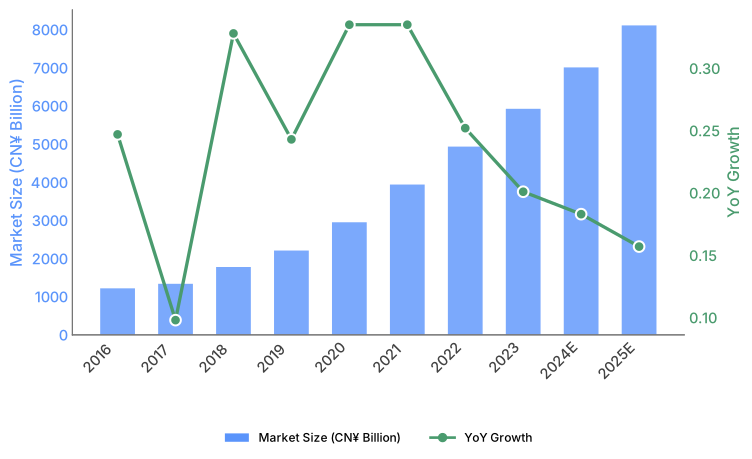
China's pet economy reached CN¥ 592.8 billion in 2023 and is projected to exceed CN¥ 800 billion by 2025, driven by rising pet humanization and a structural shift towards cat ownership[1]. The online pet market reached CN¥ 80.28 billion over the past rolling year, but the gap between revenue growth of +1.5% and volume growth of +23.3% points to strong price competition across the market. This analysis looks at the market's decade-long expansion, at the shift in ownership from dogs to cats and what it means for brand strategy, and at the competitive dynamics of China's online pet market.
Download Full Report#
Get the complete analysis with additional data, methodology details, and brand-level insights across cat and dog consumer markets.
Download the Full Q3 2024 Pet Consumer Market Whitepaper -->
A Decade of Sustained Growth#
China's pet economy expanded from CN¥ 122 billion in 2016 to CN¥ 592.8 billion in 2023, a compound annual growth rate of approximately 25%[1]. Growth peaked at +33.5% in both 2020 and 2021, when many people adopted pets for companionship while spending more time at home during the pandemic.
Growth has since moderated from that peak to +20.1% in 2023, and is projected to ease further to +18.3% in 2024 and +15.7% in 2025. The market is still adding a great deal in absolute terms, since the projected increase of CN¥ 108.5 billion from 2023 to 2024 alone is larger than the whole market was in 2016.
Three factors underpin the growth:
- Rising pet humanization, with owners treating pets as family members
- Increasing disposable income among urban Millennials and Gen Z
- Premiumization of pet products as owners demand higher-quality nutrition and healthcare
China's pet economy sustained decade-long expansion, reaching CN¥ 592.8 billion in 2023 with +20.1% YoY growth
Cats Overtake Dogs in Ownership and Spending#
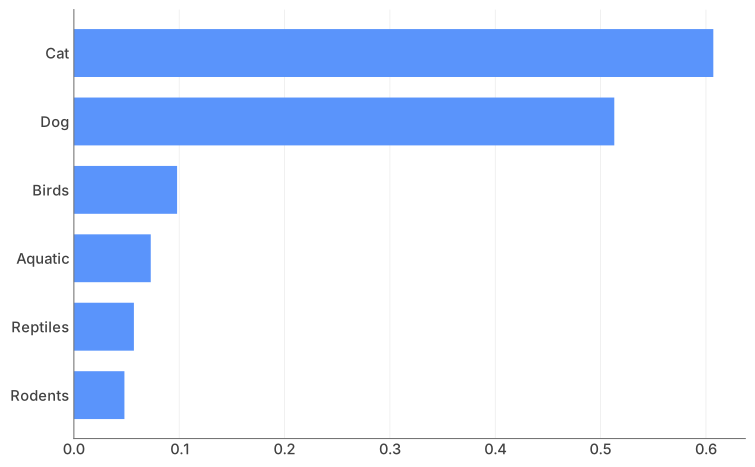
Cat ownership reached 60.7% in 2022, up from 46.0% in 2020, an increase of 14.7 percentage points in two years[1]. Dog ownership held relatively steady near 51% over the same period, which indicates that cat adoption represents net new pet ownership rather than substitution.
Several factors drive the preference for cats: they need less living space, which matters in China's largely apartment-based urban housing, they take less daily care, and they appeal strongly to single-person and young professional households, the fastest-growing household segment. The suitability of cats for apartment living also helps explain why the gap between cat and dog ownership widened most in 2020 to 2022, when urban residents spent long periods at home during the pandemic. Spending has followed ownership, as cat consumer spending grew by CN¥ 7.4 billion in 2023, nearly six times the dog market's increase of CN¥ 1.3 billion.
Cat ownership reached 60.7% in 2022, against 51.3% for dogs
Online Market: Volume Surges but Prices Fall#
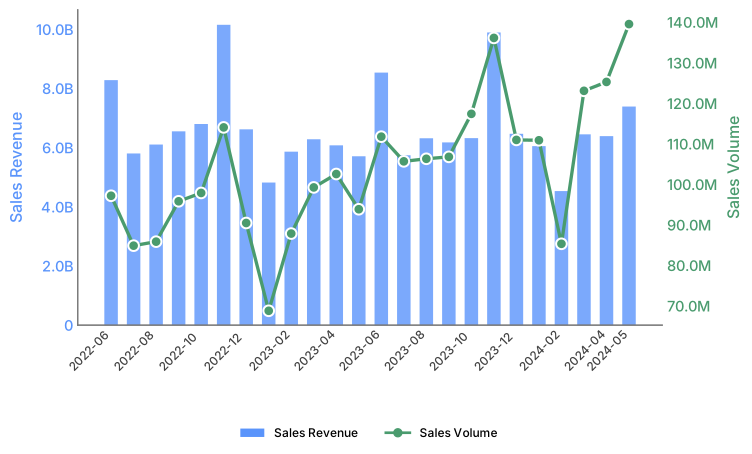
The online pet consumer market reached CN¥ 80.28 billion over the past rolling year (June 2023 to May 2024), a modest increase of 1.5% year on year[1]. Over the same period sales volume rose 23.3% year on year to 1.38 billion units, a wide gap between revenue and volume growth that points to intensifying price competition.
We believe this gap between volume and price is the most strategically significant finding: a volume increase of 23.3% alongside revenue growth of just 1.5% implies that average prices fell by approximately 18%. Price erosion on this scale suggests a market where brands compete mainly on price, which puts pressure on margins across the value chain.
Online pet market reached CN¥ 80.28 billion with +1.5% revenue growth but +23.3% volume growth, indicating aggressive price competition
About Our Data#
This analysis draws on Moojing Market Intelligence data covering Q3 2024. Moojing gathers e-commerce and social media data from China's top platforms, with reports generated through our team of market analysts. Our coverage spans major e-commerce and social platforms, representing a significant share of China's online retail market.
Request a free trial to explore our data platform.
Key Takeaways#
- China's pet economy reached CN¥ 592.8 billion in 2023, growing 20.1% YoY, and is projected to reach CN¥ 811.4 billion by 2025
- Cat ownership reached 60.7% in 2022, well ahead of dogs at 51.3%, and the market is reorienting around cats
- Cat consumer spending grew by CN¥ 7.4 billion in 2023, nearly 6x the dog market's increase of CN¥ 1.3 billion
- The online pet market reached CN¥ 80.28 billion, and volume growth of +23.3% against revenue growth of +1.5% implies average prices fell by ~18%
- Pet food (50.7%) and healthcare (29.1%) account for 79.8% of total spending, so most pet spending goes to non-discretionary categories
## About the Data
This analysis draws on Moojing Market Intelligence (魔镜洞察) data covering Q3 2024.
Moojing analyses brand and category performance across major Chinese e-commerce platforms. For full methodology and additional insights, see the complete Pet Consumer Market whitepaper.
This content adheres to Moojing's editorial standards .
Frequently Asked Questions
CN¥ 592.8 billion in 2023, up 20.1% year on year and projected to exceed CN¥ 800 billion by 2025. The decade behind it is the context: the market went from CN¥ 122 billion in 2016 at a compound rate near 25%, peaking at +33.5% in both 2020 and 2021 during pandemic-era adoption. Growth has been moderating since then, from 20.1% in 2023 to a projected 18.3% in 2024 and 15.7% in 2025, but the absolute expansion stays large. The projected CN¥ 108.5 billion increase from 2023 to 2024 alone exceeds the entire market size in 2016.
Because cat adoption was net new ownership rather than substitution. Cat ownership reached 60.7% in 2022 from 46.0% in 2020, a gain of 14.7 percentage points in two years, while dogs held roughly stable near 51%. The drivers are structural: cats need less living space, which matters in apartment-dominant urban housing, require lower daily maintenance, and appeal to the single-person and young-professional households that are the fastest-growing segment. The spending follows. Cat consumer spending grew by CN¥ 7.4 billion in 2023, against CN¥ 1.3 billion for dogs.
It is eroding sharply. The online pet market reached CN¥ 80.28 billion over a rolling year with revenue up just 1.5%, while volume surged 23.3% to 1.38 billion units. That combination implies average prices falling by roughly 18%. It is the most strategically significant number in the dataset, because it says brands are competing on price rather than differentiation and margin pressure is running through the whole value chain. The practical question for a brand is which side of that divergence its own numbers sit on, because growing units at falling prices wins share without adding profit.
Overwhelmingly into non-discretionary categories. Pet food accounts for 50.7% of total spending and healthcare for 29.1%, which together make 79.8%, close to four-fifths of the market. That concentration is what makes the category resilient: an owner who treats a pet as a family member does not stop buying food or veterinary care when spending tightens, which is why the market kept compounding through a period when many discretionary categories did not. It also means accessories, apparel and toys compete for a far smaller residual pool than the headline market size suggests.


