China's Plant Ingredient Skincare Boom: H1 2024 Market Analysis
 By Quan Wenjun
6 min read
By Quan Wenjun
6 min read
Newer data: Amazon Rainforest Botanicals in China: Zero Penetration
Executive Summary#
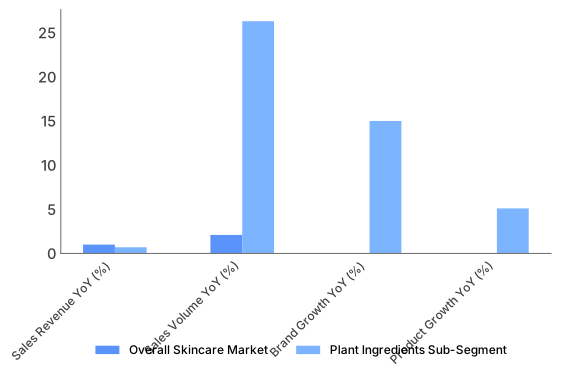
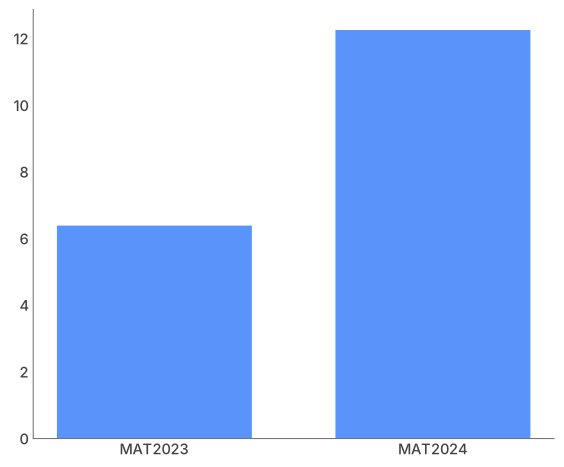
China's overall online beauty and skincare market posted CN¥ 358.09B in sales revenue for the twelve months ending May 2024 (MAT2024)[2], a modest gain of 1.0% year-on-year. Within this stable market, the sub-segment built on characteristic plant ingredients grew much faster. Unit volumes for plant ingredient skincare rose 26.3% YoY to 210 million units, the number of registered brands grew 15.0% to 7,257, and social media volume nearly doubled to 12.258 million posts, up 91.7% YoY. We believe the data shows that botanical ingredients have become one of the main sources of growth inside a consolidating market, driven by consumer demand for efficacy rooted in nature, for transparency about ingredients and for formats used every day.
China's Skincare Market in MAT2024: Stable Overall, Shifting Underneath#
China's online beauty and skincare market, measured across three of China's largest marketplaces, generated CN¥ 358.09B in sales revenue in MAT2024 and 2.71 billion units, up 1.0% and 2.1% YoY respectively. These headline numbers describe a market entering a consolidation phase after years of rapid expansion, in which penetration is high and consumers are more sophisticated. In MAT2024 growth came from shifts in the category mix and from premiumisation led by ingredients more than from new demand.
Growth differs sharply between sub-categories. Toners and face creams, which anchor the daily routine, grew by an estimated 3.5% and 2.8% YoY respectively, and face masks kept growing. Sunscreen grew faster than the market, at approximately 4.1% YoY, on the back of campaigns that raised awareness of UV protection. Targeted and supplementary categories moved the other way, with hand care down 3.2% YoY, lip care down 4.5% and eye care down 2.1%. This reflects consumers simplifying their routines and concentrating their spending on essentials that deliver visible efficacy for the money.
This return to basics, in which consumers spend on the essentials they use most often while keeping their routines short, is the setting in which characteristic plant ingredients have grown. Plant-derived actives are entering the market through the product formats that consumers trust most and use every day.
The Plant Ingredients Opportunity: 13x Volume Growth Versus the Broader Market#
Plant ingredients volume growth outpaces overall market by 24+ percentage points
Social Media Volume Nearly Doubles#
Social media volume nearly doubles YoY, signalling mainstream breakthrough
High-Growth Ingredients: A Preview of Three Breakout Ingredients#
Across five key efficacy markets, namely hydration and moisturising, anti-wrinkle and firming, oil control and acne, brightening and spot-fading, and soothing and repair, a small group of characteristic plant ingredients combined a significant number of registered products with YoY revenue growth above 30% and sales above CN¥ 5M.
Three ingredients stand out as the most commercially significant in H1 2024:
-
Purslane (马齿苋): Sales revenue approached CN¥ 190M, up 97.2% YoY, with unit volume reaching 3.677M units, up 142.7% YoY, while social media volume rose 166.1% to 219,000 posts. Purslane is positioned mainly in the soothing, barrier-repair and hydration efficacy markets, and it is popular with younger consumers on social media, where discussion has turned into purchases in a way that is typical of content-led categories.
-
Glabridin (光果甘草): The standout ingredient in the brightening and spot-fading market, where claims about brightening and reducing a yellow skin tone drive a positive consumer sentiment rate of 97.2%, which is the highest of the three ingredients analysed.
-
Astragalus (黄芪): The fastest grower of the three, with sales revenue exceeding CN¥ 510M, up 153.3% YoY, supported by 473,000 social media posts, up 116.4% YoY, and 27.489 million interactions, up 141.4% YoY. Strong interest from domestic brands, together with the credibility that its heritage in traditional medicine lends to efficacy claims, explains much of its growth.
Rose and ginseng also feature prominently across efficacy markets, rose particularly in the soothing and anti-wrinkle segments and ginseng in anti-ageing categories. The companion deep-dive article profiles each of the three breakout ingredients in detail, including consumer demographics, sentiment analysis and the products behind them.
Consumer Sentiment Points to Clear Formulation Priorities#
Across all three breakout ingredients, consumers value botanical fragrance, hydrating efficacy and skin-calming benefits, which is consistent with the wider trend of consumers favouring products that fit their daily routine and offer a pleasant sensory experience. The sentiment data therefore gives brands an unusually direct guide to product development.
The pain points shared across the ingredients include sticky textures, slow absorption and too little difference between products, all of them formulation and delivery challenges that brands can address to win share as the market matures. In the astragalus segment, complaints about counterfeits and about inconsistent colour indicate that quality control and measures to prove authenticity are becoming a way for brands to stand out, as well as a regulatory requirement.
We believe the brand that solves the trade-off between texture and absorption while keeping the botanical authenticity consumers value will build lasting loyalty in a market where switching costs are otherwise low.
Key Takeaways#
- China's overall online skincare market reached CN¥ 358.09B, up 1.0% YoY, and 2.71B units, up 2.1% YoY, in MAT2024, with toners, face creams and sunscreen as the categories that kept growing
- The plant ingredients sub-segment reached CN¥ 19.21B, up 0.7% YoY, with 210M units, up 26.3% YoY, so its volume grew 13 times faster than the overall market
- Registered brands reached 7,257, up 15.0%, and registered products 25,000, up 5.1%, which signals many new entrants and a coming split between premium and commodity products
- Social media volume nearly doubled to 12.258M posts, up 91.7% YoY, which we read as a forward indicator of continued commercial growth
- Purslane (revenue up 97.2%), glabridin and astragalus (revenue up 153.3%) are the three breakout ingredients, each with its own efficacy positioning and consumer profile
- The window for premium positioning was open but narrowing in 2024, and brands that establish efficacy, transparency about sourcing and consumer loyalty early are best placed to capture value as the segment matures
About the Data#
This analysis is based on Moojing Market Intelligence data covering the twelve months to May 2024 (MAT2024), aggregated across three of China's largest marketplaces. Characteristic plant ingredients are defined according to the Directory of Chinese Characteristic Plant Resource Raw Materials for Cosmetics published by the Beijing Daily Chemical Industry Association[1]. Social media volume is drawn from leading Chinese social platforms.
Download the Full Report#
Download the full China Chinese Plant Ingredients H1 2024 report
This content adheres to Moojing's editorial standards .


