Health Innovation in China's Snack Food Market: Biscuit, Candy, and Nuts Deep-Dive
 By Jessie Wang
4 min read
By Jessie Wang
4 min read
Newer data: China's Healthy Snacks Market Has Gone Mainstream
Biscuits: "Real Ingredients" and "Clean Label" Define the Growth Formula#
Sales in the biscuit and puffed snacks segment were almost flat in MAT2024, at -1.2%, while health-positioned products within it grew much faster than the category as a whole.[1] Sales in the segment are spread across many brands, and we believe this leaves room for brands that can show consumers what goes into their products.
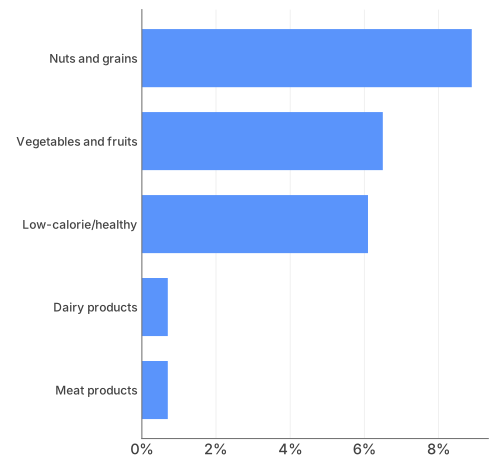
Nuts and grains lead ingredient-driven sales at 8.9% share
Candy: Functional Flavours and Herbal Ingredients Open a Fragmented Market#
Candy sales grew 4.7% YoY in MAT2024, and the growth has come with a deep change in what drives consumer choice.[1] Sales are spread across many brands, which makes candy one of the most fragmented of the major snack categories. That fragmentation gives an opening to brands that can set themselves apart through functional positioning.
Much of the growth in candy comes from products that offer "fresh breath and alertness" functional benefits through mint, lemon, tea and cooling flavours. Brands positioned on these benefits include Extra (益达) gum, Damabfu (大马碧富) mint candy and Ryukakusan (龙角散), a Japanese herbal throat lozenge brand built on medicinal function.
Chakoulai (茶口乐), a tea-infused candy brand, combines Chinese herbal and botanical ingredients with mainstream candy formats. We believe its approach shows the commercial potential of a strategy that echoes the wider "food as medicine" (药食同源) trend, which is gaining ground across many food and beverage categories.
Niche sub-categories are also growing quickly, as caramel/toffee grew 166.7%, marshmallow/nougat/aerated candy grew 52.2% and filled/liquid candy rose 46.0%. Consumers are actively trying new textures and formats, which gives an entry point to brands that can offer a distinctive eating experience alongside functional benefits.
Nuts: The "Additive-Free" Premium Wins Consumer Trust#
Nuts and roasted snacks recovered most strongly of the segments, growing 19.8% YoY, and the health premium is clearest in the "additive-free/zero-additive" sub-segment, which grew 20.7% YoY in MAT2024 after 50.7% growth in MAT2023.[1]
The Common Thread: What Health Innovation Looks Like Across Segments#
Across biscuits, candy and nuts, our analysis finds a consistent pattern in health-driven snack innovation in China:
- Ingredient transparency: Consumers reward brands that make ingredient sourcing, content percentages and processing methods visible and verifiable.
- Functional positioning: Beyond "healthy", the fastest-growing products offer specific functional benefits, such as stress relief in biscuits, fresh breath and alertness in candy and natural purity in nuts.
- Content commerce alignment: Health claims convert best when they can be shown on screen, and the video-first format of content-led platforms such as Douyin suits marketing that teaches consumers about ingredients.
- Chinese heritage ingredients: Monkey head mushroom (猴菇), tea infusions and botanical flavours draw on the "food as medicine" cultural framework, which gives Chinese brands a positioning advantage over international competitors.
Strategic Implications#
For brands evaluating China's snack food market, health innovation offers three practical entry points:
- Biscuit segment: Develop products with verifiable ingredient content claims (">= X% whole grain") and clean-label formulations, and invest in Douyin content that shows ingredient quality and how the products are made.
- Candy segment: The functional candy space (herbal, mint, botanical) remains highly fragmented and open to new entrants, and tea-infused and TCM-adjacent flavours have shown that they can sell at scale.
- Nuts segment: "Additive-free" is the fastest route to premium positioning, and stories about supply chain provenance, such as farm partnerships and minimal processing, give brands a lasting point of difference in a category that is moving toward commoditisation.
#+BEGIN_cta-download
For brand-level analysis, sub-category data, and high-growth ingredient analysis across all six snack food segments, download the full report.
#+END_cta-download
#+BEGIN_cta-series
More from this report:
#+END_cta-series
[1] Source: Moojing Market Intelligence. Data period: MAT2024 (May 2023 to April 2024). Platforms: Tmall (天猫), Taobao (淘宝), JD.com (京东), Douyin (抖音).
[2] MAT = Moving Annual Total, a rolling 12-month aggregation used to normalise for seasonal variation.
This content adheres to Moojing's editorial standards .


