Who Buys Adult Milk Powder in China? Consumer Segments and Messaging Gaps
 By Jessie Wang
4 min read
By Jessie Wang
4 min read
Executive Summary#
Two consumer groups, pregnant women (35.7%) and elderly caregivers (32.7%), together account for nearly 70% of social media discussion of adult milk powder in China. The product messaging we studied leads on nutritional ingredients. The purchase drivers consumers cite most often in reviews, however, are taste/texture (58.9% on one leading Chinese marketplace) and solubility, which points to a gap between what consumers want and what they are told. A single celebrity campaign in May 2023 produced 22.4M social media interactions in one month, which shows how much of the category's social activity can depend on one celebrity. We believe brands that close the gap between consumer demand and product communication are better placed in a market growing 16.1% YoY.
Download Full Report#
Two Main Consumer Groups#
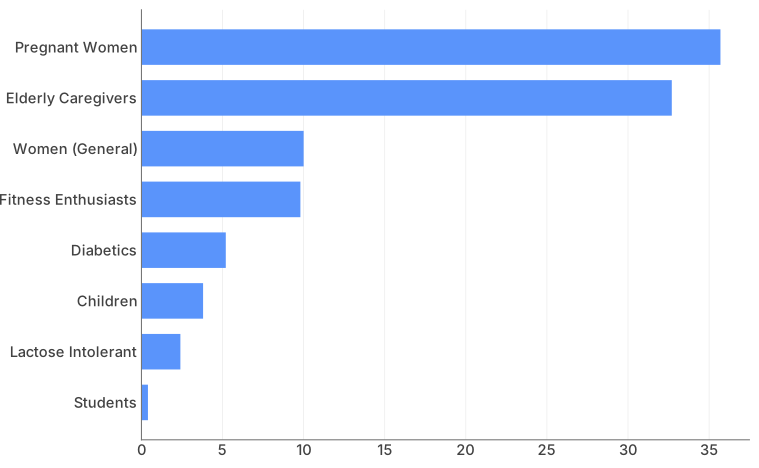
China's adult milk powder category is made up of distinct consumer groups with different needs. Adult milk powder generated 650,000 social media posts and 28.37M interactions across major Chinese social platforms in 2023. Moojing Market Intelligence's analysis of that discussion shows two large groups of consumers, pregnant women and elderly caregivers, alongside several significant smaller segments.
Pregnant women (35.7%) and elderly caregivers (32.7%) drive nearly 70% of adult milk powder discussion
Purchase Decisions: Taste and Texture Come First#
The factors consumers weight most heavily when they buy adult milk powder are the factors the product messaging we studied communicates least. Moojing's analysis of consumer purchase decision dimensions, drawn from reviews and social media discussion on two leading Chinese marketplaces, shows that taste/texture is the leading purchase driver on both, with a share of 58.9% on one and 44.2% on the other. Solubility and efficacy are the other dimensions consumers weight most heavily.
The Gap Between Consumer Priorities and Brand Messaging#
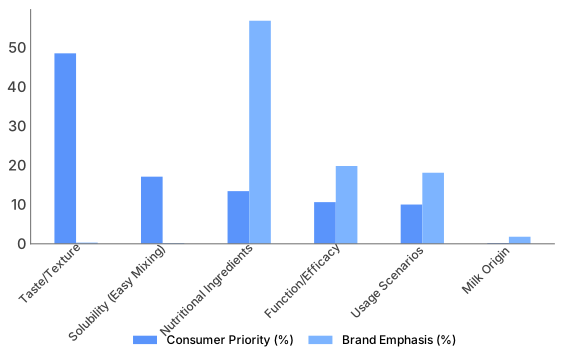
The purchase driver data becomes useful to brands when it is set against what they actually communicate. Moojing's analysis of product reviews for one major adult milk powder brand compares the priorities consumers express with the selling points the brand emphasises, and shows how far apart the two are.
Consumers weight taste and solubility most, while the brand's selling points centre on nutritional ingredients
Social Media: Video Engagement and the May Peak#
Adult milk powder generated 650,000 posts and 28.37M interactions on social media in 2023. The largest platform in the discussion accounted for 54% of posts and 58.6% of interactions, while a video platform accounted for 28.3% of posts but 40.6% of interactions, so its content drew far more engagement per post.
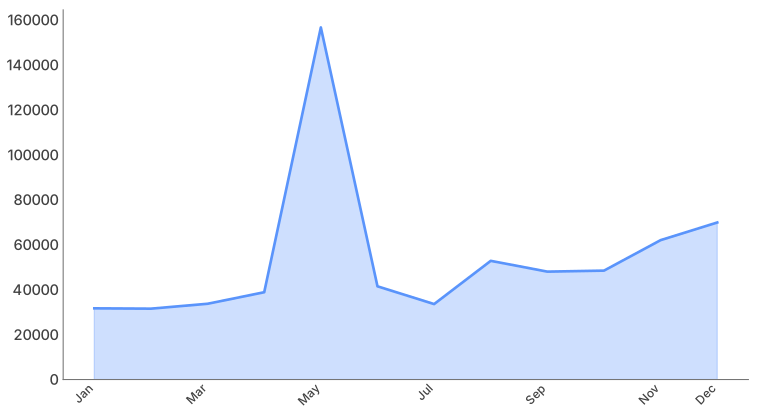
Monthly social media posts on adult milk powder peaked in May 2023
Key Takeaways#
- Pregnant women (35.7%) and elderly caregivers (32.7%) together account for nearly 70% of adult milk powder social media discussion, and the two groups buy for very different reasons.
- Taste/texture is the leading purchase driver on both marketplaces studied, at 58.9% and 44.2%, while the brand we studied puts less than 1% of its selling-point emphasis on taste and texture, a gap we believe is common in the category.
- Video content generated 40.6% of all social media interactions from 28.3% of posts, a high return on engagement which, we believe, justifies giving video priority over text-based social formats.
- A single celebrity campaign produced 22.4M interactions in May 2023, about 79% of the year's interactions, which shows both how far one campaign can lift a category's social activity and how much a strategy built on one celebrity depends on that campaign.
More from This Report#
About the Data#
This analysis draws on Moojing Market Intelligence's e-commerce and social media analysis. The social media analysis covers three major Chinese social platforms from January 2023 to December 2023. The brand messaging analysis is based on a sample of product reviews for adult milk powder brands on two leading Chinese marketplaces, and the purchase driver analysis covers consumer reviews and user-generated content on the same two marketplaces.
Source: Moojing Market Intelligence
This content adheres to Moojing's editorial standards .


