China Adult Milk Powder: Online Sales Hit CN¥ 9.18bn in 2023
 By Quan Wenjun
6 min read
By Quan Wenjun
6 min read
Newer data: China's Dairy Market: Online Sales Hit CN¥ 44.7B in 2025
Executive Summary#
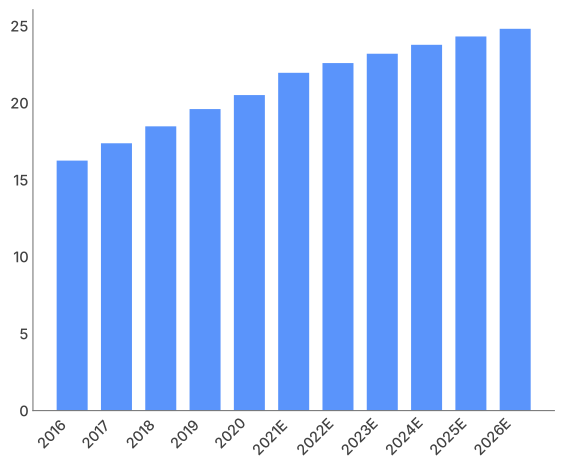
China's adult milk powder market generated CN¥ 9.18bn in combined online sales across three leading Chinese marketplaces in 2023, up 16.1% year on year. Euromonitor separately projects the total market, across all channels including offline retail, will reach CN¥ 24.82bn by 2026. Concentration among the largest players eased as more than 2,400 active brands competed for share, and the elderly milk powder sub-category delivered the period's standout performance at +53.0% YoY growth.
Download Full Report#
Steady Growth Projected to 2026#
China's adult milk powder market has grown steadily on Euromonitor's total-market series, which runs from 2016 to 2026 with estimates from 2021. The structural driver is demographic: more than a fifth of China's population was in its sixties or older at the end of 2023, according to the National Bureau of Statistics, and adult milk powder has become the "second growth curve" for China's major dairy brands.
Online sales across three leading Chinese marketplaces reached CN¥ 9.18bn in 2023. The total industry is substantially larger: it takes in offline supermarkets, hypermarkets and specialty stores, and also the online channels those three marketplaces do not cover.
No year in the 2016–2026E series sits below the year before it, and the annual increments narrow as the market matures.
Adult milk powder market will reach CN¥ 24.82bn by 2026E (Euromonitor)
Channel Structure: Online Growth Re-accelerated in 2023#
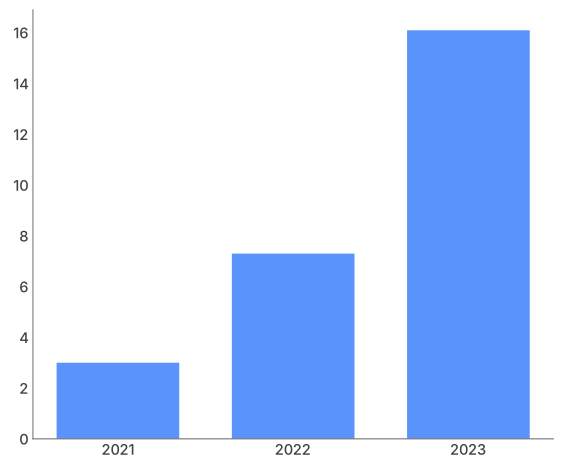
Growth in the online channel settled back to trend after the pandemic-era surge, then re-accelerated sharply. Sales across the three leading marketplaces in this dataset grew 3.0% in 2021 and 7.3% in 2022 as demand normalised, before growth rebounded to 16.1% in 2023, which points to the category's underlying resilience.
Online sales growth re-accelerated to +16.1% in 2023
In 2023 the composition of online demand changed as well as its pace, as buying moved from search-and-cart purchasing toward content-driven discovery in short video, livestream and social recommendation formats, where shoppers meet a product before they search for it. Adult milk powder suits that shift unusually well: it is a considered, explanation-heavy purchase in which formulation claims, ingredient provenance and trust signals need narrative space that a search results page does not give them.
Demand is also consolidating into brand-owned storefronts, where the brand controls the shelf, the product messaging and the after-sales relationship. Authenticity is the category's primary purchase barrier, and the storefront formats that answer it most directly are where the category's growth is concentrating. For brands, this reframes channel strategy: breadth of distribution matters less than owning a channel-native storefront and the content operation that feeds it.
Price Premiumisation Accelerates#
The adult milk powder market premiumised clearly in 2023, as the CN¥ 300–500 tiers gained share at the expense of the sub-CN¥ 200 mainstream. The CN¥ 300–400 price tier nearly doubled its share, from 6.7% in 2022 to 11.9% in 2023, the largest single-tier shift in the 2021–2023 data period, while the CN¥ 400–500 tier more than doubled from 2.2% to 4.7%.
Sales shift into the CN¥ 300–500 tiers as premiumisation accelerates
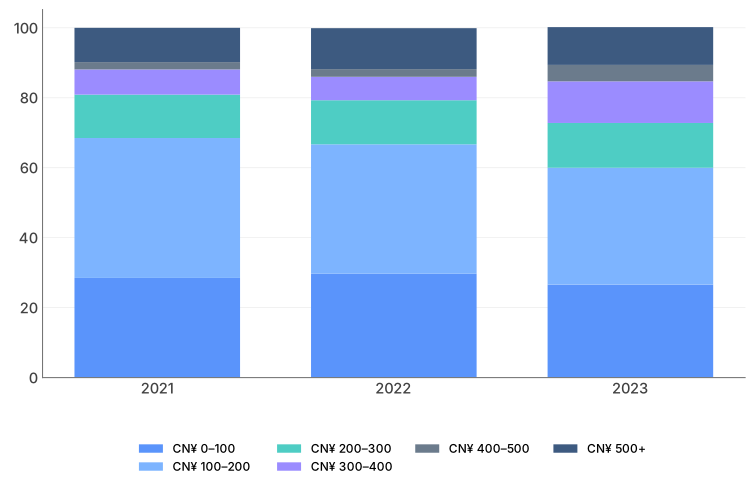
Because tier shares sum to 100%, the gains in the CN¥ 300–500 band are mirrored by a smaller share for the entry-price tiers, although both entry tiers still grew in absolute terms across 2023 because the category grew at double digits. Average unit prices also moved up across the 2021–2023 period, driven both by list-price increases and by a deliberate strategic repositioning of the leading portfolios toward premium formulations.
Brand Landscape: A Fragmenting Field#
The adult milk powder competitive landscape is fragmenting at pace. Concentration among the largest players eased in 2023, by more than in any other year of the 2019–2023 data period. With over 2,400 active brands competing in 2023, demand is dispersing across a broad long tail, and scale on its own no longer defends position: the leading cohort collectively ceded ground even as the category itself grew at double digits.
What separates the brands gaining ground is less size than a repeatable set of attributes:
- Channel-native distribution. The fastest risers built their businesses inside content-led commerce rather than porting an offline playbook onto a new surface, and they run the storefront, the content and the community as one operation.
- International provenance. Cross-border brands used imported formulations and an origin story as a shortcut to trust, capturing share without the distribution footprint incumbents spent decades building.
- Social-led brand building. Celebrity partnerships and campaign-driven engagement on major social platforms generated outsized reach for brands willing to fund them, converting attention into flagship-store demand.
- Sub-category focus. Rather than spreading across the category's three sub-categories, challengers concentrated on one demand occasion and built packaging, pricing, and messaging around it.
The elderly milk powder sub-category was the period's defining story: +53.0% YoY growth expanded its share from 29.9% to 39.4% of the adult milk powder market in a single year. Demographics explain part of this surge, and much of the buying comes from consumers aged 21 to 35 who purchase health products for their ageing parents. That makes it a gifting-oriented demand model, with distinct implications: gift-appropriate packaging and price points, festival-weighted seasonality, and messaging aimed at the purchaser rather than the end consumer.
About the Data#
This analysis draws on Moojing Market Intelligence's proprietary e-commerce analysis and social listening platform. E-commerce data covers three leading Chinese marketplaces. Sales data period: January 2021 – December 2023. Consumer-review analysis draws on product reviews for selected leading dairy brands, sampled from those same marketplaces.
Market size projections are sourced from Euromonitor International. The two sources are on different bases and are not directly comparable: every Moojing sales figure and growth rate here describes those three marketplaces only, while the Euromonitor series describes total category value across all channels, including offline retail and online channels outside that set.
Source: Moojing Market Intelligence
This content adheres to Moojing's editorial standards .
Frequently Asked Questions
Online sales across three leading Chinese marketplaces reached CN¥ 9.18 billion in 2023, up 16.1% year on year, and Euromonitor projects that the total market, including offline channels, will reach CN¥ 24.82 billion by 2026. The two figures are on different bases and are not directly comparable, so the online figure describes part of the market rather than the whole of it. The structural driver is demographic: more than a fifth of China's population was in its sixties or older at the end of 2023, according to the National Bureau of Statistics, and adult milk powder has become a second growth curve for China's major dairy brands.
Online growth has been positive in every year reported, though not smooth. The 2020 spike of +44.3% reflected pandemic pantry-stocking and heightened health consciousness; 2021 and 2022 at +3.0% and +7.3% represented demand normalising back to trend; and the 2023 rebound to +16.1% demonstrates underlying resilience rather than a one-off. Read together, the four years show that a brand taking the 2020 number as its baseline would have mis-planned 2021, and one taking 2021 as the trend would have under-invested for 2023.
Clearly, and in a specific band. The CN¥ 300–400 price tier nearly doubled its share from 6.7% in 2022 to 11.9% in 2023, the largest single-tier shift in the period measured, and the CN¥ 400–500 tier more than doubled from 2.2% to 4.7%, both gaining at the expense of the sub-CN¥ 200 mainstream. Average unit prices rose roughly CN¥ 20–30 across 2021 to 2023. That describes a market building its middle and upper tiers rather than trading down, which was unusual in China's consumer environment in 2023.
The defining structural shift of the period. Elderly milk powder grew 53.0% year on year and expanded from 29.9% to 39.4% of the adult milk powder market in a single year. Demographics explain part of it, and a large share of the buying comes from consumers aged 21 to 35 purchasing health products for ageing parents. That makes it a gifting-oriented demand model with distinct implications for packaging, channel and messaging: the buyer and the consumer are different people, the purchase carries an element of care signalling, and presentation matters more than it would in a self-purchase. Meanwhile concentration among the largest players eased as more than 2,400 active brands competed for share.


