China's AI Hardware Market Hits CN¥ 2.39B in Q1 2025
 By Jotham Lim
5 min read
By Jotham Lim
5 min read
Executive Summary#
China's AI-enhanced consumer hardware market reached CN¥ 2.39 billion in aggregate Q1 2025 sales across seven product categories, and six of the seven posted double- or triple-digit year-on-year (YoY) growth. Smart rings grew fastest, at +689.1% YoY from a small base, while digital notebooks were the largest category by revenue at CN¥ 900 million, up 48.2% YoY. This analysis sets out how the market is made up, where each category sits in its lifecycle, and what is driving the rapid expansion of AI hardware.
Download Full Report#
Get the complete analysis with additional data, brand-level insights, and overseas market benchmarking across the U.S., Japan, Singapore, and Malaysia.
Seven Categories, One Structural Shift#
AI is changing established consumer electronics categories and creating new ones at the same time. Moojing Market Intelligence (魔镜洞察) examined seven product categories in this report: AI earphones, AI glasses, smart rings, translation devices, translation earbuds, voice recorders, and digital notebooks. We believe the market is changing quickly in structure, as AI capabilities become a standard feature that consumers expect across these categories and no longer mark a product out as premium.
The seven categories sit at different stages of maturity:
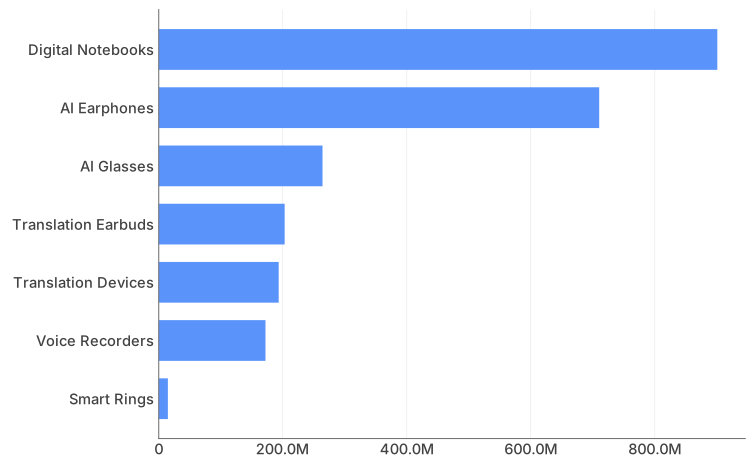
- Category creation: Smart rings, with CN¥ 14.8 million in sales and +689.1% YoY growth
- Rapid disruption of an existing product: Translation earbuds (+500.5% YoY) and AI earphones (+243.5% YoY)
- Healthy expansion: AI glasses (+97.2% YoY) and digital notebooks (+48.2% YoY)
- A mature category being disrupted: Voice recorders (-3.3% YoY), the only category whose sales fell
Digital notebooks and AI earphones lead in Q1 2025 revenue, while smart rings remain a nascent but fast-growing category
Growth Rates Reveal Category Lifecycles#
The YoY growth rates show most clearly where each category sits on its adoption curve. They range from +689.1% for smart rings and +500.5% for translation earbuds to -3.3% for voice recorders, so the market contains new categories, categories being disrupted, categories expanding on a meaningful base and one maturing category, all in the same quarter.
Consumer Behavior: Entertainment Over Productivity#
Across AI earphones, AI glasses and translation earbuds, consumers mention leisure and entertainment uses more often than the AI-powered productivity scenarios that brands promote. For AI earphones, noise cancellation accounts for 63.8% of word frequency, while AI-assisted features such as transcription and translation are barely mentioned. For AI glasses, photography leads at 35.0%, ahead of work at 19.4%, and translation earbuds are mentioned most often in connection with exercise (27.7%), more than with translation itself.
The gap between the capabilities brands market and the way consumers use the products has several implications for strategy:
- Brands should anchor product positioning in the entertainment and lifestyle uses that consumers have already adopted
- Adoption of AI features will speed up as accuracy improves, latency falls and the features become easier to use
- Work and productivity uses will need more consumer education before they become a main reason to buy
Channel Strategy Differs by Category#
The channel that suits a product depends on its price and on how much reassurance its buyers need, so brands in this market need a channel strategy for each category:
- Higher-priced categories such as AI glasses, digital notebooks and voice recorders sell to consumers who value authenticity guarantees and after-sales service, which favours channels that can offer both
- Products whose benefit can be shown in seconds, such as translation earbuds and AI earphones, sell well through short-video demonstration and live commerce, which turn viewers into buyers
- Smart rings sell as fashion-forward lifestyle products, and channels with strength in that kind of product suit them
We believe a premium translation device and a budget translation earbud therefore need different routes to market, since the first is sold on its technical specifications and expert reviews and the second on a demonstration of the earbuds translating a conversation on camera.
About Our Data#
This analysis draws on Moojing Market Intelligence data covering Q1 2025. Moojing gathers e-commerce and social media data from China's top platforms, with reports generated through our team of market analysts. Our coverage spans major e-commerce and social platforms, representing a significant share of China's online retail market.
| Metric | Coverage |
|---|---|
| Platforms | Major Chinese e-commerce and social |
| Brands Analysed | Extensive brand set |
| Coverage | Major Chinese online retail platforms |
Request a free trial to explore our data platform.
Key Takeaways#
- CN¥ 2.39 billion in aggregate Q1 2025 sales across seven AI hardware categories, with six posting double- or triple-digit YoY growth
- Smart rings grew fastest, at +689.1% YoY, from a small base of CN¥ 14.8 million in quarterly sales
- Digital notebooks remained the largest category at CN¥ 900 million, up 48.2% YoY
- Translation earbuds grew revenue by 500.5% YoY, as newer brands brought AI translation to products priced below CN¥ 500
- Consumers use these products more for entertainment than for the productivity scenarios brands market, which leaves a gap between the AI capabilities on offer and their actual adoption
About the Data#
This analysis draws on Moojing Market Intelligence data covering Q1 2025. Moojing analyses brand and category performance across major Chinese e-commerce platforms. For full methodology and additional insights, see the complete AI New Hardware whitepaper.
This content adheres to Moojing's editorial standards .
Frequently Asked Questions
CN¥ 2.39 billion in aggregate Q1 2025 sales across seven categories (AI earphones, AI glasses, smart rings, translation devices, translation earbuds, voice recorders and digital notebooks), with six of the seven posting double- or triple-digit year-on-year growth. Digital notebooks command the largest revenue at CN¥ 900 million (+48.2%), while smart rings lead on rate at +689.1% from a small CN¥ 14.8 million base. The composition matters more than the total: AI capability is becoming a table-stakes feature rather than a premium differentiator across all of them.
The spread from +689.1% to -3.3% covers an entire lifecycle at once. Smart rings are in category creation, small in revenue but growing at the fastest rate. Translation earbuds (+500.5%) and AI earphones (+243.5%) are in rapid disruption, where an existing product form is being re-specified. AI glasses (+97.2%) and digital notebooks (+48.2%) are in healthy expansion, growing fast on a meaningful base. And voice recorders at -3.3% are the one mature category being disrupted rather than doing the disrupting. A portfolio spanning all four stages needs four different investment logics, not one.
Not primarily, and the gap is consistent enough to be a planning input. Across AI earphones, AI glasses and translation earbuds, leisure and entertainment usage consistently outranks the AI-powered productivity scenarios brands promote. For AI earphones, noise cancellation commands 63.8% of word frequency against minimal mention of transcription or translation. For AI glasses, photography leads at 35.0% ahead of work at 19.4%. Translation earbuds are used primarily for exercise, at 27.7%, rather than for translation. So anchor positioning in the proven entertainment and lifestyle utility, treat the productivity case as requiring consumer education first, and expect AI feature adoption to accelerate through better accuracy and lower latency rather than through more marketing.
It varies sharply with price and with how confident buyers need to feel. In higher-priced categories such as AI glasses, digital notebooks and voice recorders, consumers value authenticity guarantees and after-sales service, so channels that can offer both suit them. Translation earbuds and AI earphones sell well through short-video demonstration and live commerce, because their benefit can be shown in seconds, while smart rings sell as fashion-forward lifestyle products. A premium translation device therefore sells on technical specification and expert review, and a budget translation earbud on demonstration, so a single category can need two different routes to market.


