China's Online Anti-Aging Skincare Sales Rose 26.3% in 2025
 By Jessie Wang
5 min read
By Jessie Wang
5 min read
Executive Summary#
China's online anti-aging skincare market reached CN¥ 129.8 billion in 2025 (+26.3% YoY), which makes it one of the main sources of growth in the wider beauty category, and growth stayed at or above 14% year on year in every month. The most notable development was body anti-aging, which grew 146.7% from CN¥ 1.2 billion to CN¥ 3.0 billion as anti-aging care extended from the face to the body. In facial serums and creams, growth was spread across many brands, and we believe that clinical credibility did most to set the fastest-growing products apart.
Download Full Report#
Get the complete analysis with additional data on China's beauty market, brand competition, makeup trends, and price segmentation dynamics.
2025 Whitepaper: China's Beauty & Skincare Market Analysis →
A CN¥ 129.8 Billion Market with No Slow Months#
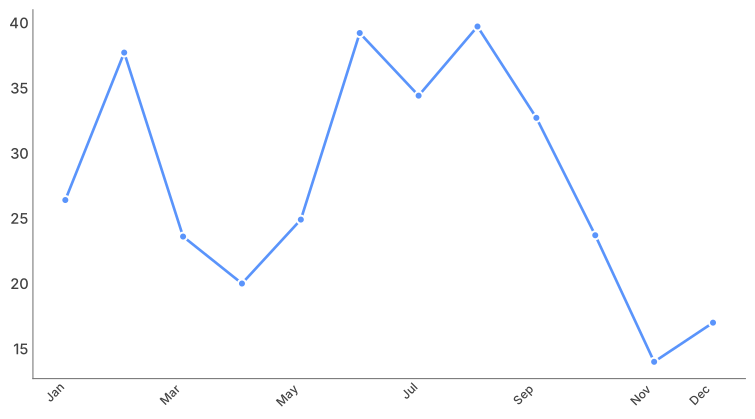
The category reached CN¥ 129.8 billion in 2025 after growth of 26.3% year on year, nearly three times the growth of 9.7% in the overall beauty and skincare market. What sets this growth apart from a typical promotional spike is how consistent it was, since monthly growth never fell below 14.0% YoY and ten of the twelve months came in at 20% or better.
October was the year's largest single month at CN¥ 18.4 billion, driven by Double 11 pre-sale campaigns. June (+39.2%) and August (+39.7%) had the strongest growth rates of the year, which we believe shows that the traditional "skincare season" is extending beyond the winter months as consumers adopt anti-aging routines all year round. November and December, when sales usually slow after the major promotions, still grew 14.0% and 17.0% respectively.
Anti-aging growth held at or above +14% YoY in every month of 2025
From Face to Body: Anti-Aging Care Extends Its Reach#
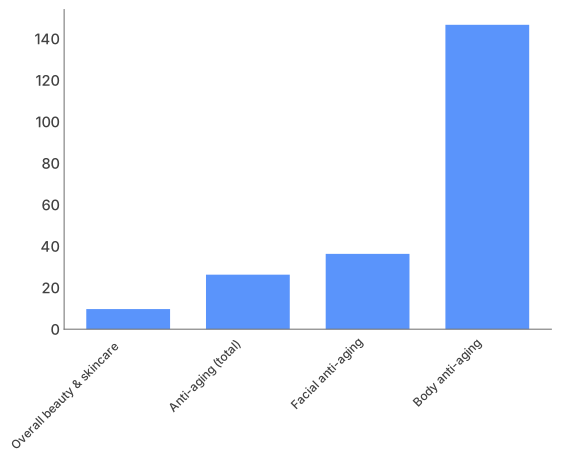
Facial care sets are the category's largest segment at CN¥ 34.9 billion, 26.9% of the category, and they grew 36.3% YoY with an average selling price (ASP) of CN¥ 354.6. The fastest growth, however, came from body anti-aging, which grew 146.7% from CN¥ 1.2 billion to CN¥ 3.0 billion at an accessible ASP of CN¥ 56.8.
If it keeps growing at its current pace, we believe body anti-aging could reach CN¥ 10 billion within three years, which would create a sizeable new sub-category that favours brands with existing body care distribution and formulation expertise. The much lower ASP (CN¥ 56.8 against CN¥ 354.6 for facial care sets) indicates that body anti-aging is entering through mass-market channels and building volume before premium products take hold.
Body anti-aging is the fastest-growing part of the category
Within the category, growth in the two largest facial formats, serums and creams, was spread across many brands, as demand moved towards the formats and price points with the clearest evidence of efficacy.
We believe two attributes set the fastest-growing products apart. The first is clinical credibility, since dermatologist-endorsed positioning and substantiated efficacy claims carried further with consumers in 2025 than new ingredients did. The second is confidence at the top of the price range, where premium demand moved towards the most expensive products in the segment.
Consumer Demographics and the Shift in Innovation#
Anti-aging generated 25.5 million social media mentions and 766.2 million total engagements in 2025, with engagement in August reaching 212.7 million, which was likely driven by summer skin concerns and by promotional seeding ahead of September.
The largest age cohort is 31-35 years old at 23.4%, up from 20.7%, which reflects consumers who start using anti-aging products earlier and treat them as a long-term habit. Engagement remains concentrated geographically, with Tier 1 and New Tier 1 cities (the next ring of large regional cities) accounting for 69.2% of anti-aging engagement, while the share of Tier 2 cities rose from 14.4% to 15.0%, an early sign that interest is spreading beyond the largest cities.
Product innovation has moved away from "ingredient stacking", the practice of combining several active ingredients for marketing appeal, and towards precision biotechnology. Collagen stimulation has moved from a niche professional treatment into a mainstream consumer claim, and marketing language has changed with it. Cycle claims such as "one-night repair" and "28-day firming" were common in new product launches in 2025, and they give consumers measurable timelines in place of vague promises of "youthful skin".
We believe anti-aging innovation is moving towards more personalised routines:
- Body-specific anti-aging formulations are being developed for differences in skin thickness, elasticity and sun exposure
- Device and serum pairings, in which at-home beauty devices are sold with their own serums, are being used to improve results
## About the Data
This analysis draws on Moojing Market Intelligence data covering China's online anti-aging skincare market for the full calendar year 2025 (January-December 2025). Moojing Market Intelligence (魔镜洞察) analyses market dynamics across consumer categories and brands on major Chinese e-commerce platforms. Social media engagement data is drawn from major Chinese social platforms. For full methodology and additional category analyses, see the complete Beauty & Skincare whitepaper.
- Website: moojing-global.com
- Email: info@moojing-global.com
- LinkedIn: linkedin.com/company/68588397/
This content adheres to Moojing's editorial standards .
Frequently Asked Questions
China's online anti-aging skincare market reached CN¥ 129.8 billion in 2025, growing 26.3% year on year, close to triple the 9.7% growth of the overall beauty and skincare market. The growth was consistent across the year, since monthly growth never fell below 14.0% YoY and ten of the twelve months came in at 20% or better. October was the largest month at CN¥ 18.4 billion on Double 11 pre-sale activity. We believe a category that holds double-digit growth in every month of the year reflects a lasting change in how consumers buy.
Body anti-aging is the extension of anti-aging formulation from the face to the body, and it was the fastest-growing part of the category in 2025, up 146.7% from CN¥ 1.2 billion to CN¥ 3.0 billion. If it keeps growing at its current pace, we believe it could reach CN¥ 10 billion within three years, which would favour brands that already hold body care distribution and formulation capability.
It suggests that body anti-aging is entering the market through mass-market channels. Facial care sets, the category's largest segment at CN¥ 34.9 billion and 26.9% of the category, carry an average selling price of CN¥ 354.6 and grew 36.3%, while body anti-aging products sell at an average of CN¥ 56.8. We believe that gap shows body products building volume first, with premium products likely to follow, so a brand that prices a body product against facial benchmarks is likely to be pricing for a stage the category has not reached.
Growth was less seasonal than the category's history would suggest, which matters for planning. The strongest growth rates came in June (+39.2%) and August (+39.7%), which are outside the traditional skincare season, indicating consumers are adopting year-round regimens rather than concentrating purchases in winter. November and December still held +14.0% and +17.0% growth despite typical post-promotional fatigue. For a brand this argues against concentrating activity around the fourth-quarter promotional peak alone, since the mid-year window is now where the fastest relative movement occurs.


