China's Online Beauty and Skincare Sales Hit CN¥454B in 2025
 By Quan Wenjun
5 min read
By Quan Wenjun
5 min read
Executive Summary#
China's online beauty and skincare market reached CN¥ 454.2 billion in 2025, growing 9.7% year-on-year (YoY) on 5.13 billion units sold, up 5.5%. Anti-aging was the main source of growth at CN¥ 129.8 billion (+26.3%), while international luxury houses competed for consumers on premium efficacy and domestic brands on innovation.
These totals come from Moojing's 2025 Beauty & Skincare white paper. Our H1 2026 report measured the same year on a different basis, as skincare, colour cosmetics, fragrance and beauty tools across three of China's largest online marketplaces, and puts 2025 online beauty sales at CN¥ 434.8 billion, up 3.4% on 2024, as set out in China Online Beauty Sales Held at CN¥ 434.8 Billion in 2025. Because the two reports measure the category on different bases, their totals and growth rates should not be compared with each other.
Download Full Report#
Get the complete analysis with brand-level breakdowns, anti-aging category deep-dives, price segmentation data, and makeup trend intelligence.
Seasonal Sales Peaks and a Split in Prices#
Online beauty and skincare sales grew faster than the number of units sold in 2025, so higher prices added to the growth that came from volume. Total online sales reached CN¥ 454.2 billion, up 9.7% YoY, while the number of units sold rose 5.5% to 5.13 billion.
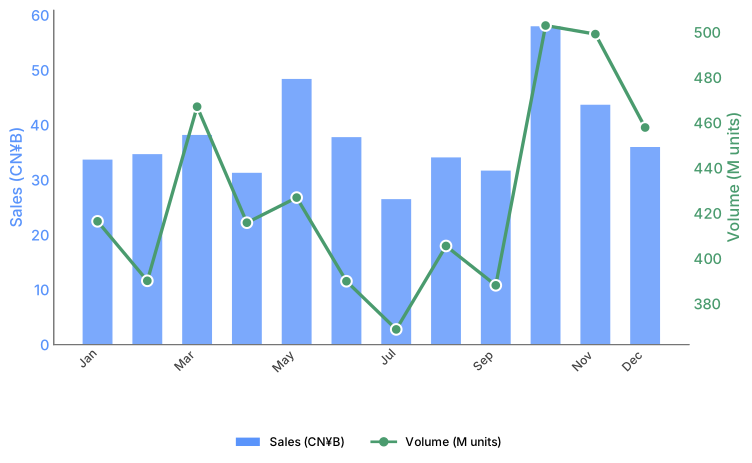
Monthly sales had two clear peaks that shape category planning. October was the largest month at CN¥ 58.0 billion, driven by National Day promotions and early access to the November shopping festival, while May reached CN¥ 48.4 billion on mid-year pre-sale activity and Mother's Day gifting. The July low of CN¥ 26.5 billion, a seasonal trough between the major shopping festivals, leaves an opening for brands with strong everyday positioning, since they face much less competition in that month.
Prices are polarising. In makeup, the CN¥ 0-300 band took 74.1% of sales, so most purchases remain at accessible prices. In skincare, the CN¥ 0-100 segment grew fastest, at 20.6% YoY, driven by entry-level consumers and value-seeking repeat buyers. The mid-market band of CN¥ 300-500 came under pressure as consumers traded either down to affordable essentials or up to premium efficacy products, and this movement towards both ends of the price range is changing how brands plan their portfolios.
Online beauty and skincare sales peak in October and May
Brand Competition: Luxury Houses and Domestic Brands#
Competition among the largest beauty and skincare brands brings together international groups, luxury houses and domestic brands, which compete on different strengths. Luxury houses such as Helena Rubinstein, YSL and La Mer compete on premium efficacy, while domestic brands such as PROYA have built their positions on a reputation for innovation.
Growth Engines: Anti-Aging and Makeup#
Anti-aging has become the most important growth driver in China's beauty market, expanding at more than double the category average. The segment reached CN¥ 129.8 billion (+26.3% YoY), nearly 29% of total beauty and skincare spending. Body anti-aging, a new category of neck, hand and décolletage treatments, grew 146.7%, which shows that anti-aging demand is extending beyond facial skincare into full-body routines.
Competition within anti-aging divides along product format. In serums, SK-II has built premium positioning on its Pitera franchise, while in anti-aging creams Helena Rubinstein has built its position among consumers aged 30 and above. Consumer interest data shows that the 31-35 age group accounts for 23.4% of anti-aging demand, the largest share of any age group.
Makeup is changing as well. Beauty enhancement sales grew 15.8% while social media buzz about beauty enhancement rose 70.2%, which shows that consumer interest is running ahead of purchases. This gap may lead to faster sales growth in the quarters that follow. The main developments are:
- Cushion foundations grew 37.3% YoY, as compact formats take the place of traditional liquid foundations as the preferred base makeup product
- Carslan (卡姿兰) has built its domestic makeup business through social commerce activation
- MGP (毛戈平) shows that premium domestic makeup brands can compete with international players on quality positioning
- The "rosy vitality" aesthetic trend drove demand across blush, lip products and tinted skincare, blurring the boundary between skincare and color cosmetics
About the Data#
This analysis is based on Moojing Market Intelligence data covering China's online beauty and skincare market for the full calendar year 2025. Moojing analyses brand and category performance across major Chinese e-commerce platforms. Sales figures reflect online channel sell-through and do not include offline retail. The figures on this page are those of Moojing's 2025 Beauty & Skincare white paper. Our H1 2026 report re-measured the category from 2022 to July 2026 on a different basis, and its figures, set out in China Online Beauty Sales Held at CN¥ 434.8 Billion in 2025, should not be set against the totals here. YoY comparisons are calculated against the corresponding 2024 period. For full methodology, brand-level data, and additional category deep-dives, download the complete report.
- Website: moojing-global.com
- Email: info@moojing-global.com
- LinkedIn: linkedin.com/company/68588397/
This content adheres to Moojing's editorial standards .
Frequently Asked Questions
CN¥ 454.2 billion in 2025, up 9.7% year on year, on 5.13 billion units, up 5.5%, according to Moojing's 2025 Beauty & Skincare white paper. Our H1 2026 report measures the category on a different basis and puts 2025 at CN¥ 434.8 billion, up 3.4%, so the two totals should not be compared. Because sales grew faster than units, higher prices as well as more units drove the increase. The year had two peaks that shape category planning: October, at CN¥ 58.0 billion, on National Day promotions and early access to the November shopping festival, and May, at CN¥ 48.4 billion, on mid-year pre-sales and Mother's Day gifting. July was the low point at CN¥ 26.5 billion, a month between the major festivals in which a brand with strong everyday positioning faces much less competition.
Towards both ends of the price range, with the middle under pressure. In makeup, the CN¥ 0-300 band captured 74.1% of sales, so most makeup purchases remain at accessible prices. In skincare, the CN¥ 0-100 segment grew fastest, at 20.6%, driven by entry-level consumers and value-seeking repeat buyers. The CN¥ 300-500 band was squeezed as consumers traded either down to affordable essentials or up to premium efficacy products. A brand whose range sits in that middle band now serves two groups of buyers whose motives are moving apart, and this is changing how brands plan their portfolios as well as their prices.
Anti-aging, at more than double the category average. The segment reached CN¥ 129.8 billion, up 26.3%, close to 29% of all beauty and skincare spending. Body anti-aging, which covers neck, hand and décolletage treatments, grew 146.7%, which shows the demand extending well past facial skincare into full-body routines. Competition divides along product format: in serums, premium positioning rests on signature ferment franchises, and in creams on brands aimed at consumers over 30. The 31-35 age group accounts for 23.4% of anti-aging demand, the largest share of any age group.
On different strengths. International luxury houses compete on premium efficacy, while domestic brands have built their positions on innovation credibility, which we believe shows that domestic brands can compete with international players on innovation. In makeup, cushion foundations grew 37.3%, and buzz about beauty enhancement rose 70.2% against growth of 15.8% in sales, which suggests that consumer interest is running ahead of purchases.


