China Clean Beauty Market 2022: Global Share Rises to 36.5%
 By Jessie Wang
4 min read
By Jessie Wang
4 min read
Executive Summary#
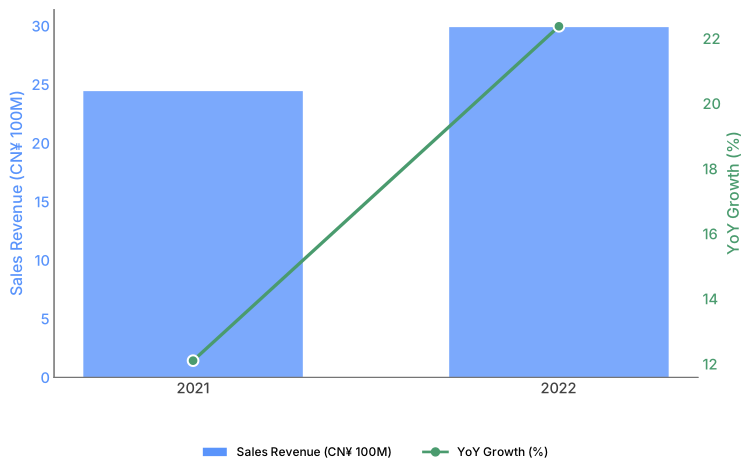
Clean beauty sales on a leading Chinese marketplace grew 22.3% YoY to CN¥ 2.99 billion in 2022, accelerating from 12.1% growth in 2021, at a time when the broader beauty market came under pressure. China's share of the global clean beauty market rose 5.0 percentage points to 36.5%, the fastest growth of any major market. Domestic brands such as Simpcare, One Leaf and LAN are building positions in the category beside international brands. Clean beauty content on a leading Chinese social platform has also grown quickly, which we believe shows that the concept has reached mainstream consumers.
Download Full Report#
Get the complete analysis with additional data on Chinese herbal ingredients, adaptogens, and superfood skincare trends.
Sub-Concepts: Where Growth Is Emerging#
The health and beauty market is made up of many sub-concepts, and their sales show which health attributes were driving demand in 2022 and which were positioned for further growth. Botanical and natural concepts account for the largest sales, while eco-friendly beauty, a much smaller sub-concept, posted the highest growth of any sub-concept in 2022.
China's Share of the Global Clean Beauty Market Rises#
China's share of the global clean beauty market rose from 31.5% in 2021 to 36.5% in 2022, the fastest growth of any major market, while the United States, still the largest market, went from 54.0% to 47.7%.
Clean Beauty Sales Accelerate to CN¥ 3 Billion#
Clean beauty sales on a leading Chinese marketplace reached CN¥ 2.99 billion in 2022, growing 22.3% YoY from CN¥ 2.44 billion in 2021. The acceleration from 12.1% growth in 2021 shows that clean beauty is expanding faster each year as well as keeping its momentum.
Clean beauty sales on a leading Chinese marketplace reach CN¥ 2.99 billion with 22.3% YoY growth in 2022
Competitive Landscape: Domestic Brands Rise#
Competition is intensifying as both international and domestic brands invest in clean beauty positioning. International brands such as REN, Drunk Elephant and Farmacy have established significant presences in China's online market, while domestic brands are building their own positions with distinct propositions:
- Simpcare offers scientifically driven, functional natural skincare
- One Leaf builds on its fresh extraction technology and its dual repair serum
- LAN is built around an oil-nourishing skincare philosophy
- MCL Florasis (花西子) co-authored China's Clean Beauty Standards
- Red Chamber positions itself as additive-free and cruelty-free
The presence of domestic brands shows that Chinese consumers are receptive to clean beauty propositions developed locally. We believe brands that build on Chinese ingredient stories, particularly those rooted in traditional Chinese medicine, are well placed to set themselves apart from international brands whose appeal rests mainly on brand heritage.
Key Takeaways#
- Clean beauty sales on a leading Chinese marketplace grew 22.3% YoY to CN¥ 2.99 billion in 2022, close to double the 2021 growth rate of 12.1%
- China's share of the global clean beauty market rose 5.0 percentage points to 36.5%, the fastest growth of any major market
- Eco-friendly beauty posted the highest sub-concept growth in 2022, while botanical and natural concepts accounted for the largest sales
- Clean beauty content on a leading Chinese social platform grew from 583 monthly posts in July 2020 to 18,020 in October 2022, an increase of about 3,000%
- Domestic brands such as Simpcare and One Leaf are building positions with functional natural skincare and fresh extraction technology
More from This Report#
About the Data#
This analysis draws on Moojing Market Intelligence data covering March 2022 to February 2023. The clean beauty sales and sub-concept figures come from one leading Chinese marketplace, and the content figures from a leading Chinese social platform. For full methodology and additional insights, see the complete Health & Beauty whitepaper.
This content adheres to Moojing's editorial standards .


