Floor Scrubbers vs Sweeping Robots: China's Cleaning Split
 By Jessie Wang
5 min read
Executive Summary#
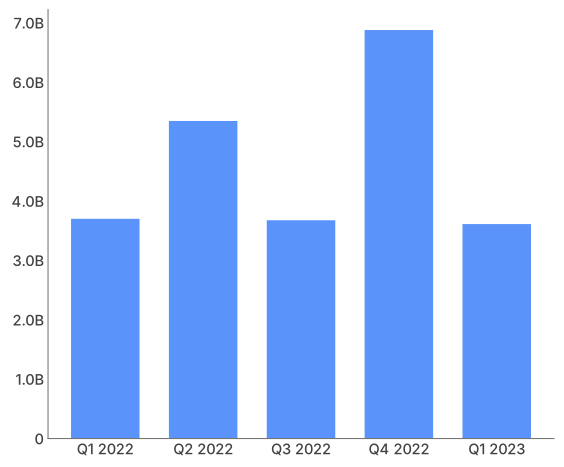
China's CN¥ 3.61 billion cleaning appliance market split into two very different categories in Q1 2023. Floor scrubbers attracted more than 200 brands and grew 28.8% YoY, while sweeping robot sales concentrated further in a small number of established brands. The split reflects two different market stages. Floor scrubbers remain an area of active innovation, in which dual roller brushes, self-cleaning and edge sweeping set products apart, while sweeping robots compete on gradual improvements to the base station in a category that is approaching saturation. This analysis examines what the split means for brands that sell to China's convenience-driven consumers.
Download Full Report#
Get the complete analysis with additional data, methodology details, and brand-level insights across all appliance categories.
A Market Divided by Maturity#
The cleaning appliance market recorded CN¥ 3.61 billion in sales in Q1 2023, and sales and volume moved in different directions, with sales down 2.4% YoY while volume grew 3.7%.[1] The gap reflects a continued fall in the average selling price (ASP), as new, cost-effective brands enter the market and established brands respond with competitive pricing. ASP fell from CN¥ 1,092.18 to CN¥ 1,028.51 (-5.8%).
Brands with capabilities in more than one category are increasingly well placed in this market. Dreame (追觅), a relatively new entrant, has followed a dual-line strategy that spans both floor scrubbers and sweeping robots.
Cleaning appliance market stabilizes at CN¥ 3.61 billion with floor scrubbers leading growth
Floor Scrubbers: An Area of Active Innovation#
Floor scrubbers are the most dynamic category within cleaning appliances, with more than 200 brands launching an average of 24 new products per month.[1] Active merchants grew from 153 to 222 (+45%) and product SKUs from 1,578 to 2,523. ASP fell by approximately CN¥ 200 YoY, from CN¥ 3,333 to CN¥ 3,165, which reflects the scale effects of a growing industry and stronger price competition.
Brands have built their positions on different strengths. Tineco (添可) has built its range around live water cleaning, edge sweeping and centrifugal air drying, Dreame's H12 ProPlus offers dual-edge lamination and 16,000Pa suction power, and Roborock (石头) has worked with the celebrity spokesperson Xiao Zhan to keep its social media visibility high.
The innovation behind the category's expansion centres on three capabilities:
- All-in-one functionality: washing, mopping, sweeping and vacuuming in a single device
- Self-cleaning automation: less maintenance for consumers after each use
- Edge cleaning technology: addressing the traditional problem of dirty edges left behind
Sweeping Robots: A Maturing, Concentrated Market#
The sweeping robot market has developed very differently. Sales concentrated further among the largest brands over the year to Q1 2023.[1] Active merchants fell from 268 to 230 and product SKUs from 4,434 to 3,491, which indicates that smaller sellers are leaving the market as the barriers to competing rise. We believe the category is entering a phase of consolidation.
ASP rose significantly, from CN¥ 2,280 to CN¥ 3,065 (+34.4%), supported by advanced features such as improved navigation, obstacle avoidance, map modelling and intelligent interaction. The price trend runs in the opposite direction to floor scrubbers, since floor scrubber ASP is falling as new entrants compete on price, while sweeping robot ASP is rising as more complex technology raises the barriers to entry.
Product development in the category concentrates on cleaning and base station features. Roborock's G10S Pure model mops at 3,000 revolutions per minute, Dreame has developed its S10Plus model, and Cloud Whale (云鲸) has positioned its J3 model, which has an omnipotent base station, in the premium segment.
What the Split Means for Brands#
The difference between floor scrubbers and sweeping robots gives brands a framework for assessing the cleaning appliance market. Floor scrubbers offer an innovation-stage opportunity, in which product differentiation drives growth, new entrants can gain share through better features and the market rewards both premium and cost-effective strategies. Sweeping robots are at a consolidation stage, in which technology barriers favour established brands and further growth comes mainly from premiumisation, since the market itself is expanding less.
Dreame's presence in both categories illustrates one approach, which is to use shared R&D and brand recognition to compete in growing categories while holding a position in consolidating ones. For new entrants, we believe floor scrubbers offer much better prospects of winning meaningful share than sweeping robots, where sales are already concentrated among a small number of established brands.
Key Takeaways#
- China's CN¥ 3.61 billion cleaning appliance market shows two distinct paths, with floor scrubbers expanding (+28.8% YoY) and sweeping robots consolidating around a small number of established brands
- Floor scrubber merchants grew 45% (153 to 222) with more than 200 brands competing, while sweeping robot merchants fell from 268 to 230
- Floor scrubber ASP fell by CN¥ 200 to CN¥ 3,165 as new entrants competed on price, while sweeping robot ASP rose 34.4% to CN¥ 3,065 as technology raised the barriers to entry
- Cleaning efficiency (59.2% of mentions) and hands-free operation (21.6%) are the leading topics in consumer social media discussion of floor scrubbers
- Full-chain automation remains the main area of technical development for sweeping robots, with base station capabilities as the key point of difference between products
More from This Report#
About the Data#
This analysis draws on Moojing Market Intelligence data covering Q1 2023.
Moojing analyses brand and category performance across major Chinese e-commerce platforms. For full methodology and additional insights, see the complete Home Appliances whitepaper.
This content adheres to Moojing's editorial standards .


