China's Online Coffee Machine Sales Grew 32% in 2025
 By Quan Wenjun
4 min read
Executive Summary#
China's online coffee machine market reached CN¥ 6.25 billion in 2025, growing 32.0% year-on-year (YoY) as home coffee culture spread across the country[1]. International brands with long histories in the category sit alongside domestic brands that are building full product ranges, among them Hauswirt (海氏), whose range runs from entry-level to commercial-grade machines. Cold brew machines grew 181.0%, the fastest growth among the larger segments.
Download Full Report#
Get the complete analysis with additional data, methodology details, and brand-level insights.
Market Sizing: Strong Growth for Home Coffee#
China's coffee machine market grew strongly in 2025, as spending on personal enjoyment and a wider home coffee culture lifted online sales to CN¥ 6.25 billion, up 32.0% YoY. The average selling price (ASP) rose 14.1%, which we believe shows that consumers are moving up to higher-end machines that can make café-standard coffee at home.
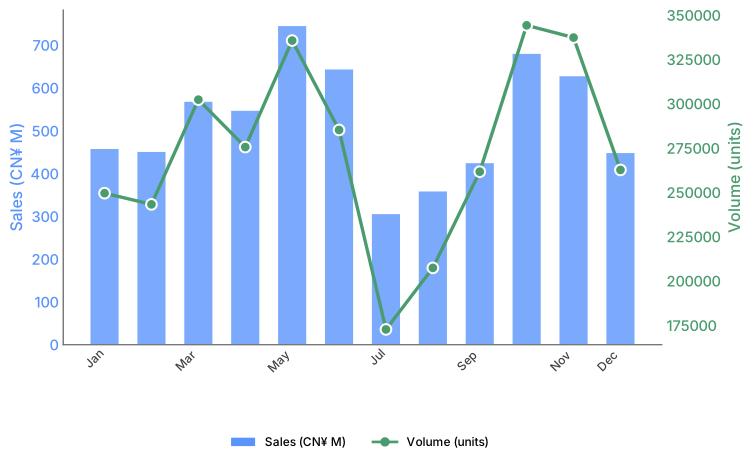
The monthly sales pattern shows how much the category depends on promotions, with May (CN¥ 744.9 million) and October (CN¥ 679.9 million) marking the peaks of the 618 and Double 11 shopping festivals. July was the low point of the year at CN¥ 305.1 million, less than half of a peak month, which suggests that buyers of high-ticket coffee machines mostly wait for promotional periods, when discounts lower the cost of an upgrade.
Coffee machine sales peak during 618 and Double 11 promotional periods
Brand Competition: International and Domestic Brands#
The market brings together established international brands and domestic brands that have grown quickly by covering more price points. Growth was broad among the larger brands, which suggests that the market is expanding and that brands are not simply taking sales from one another.
Segment Structure: Convenience Wins, Cold Brew Grows Fastest#
Three mainstream categories, semi-automatic, fully automatic and all-in-one machines with a grinder, make up the base of the market. Smaller segments such as cold brew machines and separate grinders grew much faster, through product innovation and new uses.
Consumer Pain Points: Noise, Convenience and Size#
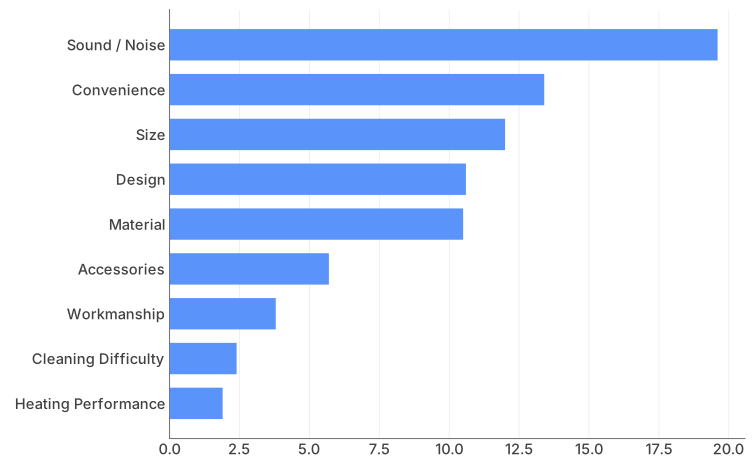
Noise was the most common consumer complaint, at 19.6% of the pain points raised, followed by convenience at 13.4% and size at 12.0%. Social media analysis shows that choosing a category of machine and the situations in which it is used are the topics coffee machine consumers discuss most. Workplace professionals and single-person households are the core consumer groups, and they want a convenient way to brew at home that saves both time and money compared with buying from a café.
Noise, convenience and size are the top consumer pain points for coffee machines
Brand Spotlight: How Hauswirt Built Its Coffee Machine Range#
Hauswirt built its coffee machine business in 2025 on a full product matrix, covering entry-level to commercial-grade models, and on marketing spread across several platforms.
Its range covers every price tier. The C5 entry-level model at CN¥ 4,800 is aimed at first-time espresso machine buyers who want simple operation and good value, and mid-range models fill the gap above it. The C9 flagship at CN¥ 11,999 is positioned against imported machines, offering comparable features such as dual boilers, rotary pumps and E61 group heads at a much lower price. The full range lets Hauswirt win customers at the entry level and then move them up to more expensive models within the brand.
In marketing, Hauswirt gave each of three platforms a distinct role. On Douyin (抖音) it used live streaming and scenario-based short videos to drive conversion, and on Weibo it used celebrity endorsements and trending topic campaigns to build mass-market awareness. On Rednote (小红书) it focused on detailed product reviews and lifestyle content showing coffee at home.
More from This Report#
## About the Data
This analysis draws on Moojing Market Intelligence (魔镜洞察) data covering January-December 2025. Moojing analyses brand and category performance across major Chinese e-commerce platforms. For full methodology and additional insights, see the complete 2025 Home Appliances whitepaper.
[1] Moojing Market Intelligence. Proprietary e-commerce transaction data covering major Chinese online platforms and an extensive brand set. Data period: January-December 2025.
This content adheres to Moojing's editorial standards .
Frequently Asked Questions
CN¥ 6.25 billion in 2025, up 32.0% year on year. The average selling price rose 14.1%, so roughly half the growth came from consumers trading up to more expensive machines, which we believe shows home coffee culture moving beyond the entry-level machine. Sales are highly seasonal, with May reaching CN¥ 744.9 million and October CN¥ 679.9 million against a July low of CN¥ 305.1 million, less than half a peak month.
Because a coffee machine is an expensive, considered purchase, and the discount is what persuades many buyers to upgrade. The two annual peaks fall on the mid-year and November promotional festivals, and the July low is under half a peak month. For a brand, this means concentrating inventory and marketing in those two windows, and making the case for a more expensive machine before each window opens, because buyers tend to decide in advance and wait for the discount to buy.
Three mainstream categories, semi-automatic, fully automatic and all-in-one machines with a built-in grinder, make up the base of the market, while the fastest growth is coming from smaller segments. Cold brew machines grew 181.0%, the fastest growth among the larger segments, because they let people make at home a drink they already buy outside it.
Noise, convenience and size, in that order, at 19.6%, 13.4% and 12.0% of the pain points raised. All three concern living with the machine rather than the coffee it makes. The core buyers are workplace professionals and single-person households who want a faster and cheaper alternative to buying from a café, so a machine that is loud, awkward to use or too large for the counter undermines the reason they bought it.


