China's Cosmetics Market Hits CN¥ 235 Billion as Value Shoppers Reshape Price Landscape
 By Jessie Wang
6 min read
By Jessie Wang
6 min read
Introduction#
Market Overview#
Key Finding
China's online makeup and skincare market reached CN¥ 235.23 billion (+10.1% YoY) and 2.56 billion units (+5.5% YoY) in H1 2025. Value-conscious consumers changed the shape of the market's price tiers, as mid-to-low-priced products gained share of sales on the strength of their cost-effectiveness.
The "appearance economy" continues to support spending across cosmetics categories, but consumption downgrading has changed where consumers put their beauty budgets. In H1 2025, shoppers favoured affordable products that work over premium alternatives, as they balanced their expectations of quality against tighter budgets.
We believe this marks a structural change in how Chinese consumers approach beauty purchases. Brands that deliver quality at accessible price points stand to gain, while brands at higher price points will need to work harder to justify what they charge.
Market Dynamics
The H1 2025 cosmetics market was defined by consumption downgrading and by different changes in the price structures of skincare and makeup.
Consumption downgrading accelerates. Price-sensitive consumers favour mid-to-low-priced products and put cost-effectiveness ahead of brand prestige, a trend that reflects broader economic caution among Chinese shoppers.
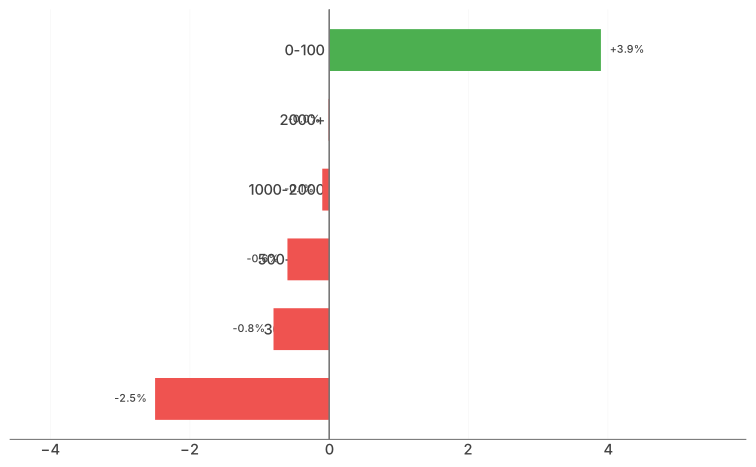
Skincare market restructures. Products priced below CN¥ 100 gained 3.9 percentage points in share of sales, while the segments above CN¥ 300 contracted, so budget skincare took a significantly larger part of consumer spending in H1 2025.
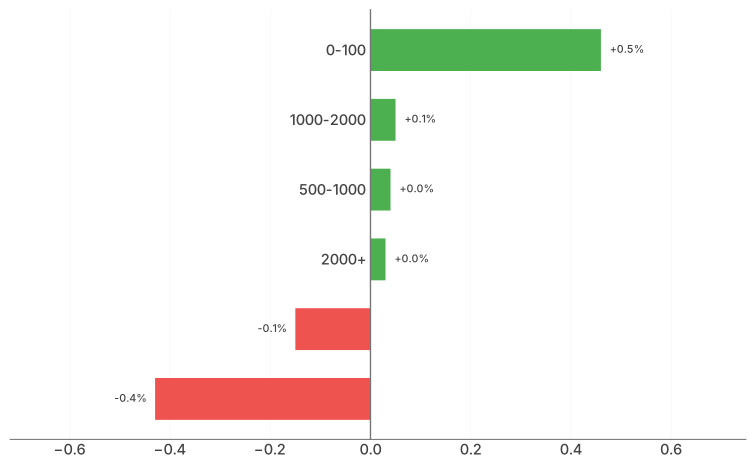
Makeup market polarises. The share of the low-price segment rose 0.5 percentage points, while the CN¥ 100-500 segments decreased. Consumer preferences have divided, as shoppers either trade down to entry-level products or keep buying premium ones, which leaves less room in the middle of the market.
Monthly Sales Analysis#
Sales Trends#
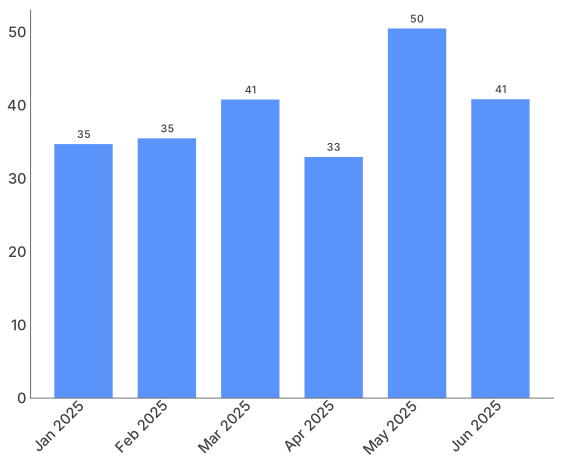
Market peaks at CN¥ 50.49 billion in May, driven by promotional events and seasonal skincare demand
Seasonal Patterns
Monthly sales followed distinct patterns that brands can use in their planning.
January-February stability. The first two months were consistent, at CN¥ 34.70 billion and CN¥ 35.48 billion respectively, as Chinese New Year festivities supported gift purchases during what is traditionally a slow period for retail.
March acceleration. Sales rose to CN¥ 40.78 billion as consumers began their spring skincare routines and moved from winter hydration to brightening and anti-allergy products.
April dip. At CN¥ 32.94 billion, April was the lowest month of the half, as shoppers held back ahead of the major May promotions, a pattern consistent with previous years.
May peak. The 618 shopping festival preview and seasonal suncare needs drove sales to CN¥ 50.49 billion, a +53.3% jump from April that shows how strongly promotional events move this market.
June normalisation. Sales after the promotion settled at CN¥ 40.83 billion, as consumers used up what they had bought in May.
How Price Tiers Changed#
Makeup Market Price Shifts#
Low-price makeup segments gain +0.46 percentage points as mid-range contracts
Makeup Polarisation Analysis
The makeup market showed a distinctive "barbell" pattern in H1 2025. Entry-level products under CN¥ 100 gained 0.46 percentage points in share of sales, the largest shift of any price tier.
The mid-market absorbed most of this movement. Products priced at CN¥ 100-300 lost 0.43 percentage points of share, while the CN¥ 300-500 segment contracted by 0.15 percentage points. We believe this reflects consumers' unwillingness to pay mid-tier premiums for products they can find at lower prices.
Premium and luxury segments held steady with marginal gains, as products above CN¥ 500 posted small positive shifts of between +0.03 and +0.05 percentage points. This stability suggests that buyers of luxury makeup remain committed to premium purchases and treat them as an investment more than as discretionary spending.
For brands, this points either to competing hard at entry-level price points or to building strong differentiation at the premium tiers, since the middle of the market offers smaller returns.
Skincare Market Price Shifts#
Skincare under CN¥ 100 surges +3.9 percentage points as premium segments contract
Skincare Shifts Towards Value
The changes in skincare price tiers were much larger than those in makeup. The under-CN¥ 100 segment gained 3.9 percentage points in share of sales, far more than the entry-level gain in makeup.
Every higher tier contracted. The CN¥ 100-300 segment lost the most, 2.5 percentage points, and the higher tiers followed, with CN¥ 300-500 down 0.8 percentage points, CN¥ 500-1000 down 0.6 percentage points and the segments above CN¥ 1000 showing marginal losses.
We believe this contraction across all the higher tiers shows that Chinese shoppers have concluded that affordable skincare works well enough for their needs, and the rise of domestic brands offering quality formulations at accessible prices has accelerated the shift.
The implications are significant. Premium international brands will need to show measurable advantages in efficacy to justify their prices, while budget brands that combine quality ingredients with value pricing have won a strong place in consumer preference.
Strategic Implications#
Market Outlook#
What This Means for Brands
The H1 2025 data describes a cosmetics market in transition, and brands selling beauty products in China should consider several strategic priorities.
Value positioning is essential. We read the +3.9 percentage point shift towards budget skincare as a structural change that is likely to last, so brands need strong value propositions at accessible price points to win sales in this growing segment.
Premium differentiation must intensify. Luxury brands cannot rely on heritage or marketing alone, and they need to show product advantages that justify premium pricing to consumers who are increasingly discerning.
The mid-market needs a new approach. The squeezed middle is the hardest position, as brands in the CN¥ 100-500 range face pressure from both directions and need to make a clear move, either upwards towards premium positioning or downwards towards value pricing.
Promotional timing matters. The May sales peak shows how responsive Chinese consumers are to well-timed promotions, and aligning with the major shopping festivals can significantly amplify results.
Download Full Report#
This article highlights key findings from Moojing Market Intelligence's comprehensive H1 2025 Makeup & Skincare Market Analysis. The full report provides detailed insights into brand performance, channel dynamics, category trends, and consumer behavior patterns.
About the Data#
This analysis draws on Moojing Market Intelligence data covering H1 2025 (January to June 2025). Moojing analyses brand and category performance across major Chinese e-commerce platforms. Market size figures reflect online retail sales across major platforms. Price tier analysis examines year-on-year shifts in the distribution of sales across price tiers.
This content adheres to Moojing's editorial standards .


