Bilberry and Saffron Surge as Lutein Declines in Eye Care
 By Jessie Wang
4 min read
By Jessie Wang
4 min read
Executive Summary#
China's eye care ingredient market is moving away from commodity ingredients and towards premium ones: lutein sales fell 21.6% to CN¥ 1.6 billion and blueberry fell 28.7% to CN¥ 900 million, as consumers tire of commodity-grade formulations. Premium anthocyanin ingredients grew strongly over the same period, with bilberry up 19.6% to CN¥ 300 million, anthocyanins as a class up 31.9% and saffron extract up 156.3%. Imported brands such as Doppelherz, Youthit and Swisse have built their bilberry ranges on "Nordic wild bilberry" origin narratives combined with compound formulation, and Vitamin B complex eye care products, a small sub-segment, grew 292.7% year on year. We believe the market for single-ingredient commodity products has reached its limit, and that in MAT2025 growth went to compound formulations that can show a scientific basis for what makes them different.
Download Full Report#
Get the complete analysis with pharmaceutical market dynamics, consumer profiling, and strategic opportunity assessments.
Lutein Leads Consumer Awareness While Its Sales Decline#
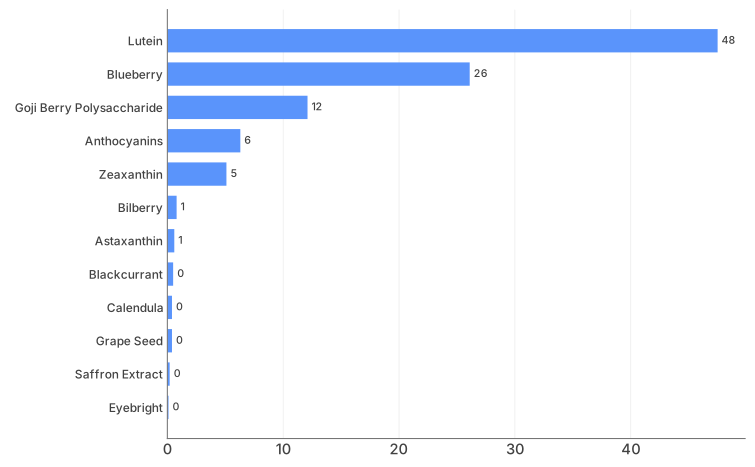
Lutein accounts for 47.5% of consumer awareness among professional eye care ingredients, nearly double the 26.1% of blueberry in second place, and together the two ingredients account for 73.6% of awareness. Their sales have fallen all the same, so being the best-known ingredient is no longer the same as being the one consumers buy.
Lutein commands 47.5% consumer awareness, with blueberry at 26.1% as the second-most recognized ingredient
The Price-Growth Correlation: Premium Ingredients Win#
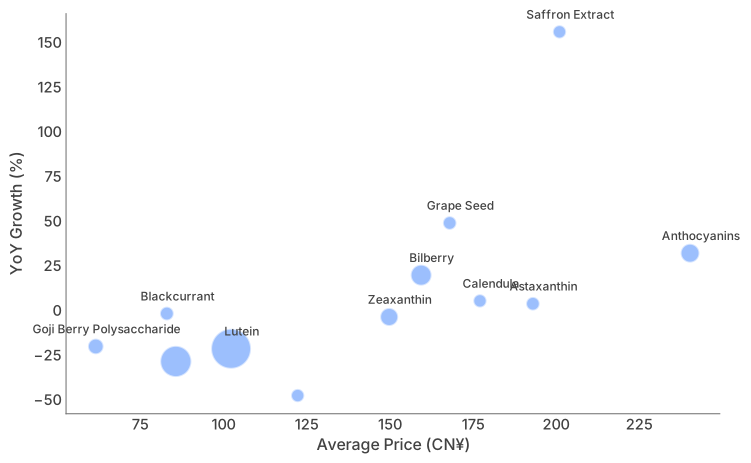
The split in the ingredient market follows price closely: every ingredient priced above CN¥ 150 per unit posted positive growth, while every ingredient priced below CN¥ 100 declined, which we read as consumers leaving the tier where products are interchangeable.
Lutein sales decline 21.6% while saffron extract surges 156.3%, marking a decisive ingredient market rotation
Bilberry's Rise: Imported Brands Build on Origin and Formulation#
Bilberry has become the premium ingredient of the anthocyanin class, since its fruit contains anthocyanin concentrations up to 15 times those of ordinary blueberries. Brands position bilberry on research reporting that its anthocyanins cross the blood-retinal barrier, and market it for eye fatigue and dark adaptation.
Imported brands such as Doppelherz, Youthit and Swisse have built their position in bilberry on "Nordic wild bilberry" origin narratives combined with compound formulation. We believe a domestic brand entering the ingredient would need to build both a story of origin and a differentiated formulation of its own.
Vitamin B Complex: The Fastest-Growing Sub-Segment at 292.7%#
Vitamin B complex eye care products grew faster than any other part of the market, with sales up 292.7% year on year to CN¥ 24.49 million, and sales in the sub-segment are concentrated among a few brands. Brands market Vitamin B complex combined with lutein for eye fatigue, aiming it at consumers who spend long hours looking at screens.
Key Takeaways#
- Lutein fell 21.6% to CN¥ 1.6 billion and blueberry fell 28.7%, which points to consumer fatigue with commodity-grade eye care supplements.
- Bilberry grew 19.6% to CN¥ 300 million, and imported brands such as Doppelherz, Youthit and Swisse have built their bilberry ranges on premium origin narratives.
- Every ingredient priced above CN¥ 150 posted positive growth and every ingredient below CN¥ 100 declined, which confirms a structural shift towards premium products.
- Saffron extract (+156.3%) and grape seed (+48.8%) are emerging niche opportunities with strong growth but low absolute sales.
- Vitamin B complex (+292.7%) is the fastest-growing sub-segment but still accounts for less than 1.3% of the market, so it is a positioning opportunity more than a volume one.
More from This Report#
Continue reading the Eye Health analysis:
About the Data#
This analysis draws on Moojing Market Intelligence's proprietary e-commerce transaction data covering major Chinese online platforms, combined with social media listening and consumer review analysis. The primary comparison period is MAT2025 (June 2024-May 2025) vs. MAT2024 (June 2023-May 2024). Professional eye care ingredients are defined by direct ocular mechanisms of action and high consumer awareness specifically focused on eye care. Moojing analyses brand and category performance across major Chinese e-commerce platforms.
This content adheres to Moojing's editorial standards .
Frequently Asked Questions
A rotation out of commodity ingredients into premium ones. Lutein contracted 21.6% to CN¥ 1.6 billion and blueberry 28.7% to CN¥ 900 million, while bilberry grew 19.6% to CN¥ 300 million, anthocyanins as a class rose 31.9% and saffron extract grew 156.3%. Awareness has not moved with sales: lutein still commands 47.5% of consumer awareness among professional eye care ingredients and blueberry 26.1%, together 73.6%. Being the best-known ingredient is no longer the same as being the one people buy, and that gap is unusual enough to be worth building a product against.
The fault line is remarkably clean. Every ingredient priced above CN¥ 150 per unit posted positive growth; every ingredient priced below CN¥ 100 contracted. We read it as consumers leaving the tier where products are interchangeable, more than as consumers spending more for its own sake. A commodity-grade single-ingredient supplement has no defensible claim once several sellers offer the same active at the same dose, and the category has reached that point for its two most familiar ingredients. Growth has moved to formulations that can explain why they are different, which in practice means a compound formulation or a differentiated source.
It has both a mechanism and an origin story, which is a rare pairing. Bilberry fruit carries anthocyanin concentrations up to 15 times those of ordinary blueberries, and brands market it on research reporting that its anthocyanins cross the blood-retinal barrier, positioning it for eye fatigue and dark adaptation. Imported brands have built their position in bilberry on "Nordic wild bilberry" provenance narratives combined with compound formulation. The lesson for a domestic challenger is that the moat here is narrative and formulation rather than the raw ingredient, and both of those can be built.
Vitamin B complex eye care grew 292.7% year on year to CN¥ 24.49 million, the highest growth rate in the market, while still accounting for under 1.3% of it. Sales in the sub-segment are concentrated rather than contested. Brands market Vitamin B complex combined with lutein for eye fatigue, a claim that maps directly onto high-intensity screen use. Saffron extract (+156.3%) and grape seed (+48.8%) share the same profile of strong growth on low absolute sales. These are positioning opportunities rather than volume opportunities, and they should be taken on that basis rather than on the growth rate alone.


