Food-Medicine Ingredients Surge as Probiotics Plateau
 By Quan Wenjun
5 min read
By Quan Wenjun
5 min read
Executive Summary#
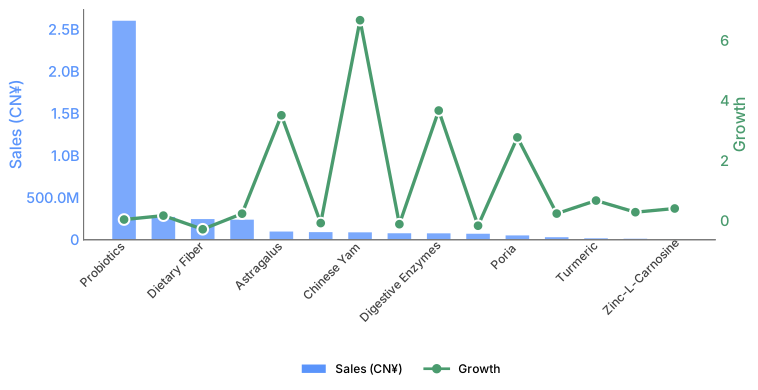
China's GI health ingredient landscape is splitting into two speeds: probiotics dominate at CN¥ 2.60 billion but growth has slowed to 3.8% YoY, while food-medicine homology ingredients rooted in traditional Chinese medicine are posting triple-digit gains. Chinese yam surged 666.9% YoY, astragalus climbed 350.6% and digestive enzymes grew 366.4%, signaling a market inflection point. This analysis examines how ingredient dynamics and delivery format innovation are reshaping competitive positioning for GI health brands.
Download Full Report#
Get the complete analysis with additional data, brand-level performance, consumer insights, and GLP-1 technology trends.
Download the Full H2 2025 GI Health Supplements & Probiotics Whitepaper →
A Two-Speed Ingredient Landscape#
The GI health ingredient market reveals a clear two-speed dynamic. Probiotics remain the dominant force at CN¥ 2.60 billion, representing approximately 67% of the total ingredient market. However, their +3.8% YoY growth signals approaching maturation after years of aggressive category expansion. The real growth momentum has shifted to traditional Chinese medicine-inspired ingredients and functional compounds that are transforming how consumers approach digestive wellness.
Chinese yam leads with extraordinary +666.9% YoY growth to CN¥ 88.1 million, followed by digestive enzymes at +366.4% to CN¥ 76.2 million, and astragalus at +350.6% to CN¥ 97.0 million. These ingredients share several characteristics:
- They align with the food-medicine homology (药食同源) philosophy that has deep cultural resonance in China
- They frequently appear as compound formulations rather than standalone products
- Many are being reformulated into snack-type products to align with contemporary consumption preferences
This convergence of traditional ingredients with modern probiotic science represents a distinctively Chinese innovation pathway that differentiates the domestic market from Western supplement approaches.
Chinese yam (+666.9%) and digestive enzymes (+366.4%) surge while probiotics plateau at +3.8%
Declining Prebiotics Signal a Shift Toward Compound Formulations#
Among the declining categories, dietary fiber fell 28.6% to CN¥ 245.8 million, fructo-oligosaccharides declined 16.8% to CN¥ 71.5 million and inulin dropped 11.7% to CN¥ 76.6 million. We believe these prebiotic ingredients are giving ground as consumers shift toward more comprehensive probiotic-plus-traditional-ingredient compound products that offer perceived holistic benefits rather than single-function prebiotic supplementation.
The emerging ingredients also represent distinct commercial opportunities:
- Glutamine (+23.6%) is gaining traction through products positioned on gut repair and through sports nutrition crossover
- Postbiotics (+28.2%) offer stability advantages over live probiotics for storage and distribution
- Zinc-L-Carnosine (+40.5%), though still at an early CN¥ 1.6 million in sales, is marketed for H. pylori management and gastric mucosal repair, a specialised niche
These specialized ingredients represent the vanguard of the market's evolution toward precision GI health management, moving beyond broad-spectrum probiotics toward condition-specific formulations.
Format Innovation: Drops and Chewables Challenge Powder Dominance#
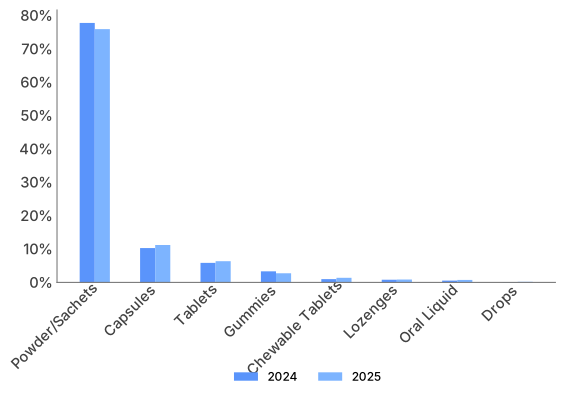
The delivery format landscape reveals a parallel transformation. Powder/sachets remain the primary format at 75.9% share in 2025 (down from 77.7% in 2024), while capsules grew from 10.3% to 11.2%. These two established formats together account for 87% of the market, providing the foundation upon which emerging formats are building.
Powder dominates at 76% share but drops (+78% YoY) and chewables (+48%) emerge
Format YoY Growth Rates#
| Format | YOY |
|---|---|
| Powder/Sachets | +1% |
| Capsules | +13% |
| Tablets | +13% |
| Gummies | -14% |
| Chewable Tablets | +48% |
| Lozenges | +13% |
| Oral Liquid | +45% |
| Drops | +78% |
Gummies are the only format in decline, at -14% YoY, suggesting that novelty-driven adoption has given way to consumer skepticism about probiotic viability in gummy formulations. This stands in contrast to the broader global trend of gummy supplement growth, indicating that Chinese consumers may apply higher efficacy standards to probiotic delivery formats.
Consumer research reinforces this efficacy-first hierarchy. When purchasing probiotics, efficacy is the dominant consideration at 79%, followed by adverse reactions at 17% and taste at 16%. The narrow gap between adverse reactions and taste indicates that once basic efficacy expectations are met, sensory experience becomes the key differentiator for consumer loyalty and repeat purchases. Format innovation must therefore demonstrate functional credibility before pursuing sensory appeal.
Strategic Implications for Brand Positioning#
The convergence of ingredient innovation and format diversification creates a clear strategic framework for GI health brands. Brands that can position products at the intersection of traditional Chinese medicine heritage and modern probiotic science, delivered in convenient new formats, are in our view best placed to capture the next wave of growth.
The food-medicine homology ingredients represent a compound formulation opportunity that is distinctly Chinese. Products combining probiotics with astragalus, Chinese yam, and hawthorn align with the traditional "digest, strengthen, nourish" philosophy while meeting modern consumers' demand for scientifically validated functional benefits.
For format strategy, the data suggests investing in drops for the infant segment, chewable tablets for the children and young adult market, and convenient sachets or capsules for the growing portable consumption occasion. Products that fail to deliver a pleasant sensory experience will face competitive disadvantage in reaching the mass market, regardless of formulation quality.
Key Takeaways#
- Probiotics dominate at CN¥ 2.60 billion but growth has slowed to 3.8% YoY, signaling category maturation
- Chinese yam (+666.9%), digestive enzymes (+366.4%), and astragalus (+350.6%) lead food-medicine homology ingredient growth
- Prebiotic ingredients are declining as consumers shift toward compound formulations with perceived holistic benefits
- Drops (+78% YoY), chewable tablets (+48%), and oral liquids (+45%) are the fastest-growing delivery formats
- Gummies declined 14% YoY, suggesting Chinese consumers apply higher efficacy standards to probiotic formats
More from This Report#
About the Data#
This analysis draws on Moojing Market Intelligence data covering January 2024 through September 2025. Moojing analyses brand and category performance across major Chinese e-commerce platforms. For full methodology and additional insights, see the complete GI Health Dietary Supplements & Probiotics whitepaper.
This content adheres to Moojing's editorial standards .


