Value Brands Reshape China's CN¥ 2.7B Online Tissue Market
 By Jessie Wang
3 min read
By Jessie Wang
3 min read
Executive Summary#
China's online moisturizing tissue market reached CN¥ 2.7 billion in MAT2025 (September 2024 to August 2025)[1]. The category is changing in structure, because volume grew 81.2%, far faster than value, as value brands entered the market at price points below CN¥ 10 per unit. Value brands such as Yipiao and Congma are bringing cream-formulated tissue to consumers who did not buy it before, as cream tissue moves from a premium niche towards the mass market. COROU (可心柔), meanwhile, competes on brand equity and a premium position.
Read the Full Series#
This article is part of our household paper products market analysis series.
Read: China Household Paper Market Hits CN¥ 56.8B on Volume Growth -->
Download Full Report#
Get the complete analysis with brand-level insights, pricing trends, consumer sentiment data, and social media marketing strategies across all nine sub-categories.
Download H1 2025 Whitepaper: China's Household Paper Products Market Analysis -->
Volume Growth Signals a Wider Market#
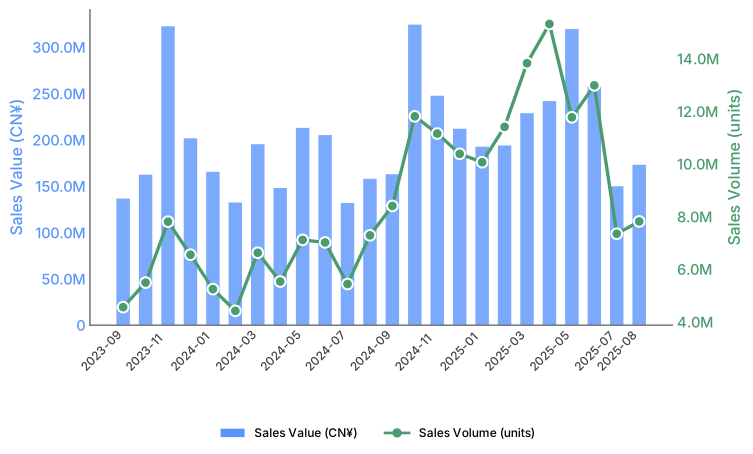
In moisturizing tissue, volume grew 81.2%, far faster than value[1], and the gap between the two is the measure of how far prices fell. Average prices fell 31.2% year on year to CN¥ 20.4 per unit as value brands entered the market, and those lower prices are making cream-formulated tissue affordable for a much broader base of consumers.
Monthly sales data shows that growth was strongest in the spring of 2025 and eased in July and August[1]. Volume in April 2025 reached 15.3 million units against 5.5 million in April 2024, nearly three times the level of a year earlier.
Moisturizing tissue reaches CN¥ 2.7 billion in MAT2025 as +81.2% volume growth outpaces value growth
Premium and Value Strategies in Competition#
In MAT2025, competition in moisturizing tissue was between two strategies, the premium positioning of COROU (可心柔) and the value pricing with which challenger brands entered the market[1]. COROU continues to invest in brand equity and in cream-formulated products at the premium end of the market. Value brands such as Yipiao, Congma and Zhihu have brought prices down far enough that cream tissue can be sold as an everyday product.
Consumer Profile: Beyond Baby Care#
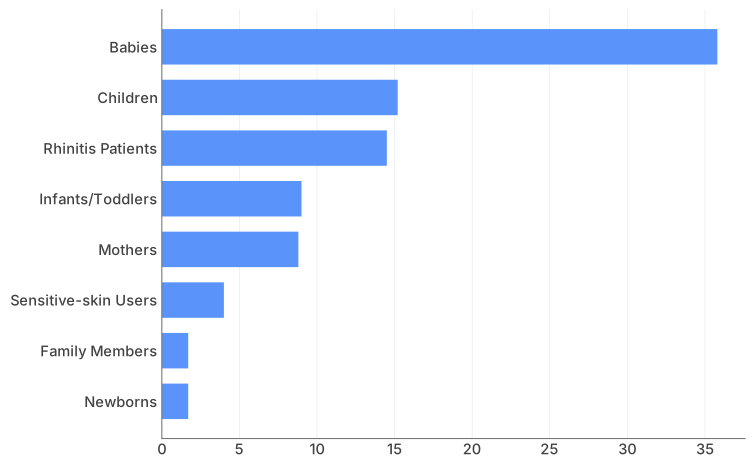
Analysis of consumer reviews on a leading Chinese marketplace shows that moisturizing tissue remains mainly a baby-care product, with babies, infants and young children accounting for approximately 60% of all demographic mentions in product reviews[1].
Babies, infants and young children account for about 60% of demographic mentions in reviews
Key Takeaways#
- Consumer opportunity: Rhinitis patients (14.5% of mentions) and sensitive-skin users (4.0%) are groups beyond the baby-care positioning that brands have so far done little to reach
- Strategic implication: Premium brands need to differentiate on ingredients and brand equity, while value brands can win share through competitive pricing and content commerce
About the Data#
This analysis is based on Moojing Market Intelligence's proprietary e-commerce database, covering sales transactions, product listings and pricing on four leading Chinese marketplaces. MAT2025 refers to the Moving Annual Total from September 2024 through August 2025, and the market figures are for the four marketplaces together. Consumer review analysis covers the MAT2025 period and specified product listings on one of the four marketplaces.
[1] Source: Moojing Market Intelligence, MAT2025 e-commerce data.
This content adheres to Moojing's editorial standards .


