From Babies to Pets: China's Nine-Quarter Conversation Shift
 By Jessie Wang
7 min read
By Jessie Wang
7 min read
Executive Summary#
Get the Full Report: Download the complete analysis for detailed data, methodology, and pages of insights.
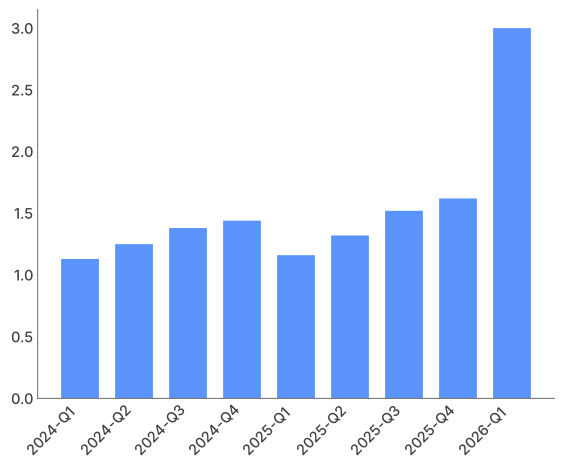
Across nine consecutive quarters of multi-platform social listening, the ratio of pet-related posts to baby and maternity posts in China has expanded from 1.13× in Q1 2024 to 3.00× in Q1 2026. The defensible standalone signal — the like-for-like Q4 2024 to Q4 2025 window — moved from 1.44× to 1.62×, a +12.5% expansion that removes any seasonal explanation. Pet conversation is not displacing baby conversation through brand competition; it is absorbing the cultural attention, emotional investment, and discretionary budget that historically flowed toward the maternity vertical. For brand-marketing teams that have anchored growth plans to baby and infant-care, this is the prompt for portfolio recalibration.
The Headline Trend: Parity in 2024, Dominance by 2026#
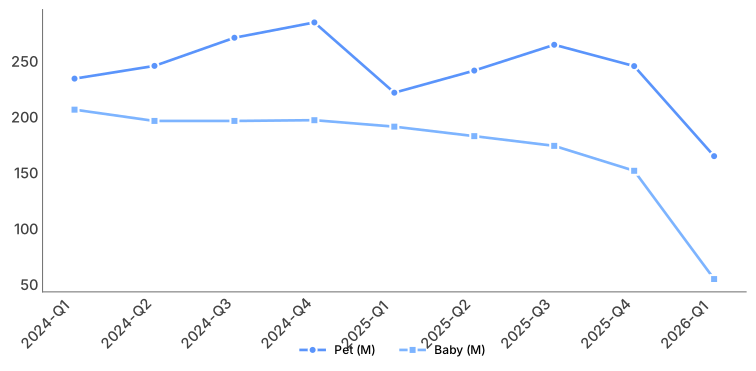
The single most important data point in Moojing's nine-quarter analysis is the steady expansion of the pet-to-baby conversation ratio. In Q1 2024, China's pet vertical sat at near-parity with baby and maternity content: 234.3 million pet posts against 206.5 million baby posts across mainstream e-commerce platforms and adjacent social channels. By Q4 2025, the gap had widened to 245.5 million pet posts versus 151.8 million baby posts. The Q1 2026 reading — 164.9 million pet posts against 54.9 million baby posts — extends the trajectory further, although the partial-quarter window and a methodology adjustment on the baby-keyword set warrant the caveat we discuss below.
Treat this as a macro signal, not a brand-level story. The cultural conditions that built the China baby category over the past two decades — emotional investment, premium positioning, gift-giving rituals, generational anxiety — are now expressing themselves through the pet category at a meaningfully higher growth rate. The post-1995 and post-2000 cohorts that lead Chinese social conversation are choosing to publish, share, and engage around pets more frequently than around infants. Goldman Sachs has projected that urban pets will outnumber young children two-to-one by 2030; in tier-1 cities, that threshold has already been crossed.
Quarter by Quarter: A Widening Gap#
The quarterly volume series reveals a story of widening differentiation rather than collapse. Pet conversation peaked at 284.6 million posts in Q4 2024, eased to 245.5 million in Q4 2025 (still well above the Q1 2024 baseline), and printed 164.9 million in the partial Q1 2026 window. Baby and maternity conversation peaked at 206.5 million in Q1 2024, drifted through the high-180s and 170s across 2024-2025, and registered 54.9 million in Q1 2026.
The pet line has held its multi-quarter average at roughly 250 million posts. The baby and maternity line is rebalancing toward a lower steady-state baseline, having shed about a third of its peak before the Q1 2026 step-change. Each of the past four like-for-like quarters has expanded the gap, and the directional consistency removes the easy explanation that any single quarter is a seasonal artefact.
Pet conversation has eclipsed baby conversation across nine quarters
The ratio has tripled in eight quarters
The Methodology Caveat: Why Q1 2026's 3.00× Carries Disclosure#
The Q1 2026 jump from 1.62× to 3.00× includes both a real structural reallocation and a partial methodology effect that we want to surface clearly. The pet series is sourced from a stable category CID across the social-listening footprint. The baby and maternity series uses a keyword set (母婴/婴儿奶粉/纸尿裤/宝宝) that experienced coverage drift during the Q1 2026 window as platforms reorganised their parenting taxonomy. The pet line is a clean apples-to-apples read; the baby line carries a partial undercount in the most recent quarter.
For that reason, the defensible standalone signal for citation in external collateral is the +12.5% expansion of the ratio across the like-for-like Q4 2024 to Q4 2025 window — 1.44× to 1.62×. That movement sits comfortably inside the stable methodology band and is sufficient on its own to support the strategic conclusion. The Q1 2026 figure usefully extends the directional story but should be read as indicative rather than headline-defensible.
This is also the disciplined way to present the chart to a CFO or board audience: lead with the multi-year trajectory that holds under any reasonable methodology stress test, then disclose the most recent quarter's caveat alongside it. Confidence in the trend should not depend on the Q1 2026 print.
What This Means for Brand-Marketing Teams#
A 1.6× ratio is a category preference. A 3.0× ratio is category dominance. Most pet-versus-baby allocation decisions made in 2024 were predicated on parity assumptions, and under any reasonable extrapolation of Q4 2025's 1.62× ratio, those allocations need updating in 2026.
Three implications follow for brand-marketing leaders.
First, the cohort that drives Chinese social conversation has shifted its emotional anchor. The post-1995 and post-2000 women who set the agenda on mainstream e-commerce platforms and adjacent content channels are publishing pet content at three times the rate of baby content. Reallocating brand-marketing capital from baby-anxiety creative toward pet-companionship creative is an immediate, low-risk move with measurable share upside.
Second, the strategic question for FMCG parents in baby and infant care is no longer whether to enter pet — it is which pet sub-segment to lead with and at what scale. The cross-vertical migration shows up in capital flows as well as conversation: every Chinese FMCG parent with reportable trajectory data is rebalancing investment toward pet subsidiaries. Companies that wait for ratio confirmation in 2026-Q3 or Q4 will be entering a category in which positioning, content cohorts, and shelf positions are already taken.
Third, the trade-off between baby and pet budget allocation has flipped from theoretical to operational. In planning conversations through 2024, this was a directional thesis. Today it is a pricing and inventory decision. Brand teams should model their 2026 share-of-voice spend against the conversation share they are actually achieving, not against the historical baseline they inherited.
Key Takeaways#
- China's pet-to-baby conversation ratio has expanded from 1.13× in Q1 2024 to 3.00× in Q1 2026 across nine quarters of multi-platform social listening
- The headline-defensible like-for-like signal is Q4 2024's 1.44× to Q4 2025's 1.62× — a +12.5% expansion that holds under any methodology stress test
- Pet conversation has held its multi-quarter average at roughly 250 million posts; baby and maternity is rebalancing toward a lower steady-state baseline
- The Q1 2026 reading of 3.00× includes both a real structural reallocation and a partial methodology effect from baby-keyword coverage drift
- For brand-marketing teams, the trade-off between baby and pet budget allocation has flipped from theoretical to operational
About the Data#
Moojing Market Intelligence analyses pet and baby/maternity conversation across mainstream e-commerce platforms and adjacent social channels. The pet series is sourced from a stable category CID; the baby and maternity series uses a Mandarin keyword set covering 母婴, 婴儿奶粉, 纸尿裤, and 宝宝. Volumes are reported in millions of posts per quarter from Q1 2024 to Q1 2026. The Q1 2026 baby and maternity reading reflects a partial methodology adjustment as platforms reorganised their parenting taxonomy; the pet series carries no such adjustment. For external citation, we recommend leading on the like-for-like Q4 2024 to Q4 2025 trajectory (1.44× to 1.62×). All figures: Source: Moojing Market Intelligence.
More from This Report#
This article is part of our report series:
Download the Full Report#
Get the complete analysis with detailed data, methodology, and additional insights.
This content adheres to Moojing's editorial standards .


