China Probiotics on Leading Marketplaces: CN¥ 8.27B, +18.1%
 By Jotham Lim
6 min read
Newer data: China GI Health Supplements Reach CN¥ 3.88B in 2025
Executive Summary#
Online probiotics dietary supplement revenue across several leading Chinese marketplaces reached CN¥ 8.27 billion in MAT2023, growing 18.1% YoY[1], driven by expanding consumer health awareness and a broadening base of online distribution. By MAT2023 the category had compounded through two consecutive double-digit years, adding CN¥ 1.45 billion of revenue between MAT2021 and MAT2022 and a further CN¥ 1.27 billion into MAT2023. Within that total, the probiotics-specific category accounts for 65.8% of dietary supplement segment revenue and came to CN¥ 5.44 billion in MAT2023. Every price tier in it expanded in MAT2023 with the premium tiers growing fastest, and jelly dosage forms grew 5,785% YoY from a near-zero base, which suggests that consumers are open to snack-like consumption formats.
Download Full Report#
Get the complete analysis with additional data, methodology details, and brand-level insights.
Market Scale: Two Consecutive Double-Digit Growth Years#
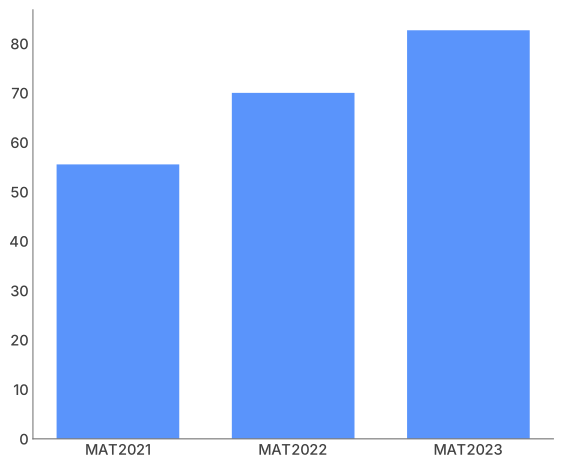
Online probiotics dietary supplement revenue rose from CN¥ 5.55 billion in MAT2021 to CN¥ 7.00 billion in MAT2022 (+26.1%), and on to CN¥ 8.27 billion in MAT2023 (+18.1%)[1]. Two consecutive years of double-digit expansion is unusual in a supplements sub-segment that used to sit alongside general nutrition. We believe the growth is coming from a broadening base of products and buyers, with no single product cycle behind it.
The structural driver is what the category itself demands of fulfilment. Probiotics are temperature-sensitive, and their perceived efficacy depends on culture viability at the point of consumption, so fulfilment quality is part of what the shopper is buying. In practice the category asks the same things of any seller. These are short transit times with cold-chain-aware handling from warehouse to doorstep, storage guidance that holds up through the last mile, and product pages that explain strain, dose and shelf life at the point of purchase. For brands planning a China supplements launch, these belong in the launch plan alongside audience reach and are hard to resolve after listing. Coverage here spans several leading Chinese marketplaces and does not cover the whole market, so the totals above should be read as a large, representative share of online demand and not as a census.
Category revenue compounds to CN¥ 8.27 billion across three rolling years
Premiumization Accelerates Above CN¥ 500#
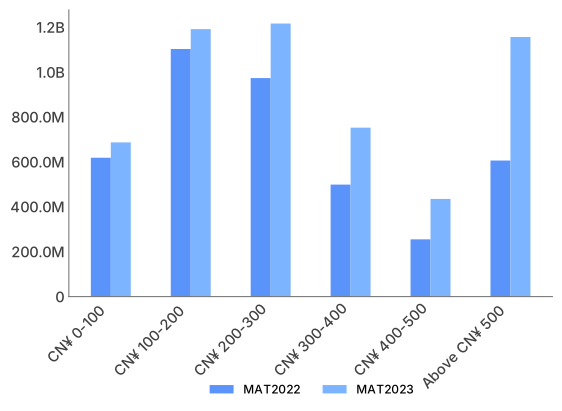
The above-CN¥ 500 price segment grew fastest, rising from CN¥ 257 million in MAT2021 to CN¥ 1.16 billion in MAT2023, representing approximately 90.8% YoY growth in MAT2023[1]. The two tiers immediately below it moved the same way: CN¥ 400-500 grew 70.5% YoY and CN¥ 300-400 grew 50.9% YoY, while CN¥ 200-300, the largest tier by revenue in MAT2023 at CN¥ 1.22 billion, added 25.0%.
This premiumization is driven mainly by multi-box packaging, where merchants bundle several units into higher-value SKUs, which raises the Average Selling Price (ASP) while offering consumers perceived bulk-purchase savings, and per-unit prices have changed much less. Key dynamics include:
- Multi-box bundles elevate average transaction values above CN¥ 500
- Every price tier expanded in MAT2023, so premium demand is adding to the value base without displacing it
- CN¥ 200-300 roughly doubled and CN¥ 300-400 more than tripled their revenue contribution since MAT2021
- Subscription-based packaging emerges as a premium justification strategy
The tiers below cover the probiotics-specific category, which came to CN¥ 5.44 billion in MAT2023 (the 65.8% share cited above), and not the full CN¥ 8.27 billion headline, so they sum to less than that total. The entry tier below CN¥ 100 also grew in MAT2023, which matters for positioning, since the market is adding premium options above an established value tier while still serving price-sensitive consumers. We believe brands entering the category can treat the CN¥ 200-400 band as the realistic price range for a first SKU, and use bundles more than a higher unit price to move into the premium tiers.
Every price tier expands in MAT2023, with the premium tiers growing fastest
Dosage Form Innovation: Jelly Grows 5,785% YoY#
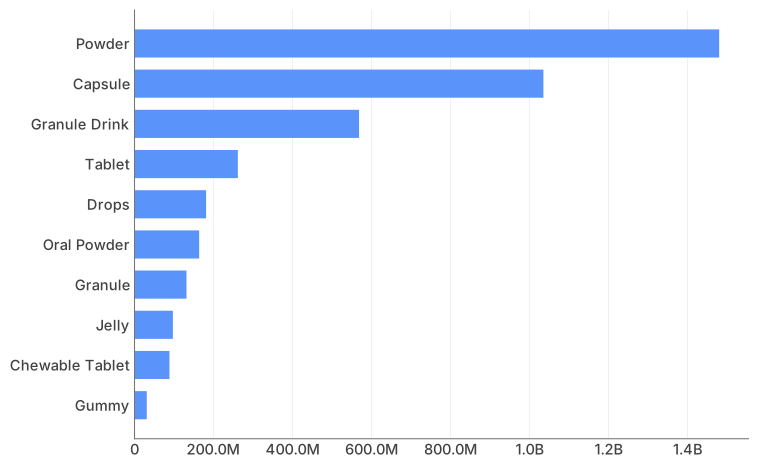
The jelly format grew 5,785% YoY, reaching CN¥ 97 million in MAT2023[1], from a near-zero base, which shows how quickly snack-like product forms can win consumer attention in the supplements category. Other emerging formats moved the same way, as oral powder grew 274.7% YoY, chewable tablets 174.4%, gummies 88.9% and drops 119.5%, the last driven by demand for precise dosing in infant probiotics.
Powder remained the largest format, with CN¥ 1.48 billion in MAT2023 and +29.6% YoY growth. Capsules followed at CN¥ 1.04 billion (+23.3% YoY), granule drinks at CN¥ 568 million (+27.6% YoY) and tablets at CN¥ 262 million (+43.3% YoY). Together, powder and capsule account for more than three-fifths of the revenue across the dosage forms shown here, at CN¥ 2.52 billion of CN¥ 4.04 billion. The established formats were still growing solidly while a long tail of newer forms scales from a much smaller base. The forms charted below do not make up the whole category, since they sum to CN¥ 4.04 billion against the probiotics-specific category's CN¥ 5.44 billion, with the remainder spread across forms outside this set. We believe incremental growth will increasingly favour formats that combine functional efficacy with convenience.
Two traditional formats anchor category revenue, with a long tail of emerging forms
Key Takeaways#
- Online probiotics revenue across leading Chinese marketplaces reached CN¥ 8.27 billion in MAT2023, growing 18.1% YoY, after 26.1% the year before
- Within that total, the probiotics-specific category accounts for 65.8% of dietary supplement segment revenue, at CN¥ 5.44 billion in MAT2023, and is the base for the price tiers above
- The above-CN¥ 500 price segment grew approximately 90.8% YoY to CN¥ 1.16 billion, driven mainly by multi-box bundling
- Every price tier expanded in MAT2023, so premiumization is adding to the value tier without replacing it
- The jelly format grew 5,785% YoY from a near-zero base, which points to consumer interest in snack-like supplement forms
## About the Data
This analysis draws on Moojing Market Intelligence data covering MAT2023 (rolling annual period ending January 2023). Moojing analyses brand and category performance across major Chinese e-commerce platforms. Coverage for this analysis spans several leading Chinese online marketplaces and the online channel only; it is not a whole-market census. For full methodology and additional insights, see the complete Probiotics Dietary Supplements whitepaper.
This content adheres to Moojing's editorial standards .


