China's Rice Sauce Market Rides Health and Flavor Trends
 By Quan Wenjun
7 min read
By Quan Wenjun
7 min read
Executive Summary#
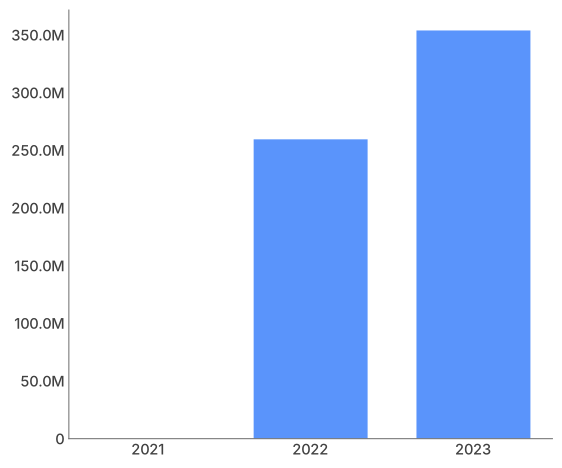
Health-conscious positioning is penetrating China's traditionally flavor-heavy rice sauce segment at an accelerating pace, with low-fat products growing 177.0% year-over-year (YoY), oil-free 91.9%, and additive-free 71.2% on a leading Chinese content-commerce marketplace [1]. Rice sauce sales on that marketplace reached CN¥ 354 million in 2023, up 36.4% YoY from a standing start two years earlier. This analysis examines the channel's emergence, the competitive structure it has produced, the flavor trends riding on it, and the health innovation opportunity reshaping this high-growth niche.
Download Full Report#
Get the complete analysis with additional data, methodology details, and brand-level insights.
Download the Full Seasonings & Condiments Market Whitepaper →
Channel Emergence: Content Commerce Enters the Rice Sauce Segment#
Between 2021 and 2023 the rice sauce segment acquired an entirely new route to the consumer. Rice sauce had no measurable presence on content commerce in 2021. By 2023 the category was turning over CN¥ 354 million a year on a single leading Chinese content-commerce marketplace, with +36.4% YoY growth between 2022 and 2023.
The mechanism is specific to what this product has to communicate. Rice sauce is a high-frequency, low-consideration condiment whose value sits in what it does to a bowl of rice or a plate of noodles rather than in the jar itself. What a shopper needs in order to judge it is therefore practical: how it is used, how much goes in, and what the result looks like. Video answers that in the form the question is asked: a fifteen-second preparation clip shows use, portion and result in a single pass, and recipe content gives the category an occasion to appear in a feed at all. Demand for rice sauce spans both catalogue-led and content-led discovery, and what the category has to supply in either is the same thing: a use case that can be shown.
This is a finding about where demand is discovered, not about how large the segment is overall: the figures here describe one content-commerce marketplace and are not a whole-market total. What the content surface added was a discovery route the category could use, and the categories that use it best are those with a demonstrable use case and a low price point.
Content-commerce rice sauce sales reached CN¥ 354 million in 2023, up 36.4% YoY
Competition Fragments as Challengers Scale#
The segment has no entrenched leader. Concentration among the largest sellers eased between 2022 and 2023, and share is distributing across a widening set of sellers rather than consolidating behind incumbents, which is the structural signature of a category whose distribution is still being re-decided.
The challenger playbook is consistent. A newcomer establishes itself with a single hero product built around one legible ingredient claim, seeds it through creator content, and cross-posts the same material to lifestyle-sharing platforms so that search-led and feed-led discovery reinforce each other. Because the hero product carries the seller, an ingredient niche can be built from nothing inside a single year, and the ingredient data below shows this happening in several segments at once.
The consequence for established sellers is a second asset base to build. Distribution in the content-led channel is decided by content performance rather than by catalogue position. The capability it asks for is therefore a creative one: the same asset working across short-video commerce and lifestyle-sharing feeds, produced at a cadence a feed will carry. For sellers with long-standing shelf presence and search ranking, that is an additional capability to build, not a substitute for the ones they already run.
Spicy Fragrant Flavor Surges on Content Virality#
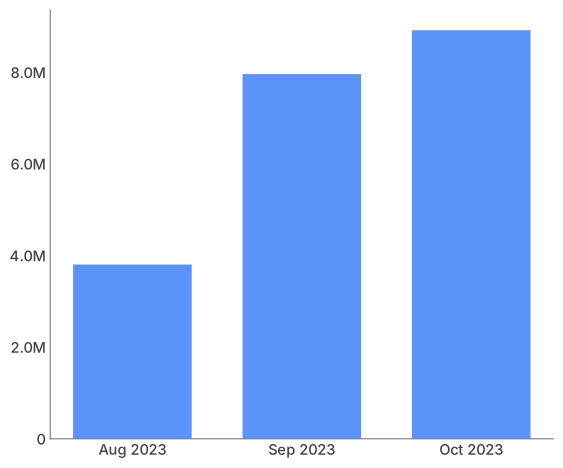
"Spicy" occupies a dominant position in the rice sauce category on the marketplace covered. Within the spicy flavor family, "spicy fragrant" showed a dramatic inflection in September–October 2023, with monthly sales rising from CN¥ 3.8 million in August to CN¥ 8.0 million in September and CN¥ 8.9 million in October.
The acceleration was driven by a challenger seller's viral Hunan-style hot-and-sour chicken-offal rice sauce. Its own social accounts produced the content that carried it, and the effect did not stay with the product. A single viral item pulled an entire flavor descriptor into the feed, and demand followed at the level of the flavor rather than the seller. This is what makes feed-led demand hard to plan for, because the beneficiary is the descriptor and not necessarily the product that started it.
Spicy fragrant monthly sales more than doubled between August and September 2023
Ingredient Innovation: Beyond Shiitake and Beef#
Shiitake mushroom and beef dominate the content-commerce rice sauce ingredient landscape, generating CN¥ 61.4 million and CN¥ 54.7 million respectively. However, the fastest-growing ingredients tell a different story: peanut surged 353.2%, scallion oil expanded 239.8%, and double pepper grew 288.6%, signaling consumer appetite for flavor diversification.
Shiitake mushroom leads rice sauce ingredients at CN¥ 61.4 million; peanut grows 353.2%
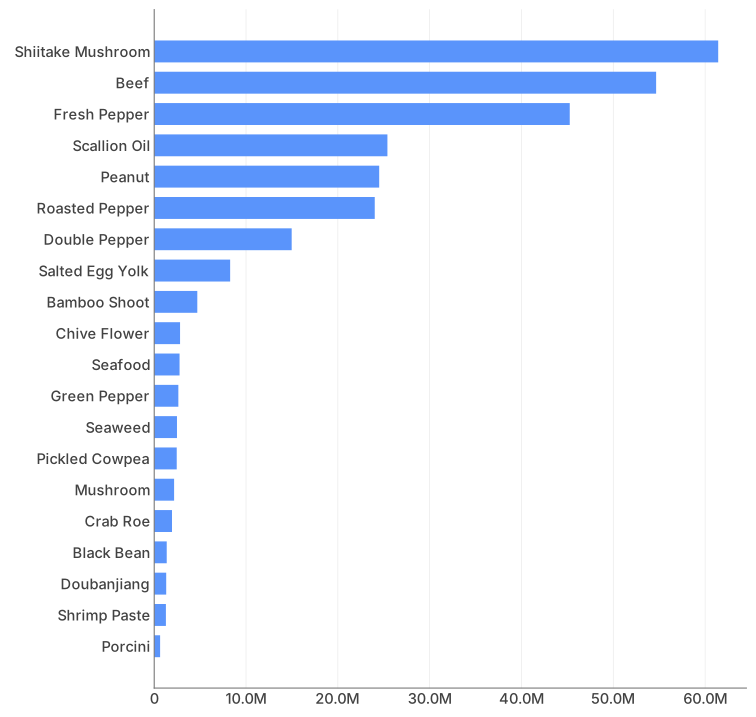
Emerging premium ingredients such as porcini (+578.6%) and crab roe (+191.4%) point to a premiumization trend, as sellers introduce higher-value ingredients to differentiate products and justify a higher price point. The pattern to watch is how quickly a new ingredient can be established, more than which one wins. The head of the ingredient distribution is stable, while the tail is turning over fast enough that a niche built in one year can be a mainstream flavor claim the next.
Health Trends Penetrate the Flavor-Heavy Segment#
Three health-related product concepts demonstrated triple-digit or near-triple-digit growth on the content-commerce channel in 2023:
- Low-fat: +177.0% YoY growth, typified by chicken-breast-based sauces sold on reduced fat content
- Oil-free: +91.9% YoY growth, from oil-free chili sauces positioned for both rice and noodle use
- Additive-free: +71.2% YoY growth, from zero-fat, additive-free formulations pitched at all age groups
This health trend convergence aligns with consumer review analysis, which identified "too salty" as a persistent taste complaint. Reformulation toward reduced sodium could address both health concerns and taste dissatisfaction simultaneously. The precedent of reduced-salt light soy sauce, which has established itself as a mainstream product variant, suggests that health-positioned rice sauce products can achieve meaningful market share if they maintain satisfactory taste profiles. China's "Healthy China 2030" national strategy, which targets reduced sodium intake to below 5 grams per day [2], provides a favorable regulatory tailwind for reduced-salt and low-fat condiment formulations.
Social media listening reveals growing demand from middle-aged and elderly consumers, fitness enthusiasts, and convenience-seeking office workers [3]. These demographic clusters represent distinct targeting opportunities: health and nutrition messaging for older consumers, macronutrient optimization for fitness enthusiasts, and convenience and value for students and office workers.
Key Takeaways#
- Rice sauce on a leading Chinese content-commerce marketplace reached CN¥ 354 million in 2023, +36.4% YoY, from no measurable presence in 2021
- Concentration among the largest sellers eased and the segment has no entrenched leader, leaving the category open to challengers
- A single viral product lifted the "spicy fragrant" flavor from CN¥ 3.8 million in August 2023 to CN¥ 8.9 million in October
- Health-positioned products surged: low-fat +177.0%, oil-free +91.9%, additive-free +71.2%
- Emerging ingredients such as peanut (+353.2%) and porcini (+578.6%) indicate premiumization and flavor diversification
More from This Research#
About the Data#
This analysis draws on Moojing Market Intelligence data covering 2021-2023. Moojing analyses brand and category performance across major Chinese e-commerce platforms. Channel-level figures in this article describe a single leading Chinese content-commerce marketplace and are not a whole-market total. For full methodology and additional insights, see the complete Seasonings & Condiments whitepaper.
For inquiries, contact us at info@moojing-global.com or visit moojing-global.com. Follow us on LinkedIn.
This content adheres to Moojing's editorial standards .


