China Robot Vacuums Hit CN¥ 13.5B on Premium Shift
 By Quan Wenjun
7 min read
By Quan Wenjun
7 min read
Newer data: China's Online Home Appliance Sales Hit CN¥ 766B in 2025
Executive Summary#
China's robot vacuum market reached CN¥ 13.52 billion in the 2024 rolling year (+12.2% YoY), making it approximately 16 times larger than the next biggest smart device segment. A decisive premiumization shift is underway: mid-to-high-end products grew 16.8% YoY to CN¥ 11.27 billion, while the budget tier finished the year below its prior-year level. Moojing Market Intelligence (魔镜洞察) data also shows demand moving upward within the premium tier itself, and consumer priorities differing sharply by household type. This analysis examines market dynamics, the gap between the premium and budget tiers, the competitive structure behind it, and the preferences of different consumer groups.
Download Full Report#
Get the complete analysis with additional data on all five smart device segments, brand-set analysis, and product-level consumer sentiment.
Market Overview: Growth Moderates but Demand Persists#
Robot vacuum trailing-year sales across the leading Chinese online marketplaces covered by this analysis reached CN¥ 13.52 billion (+12.2% YoY), though H1 2024 growth moderated to 6.3% YoY. The market is still expanding, but the rate is easing as household penetration matures. We believe the category is moving from a phase in which most sales went to first-time buyers into one in which growth increasingly has to come from households replacing or upgrading a machine they already own.
Demand is also heavily seasonal, and increasingly concentrated in the autumn promotional window. November is comfortably the largest month of the year for the category, and in 2023 the build-up began earlier than the year before, spreading purchasing across an extended October-November period instead of a single peak week. For brands, this means planning for how early in the autumn consumers make their November purchase decisions, as well as for how much can be sold in November itself.
Premiumization: The Defining Market Shift#
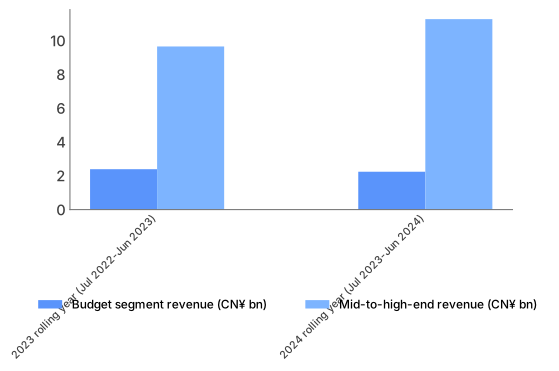
Mid-to-high-end robot vacuums, priced above CN¥ 3,000, with suction above 2,700 Pa and battery above 5,200 mAh, reached CN¥ 11.27 billion in trailing-year sales (+16.8% YoY). The budget tier finished the 2024 rolling year at CN¥ 2.24 billion, against CN¥ 2.39 billion a year earlier. The resulting revenue split of roughly 5:1 in favour of premium products shows that Chinese consumers are willing to invest significantly more for advanced cleaning technology.
Mid-to-high-end robot vacuums reached CN¥ 11.27 billion in the 2024 rolling year, +16.8% YoY
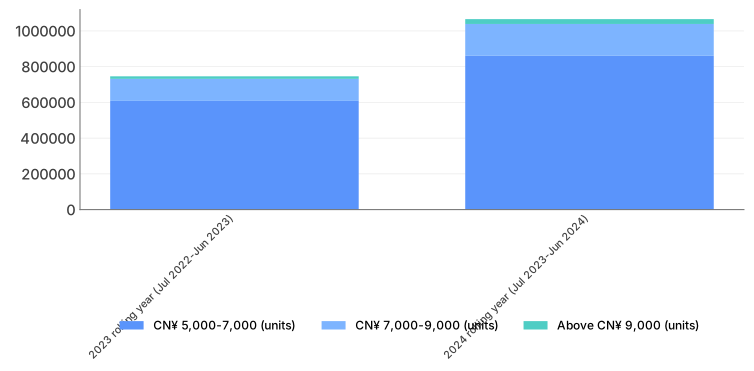
Within the mid-to-high-end segment, the move toward higher price bands is accelerating, and we read it as additional demand, since the buyers in the entry premium band have not moved away from it. Unit sales in the CN¥ 5,000-7,000 band rose from roughly 608,000 to 861,000 across the rolling year (+41.5%), the CN¥ 7,000-9,000 band went from about 123,000 to 178,000 units (+44.5%), and the small niche above CN¥ 9,000 roughly doubled, from about 14,000 to 27,000 units (+92.2%). Taken together, bands above CN¥ 5,000 accounted for about 1.07 million units, up from about 746,000. Over the same period the entry CN¥ 3,000-5,000 band was essentially flat, at -3.1% in units, which shows that consumers are choosing increasingly premium machines within the premium segment itself while the entry price point keeps its buyers.
Unit demand above CN¥ 5,000 grew about 43% year on year, led by the CN¥ 5,000-7,000 band
November promotional periods show the widest gap between the premium and budget tiers of the year. During the Singles' Day window the mid-to-high-end tier takes a far larger share of category revenue than it does across the year as a whole. We believe this suggests that promotional events serve mainly as triggers for premium purchase decisions that consumers have already considered, since the discount is what makes a CN¥ 5,000 machine feel affordable. They do much less to drive impulse purchases of budget models such as a CN¥ 1,500 one.
Competitive Structure: Innovation and Ecosystems Shape Growth#
Sales in the segment are concentrated among a small group of large brands, and concentration rose further over the rolling year, more so inside the mid-to-high-end tier than in the market as a whole. Positions within that group are still changing, and two forces explain most of the movement.
Feature-led differentiation. The models driving premium growth compete on an explicit list of capabilities, including tangle-free brush systems, automatic mop re-washing, sterilisation, camera-based obstacle avoidance and mopping mechanisms that keep the cloth in continuous contact with the floor. Where a genuinely new mechanism has reached the market, it has turned into rapid volume gains from a small base, which is how challenger brands have grown in the segment without matching the distribution or marketing spend of established brands.
Ecosystem leverage. Part of the entry tier is made up of models that connect to a smart-home ecosystem, where the vacuum is bought as one device in a wider connected-home setup and less on its own specification. Above CN¥ 5,000, consumers choose mainly on cleaning mechanism and autonomy, and app compatibility weighs less in their decision.
The practical implication is that growth in this category depends on a clear reason to buy. Without either a differentiated mechanism or a place in a connected-home ecosystem, a new entrant is left competing on price in the one tier that is not growing.
Demographic Divide: Elderly vs. Pet-Owning Consumers#
Consumer reviews reveal distinct priorities between elderly users and pet-owning households. Smart features dominate for both groups, but secondary priorities diverge significantly.
Pet-owning households prioritize smart features (41.8%) and cleaning performance (23.6%), with noise level a notable concern at 8.3%, which reflects worry about frightening animals. Pet owners specifically value obstacle avoidance that prevents the robot from bumping into pets, pet-hair-specific cleaning, and cameras for checking on pets remotely. Consumer feedback highlights: "Can remotely watch pets and serves as a video monitoring device."
Elderly users show a distinctly different profile. While smart features still lead at 43.1%, convenience ranks second at 16.0%, more than double the proportion seen in pet-owner reviews (7.2%). Elderly users favor voice control (14.6% vs. 5.4% for pet owners) and APP operation (14.1% vs. 5.2%), which reflects their need for hands-free and remotely guided cleaning. Consumer feedback specifically mentions: "Voice and app remote control, very friendly for seniors."
These differences between household types have direct implications for product design and marketing, and we believe a single approach to positioning robot vacuums misses part of the opportunity. Brands targeting elderly households should invest in voice recognition accuracy and simplified interfaces, while those targeting pet owners should develop enhanced obstacle detection and dedicated pet-hair cleaning modes.
Key Takeaways#
- Robot vacuums reached CN¥ 13.52 billion (+12.2% YoY), with H1 2024 growth moderating to 6.3% as the market matures
- Mid-to-high-end products grew 16.8% YoY to CN¥ 11.27 billion, while the budget tier ended the year at CN¥ 2.24 billion against CN¥ 2.39 billion a year earlier, a decisive premiumization shift
- Unit sales above CN¥ 5,000 grew about 43% year on year, to roughly 1.07 million units from about 746,000, led by the CN¥ 5,000-7,000 band at +41.5%, while the entry CN¥ 3,000-5,000 band held roughly flat at -3.1%, so the premium shift adds demand without drawing buyers away from the entry band
- Growth is going to differentiated cleaning mechanisms at the top of the range and to ecosystem-connected models at the bottom, and undifferentiated products in the middle have no obvious route in
- Elderly and pet-owning consumers show distinct priorities, convenience for the first and noise levels for the second, which creates an opportunity for positioning aimed at each group
More from This Report#
About the Data#
This analysis draws on Moojing Market Intelligence data covering the 2024 rolling year (July 2023 to June 2024), with the prior rolling year (July 2022 to June 2023) as the comparison base. The dataset covers two leading Chinese online marketplaces. Moojing analyses brand and category performance across major Chinese e-commerce platforms. For full methodology and additional insights, see the complete Smart Devices whitepaper.
This content adheres to Moojing's editorial standards .


