China's Sportswear Market: Positioning, Channel Breadth and the Women's Growth Engine
 By Jotham Lim
8 min read
By Jotham Lim
8 min read
Newer data: China's Online Sportswear Sales Hit CN¥ 168.3B in 2025
Executive Summary#
China's sportswear market reached CN¥ 385.8 billion in 2023, and the competitive question inside it is no longer who has the widest distribution. Two structural forces are doing most of the sorting. The first is positioning: among the largest brands in the market, average transaction values differ by more than 2.5x, which means premium lifestyle lines and mass-market performance lines are effectively addressing different consumers rather than competing for the same one. The second is channel breadth: growth is arriving fastest through content-driven commerce, but it is most durable for the brands that grow across several storefront types at once. Alongside both, women's dedicated sportswear has become the market's growth engine, reaching CN¥ 29.80 billion in online sales (+8.4% YoY), while demand inside footwear rotates toward running, chunky sneakers and walking shoes. This analysis examines the segment and category dynamics reshaping competitive strategy across the category.
Positioning Beats Distribution Breadth#
The most instructive competitive lesson in China's 2023 sportswear market is that the scale of a brand's distribution no longer predicts its growth. Two of the largest brands in the market -- selling in the same categories, frequently on the same storefronts -- sit more than 2.5x apart in average transaction value. That is not a rounding difference in product mix. It means premium lifestyle positioning and mass-market performance positioning are addressing effectively separate segments, with different price expectations, different purchase triggers and different competitive sets, even where the two brands appear side by side in a search result.
The consequence shows up in where growth comes from. Content-driven commerce is the single fastest-expanding route to market: across the storefronts observed for two of the largest brands, all four content-platform storefronts grew by more than 100% year on year. But precisely because that lift showed up on every content storefront observed, it does not separate performers from the field. What separates them is whether growth appears on marketplace storefronts at the same time. A brand whose expansion is confined to one channel type is riding a lift the whole observed set shared. A brand growing simultaneously on marketplace and content-led storefronts is demonstrating brand equity that generates demand wherever the consumer happens to be shopping.
For category managers the practical read is that channel strategy and positioning are the same decision, not two. A premium proposition travels across channels because the consumer is seeking the brand and will follow it. A price-led proposition travels only to wherever traffic is currently cheapest, which leaves it exposed the moment a platform's economics shift.
Market Structure: Concentrated, but With No Runaway Leader#
The shape of the leading group explains why positioning matters so much. Among the ten largest brands in online sportswear, five hold between 6% and 13% of online sales and the other five sit between 2% and 3%. There is no dominant incumbent setting terms for the category and no brand approaching the kind of share that would let it absorb a strategic mistake. The leading group mixes international and domestic names, and the distance between its members is small enough that a single strong year or a single missed product cycle moves a brand's standing within it.
Below that group the market is more fragmented, and it is where some of the clearest growth is happening. Two brands in the second tier grew by more than 10% year on year, both by combining accessible pricing with a focus on running shoes. That is a reminder that share in this category is not defended by size. It is defended by having a reason for the consumer to choose you, at a price that matches the reason.
Concentration is therefore moderate rather than decisive. For a challenger brand, the practical implication is that the ceiling is not set by an entrenched leader. It is set by how sharply the brand can define a segment and how consistently it can show up in the channels that segment uses.
Women's Sportswear: The Growth Engine Brands Cannot Ignore#
Women's dedicated sportswear reached CN¥ 29.80 billion in online sales (+8.4% YoY) in 2023, with growth outpacing the men's-dedicated segment in every quarter of the period. The structural shift is visible in the mix: the men's-dedicated share eased from 41.9% to 39.4% between Q1 2022 and Q4 2023 while unisex products expanded from 37.9% to 41.5%. Women's dedicated share held steady at approximately 20% throughout.
Unisex products expand to 41.5% of the gender mix as the market rebalances through 2023
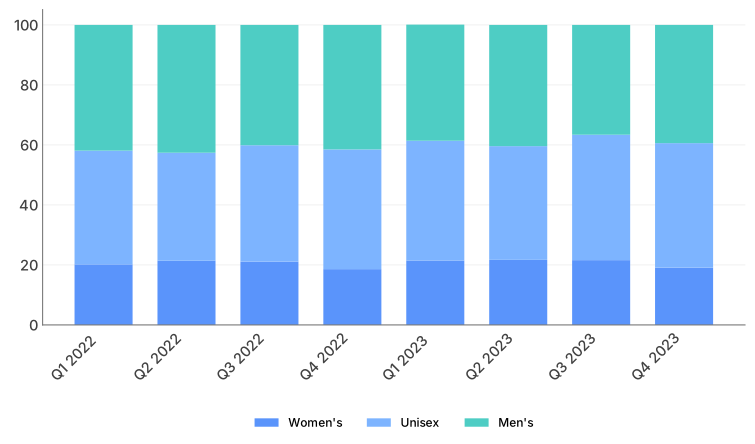
The apparel side of the market is where female consumers weigh most heavily: women account for 43.1% of apparel demand, an outsized influence on that segment specifically. The leading group in women's sportswear has also stopped being closed -- a newcomer has entered a set that had otherwise been stable, which is a signal worth reading. Established brands hold their position in women's products by inheritance of scale; the segment's growth rate is high enough to fund a challenger that gets the proposition right.
That proposition is often a product-development question rather than a marketing one. Sizing and fit are the recurring themes in women's sportswear consumer sentiment, and they are solvable with pattern and grading work rather than with spend. In the market's fastest-growing demographic segment, leaving them unaddressed is an expensive omission.
Category Rotation: Where Demand Is Moving#
Inside footwear, demand is rotating fast enough that assortment decisions made two seasons ago are already being tested. Running shoes delivered +12.2% YoY growth, with the CN¥ 600-800 price segment seeing the largest share increase -- growth in the category is coming from consumers trading up within it, not only from new runners entering it.
Within running, the gains came from both ends of the price ladder. One value-positioned player grew by nearly 50% year on year with a range concentrated in the accessible CN¥ 0-200 segment, while premium specialists anchored at CN¥ 400-600 sustained double-digit growth on the back of a well-received flagship launch. The running market is rewarding clarity at either end and offering little to the undifferentiated middle.
The chunky sneaker phenomenon was the period's sharpest move: +142% YoY to CN¥ 2.5 billion, with the largest brands broadly participating rather than a single label capturing it. Walking shoes grew 76.2%, driven by elderly-focused marketing through content-led livestream channels, which shows precise demographic targeting delivering outsized category returns from a segment most assortments treat as an afterthought.
Rotation at this speed rewards portfolio breadth. A brand anchored to a single silhouette has very little to work with when demand moves to another, and in 2023 the interval in which it could respond was shorter than a development cycle.
Key Takeaways#
- Positioning, not distribution breadth, is doing the sorting: average transaction values among the largest brands differ by more than 2.5x, so premium and mass-market lines are competing for different consumers rather than for the same one.
- Content-driven commerce is the fastest-growing route to market, and all four content-platform storefronts observed across two of the largest brands grew by more than 100%. Because the same lift was visible on every content storefront observed, durable outperformance comes from growing on marketplace and content-led storefronts at the same time.
- The leading group is closely packed: five of the ten largest online brands hold between 6% and 13% of online sales and five sit between 2% and 3%, so no incumbent is positioned to absorb a strategic mistake.
- Women's sportswear reached CN¥ 29.80 billion online (+8.4% YoY) and outpaced the men's-dedicated segment every quarter, while unisex products expanded to 41.5% of the mix -- and sizing and fit remain the segment's recurring product-development gap.
- Category rotation is fast -- running +12.2%, chunky sneakers +142% to CN¥ 2.5 billion, walking shoes +76.2% -- which rewards portfolio breadth over specialisation in any single silhouette.
About the Data#
This analysis is based on Moojing Market Intelligence (魔镜洞察) data drawn from China's mainstream e-commerce and content-commerce platforms. Data covers full-year 2023 with year-on-year comparisons. Share figures are shares of online sales and are not on the same base as the CN¥ 385.8 billion total-industry figure.
Download the Full Report#
Get the complete sportswear analysis -- the full eight-quarter gender mix, the online share structure of the leading group, and the category-rotation detail behind running, chunky sneakers and walking shoes.
More from This Report#
- The market-wide view: category scale, the online gender mix, and where content commerce is taking share (pillar article)
- Positioning versus distribution breadth among the largest brands in the category
- Category rotation inside footwear: running, chunky sneakers and walking shoes
Related reading from an adjacent category: China's outdoor apparel market in 2023
This content adheres to Moojing's editorial standards .
Frequently Asked Questions
The industry is sized at CN¥ 385.8 billion, and the growth inside it is not distributed the way most brands' portfolios are. Women's dedicated sportswear reached CN¥ 29.80 billion in online sales in 2023, up 8.4%, outpacing men's in every quarter of the period. The structural movement shows up in the mix: men's dedicated share moved from 41.9% to 39.4% between Q1 2022 and Q4 2023 while unisex products expanded from 37.9% to 41.5%, with women's dedicated holding steady near 20%. A portfolio still weighted toward men's dedicated product is fishing in the part of the market that is contracting.
Running shoes grew 12.2% year on year, with the CN¥ 600-800 price segment gaining the most ground. Chunky sneakers were the standout at +142% to CN¥ 2.5 billion, cutting across the largest brands rather than belonging to any one of them. Walking shoes grew 76.2%, driven by targeted marketing to older consumers through livestream channels, which makes them a good example of a narrow demographic delivering outsized category returns. Basketball shoes moved the other way at -19.5%, with the CN¥ 1,000+ segment contracting most sharply. A brand whose hero product sits in basketball is differentiated but exposed, because its specialisation points away from where the category is expanding.
The clearest illustration sits inside a single corporate group that runs both a mass-market performance brand and a premium lifestyle brand. Across 2023 the premium brand overtook the mass-market one in online sales despite selling far fewer units, 15.58 million against 40.2 million. The implied average transaction value tells the story: approximately CN¥ 655 versus approximately CN¥ 241, more than 2.5x. The two are not really competing in the same market. The transferable lesson is that premium positioning combined with multi-channel execution has been outperforming distribution breadth in this category, and unit volume is a poor proxy for commercial outcome.
Breadth of channel execution, rather than presence on the fastest-growing one. Content-led commerce is a growth driver for the major brands in the category, so it differentiates nobody; what does differentiate is the ability to grow on marketplace channels at the same time. The stronger performers in 2023 grew across six of the eight channels in the analysis, while weaker ones grew on three. That gap is a question of operating capability rather than of positioning: it takes separate content teams, merchandising tuned to each channel's buying behaviour, and a pricing architecture that survives being visible everywhere at once.


