Tonic Packaging Innovation: Powder Formats Surge 29.4%
 By Quan Wenjun
5 min read
Newer data: Ready-to-Eat Tonics and Gift Boxes Drive China's TCM Product Revolution
Executive Summary#
China's dietary wellness market nearly doubled over the past decade, reaching CN¥ 538.7 billion by 2021, and traditional tonic products are changing their packaging on two leading Chinese marketplaces. Gift-box formats remain the largest, with CN¥ 9.24 billion in sales, while powder formats grew 29.4% year-on-year (YoY) and liquid formats 28.5% YoY, roughly three times faster than traditional packaging. This analysis examines how brands are reinventing centuries-old tonic ingredients through modern packaging aimed at young, urban consumers.
Download Full Report#
Get the complete analysis covering tonic products, unsweetened tea, and dairy packaging innovations across China's health-driven food and beverage market.
A CN¥ 538.7 Billion Market Built on Health Consciousness#
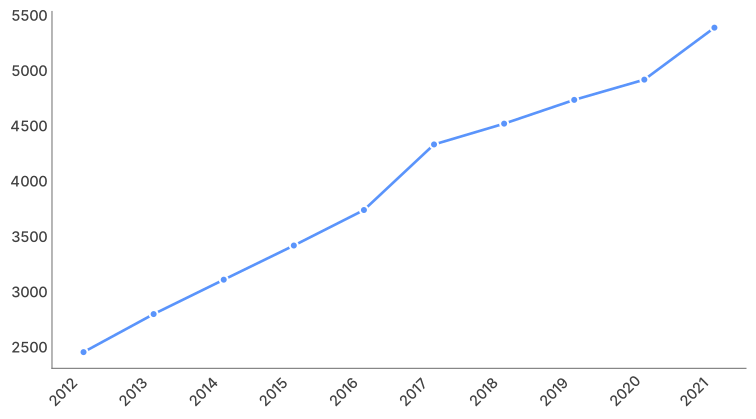
China's dietary wellness market has grown steadily, from CN¥ 245.3 billion in 2012 to CN¥ 538.7 billion in 2021, and we believe this near-doubling reflects consumers' growing commitment to health-oriented food. Growth accelerated notably between 2016 and 2017, when the market expanded by CN¥ 59.3 billion in a single year, which coincided with the announcement of China's "Healthy China 2030" national strategy.
Dietary wellness market doubles from CN¥ 245.3 billion (2012) to CN¥ 538.7 billion (2021)
Urban, Female Consumers Drive the Food-Medicine Homology Trend#
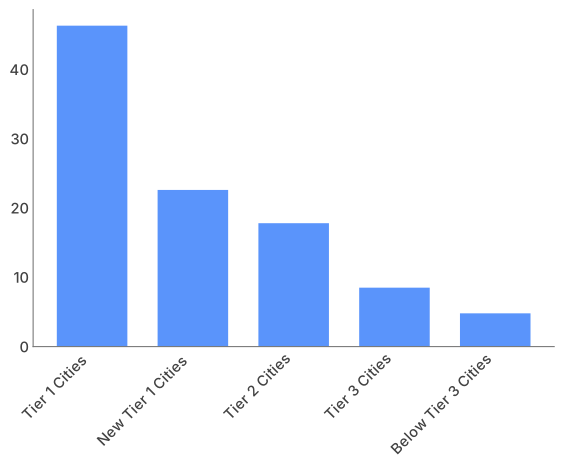
Food-medicine homology products, which contain ingredients from China's traditional catalogue of medicinal foods, are bought mainly in the largest cities. Tier 1 and new Tier 1 cities together account for approximately 70% of the consumer base, with Tier 1 cities alone representing 46.3%. Women make up 54.2% of consumers, which is consistent with wider health and wellness purchasing patterns.
Tier 1 and new Tier 1 cities account for 70% of food-medicine homology users
Powder and Liquid Formats Outpace Gift Boxes by 3x#
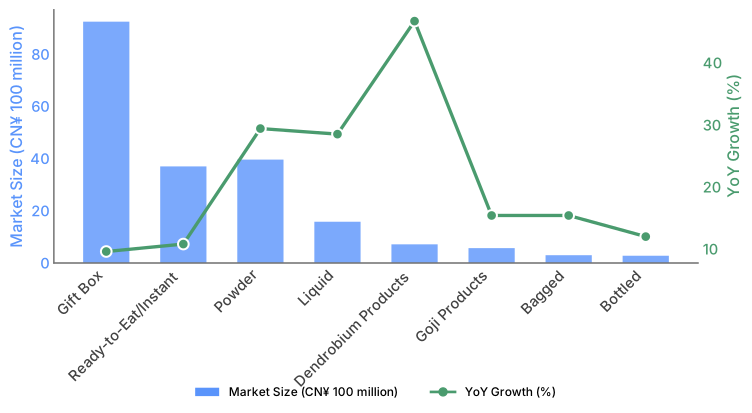
Gift-box packaging still provides most of the revenue for tonic products, with sales of CN¥ 9.24 billion and growth of 9.6% YoY. However, the fastest growth is in modern product forms: powder formats reached CN¥ 3.96 billion, up 29.4% YoY, while liquid formats reached CN¥ 1.58 billion, up 28.5% YoY, so both are growing roughly three times faster than gift boxes.
Gift boxes generate CN¥ 9.24 billion; powder (+29.4% YoY) and liquid (+28.5% YoY) show fastest growth
Case Studies: From Ancient Ingredients to Modern Sachets#
Two brands show how traditional tonic ingredients are being reinvented through packaging.
Guoxiaofan Goji Puree, produced by the established brand Bairuiyuan, turns whole goji berries into a liquid puree packed in individual sachets with straws included. Its "Morning Red, Evening Black Goji Puree" is priced at CN¥ 79 per set, and reviewers praise the sachet format as "very convenient to carry and drink" and its design as "attractive and stylish", which supports the packaging concept.
Nin Jiom Dendrobium Drinks build on the brand's established reputation in throat care to enter the food-medicine homology market. The lemon tea-flavoured Dendrobium granule product (CN¥ 172 per set, 6g x 12 sachets) is positioned around everyday health maintenance instead of acute treatment, and its sales naturally rise in winter, when demand for throat-care products increases.
Five Packaging Design Trends Reshaping Tonics#
Packaging for tonics is developing around five main themes, which reflect a move from packaging that simply holds a product to packaging that communicates its value:
- Premium gift boxes: Target holiday and elder gifting occasions with high-nutritional-value or rare-ingredient products that signal care and filial piety
- Limited-edition gift boxes: Create purchase urgency through seasonal themes and creative designs that appeal to self-gifting consumers
- Convenient gift boxes: Feature individually wrapped, open-and-eat packaging that removes the need for preparation
- Raw material visibility: Transparent bottles directly showcase ingredients, using visual cues to communicate quality and freshness
- Intuitive portioning: Individually packaged designs communicate hygiene and freshness while enabling on-the-go consumption
For brands and packaging manufacturers, we believe the implication is that while the gift-box format provides the revenue base, investment for growth should go to powder and liquid formats, which command premium pricing and meet the demand of younger, urban consumers for convenience.
Key Takeaways#
- China's dietary wellness market nearly doubled over the past decade, reaching CN¥ 538.7 billion by 2021
- Gift-box tonic packaging is the largest format at CN¥ 9.24 billion, but powder (+29.4% YoY) and liquid (+28.5% YoY) formats are growing three times faster
- Tier 1 and new Tier 1 cities account for approximately 70% of food-medicine homology consumers
- Dendrobium products grew 46.7% YoY, with puree formats growing 150% YoY
- Individual sachet formats appeal to consumers on convenience
More from This Report#
About the Data#
This analysis draws on Moojing Market Intelligence data covering August 2022 to July 2023 on two leading Chinese marketplaces. Moojing analyses brand and category performance across major Chinese e-commerce platforms. For full methodology and additional insights, see the complete Food & Beverage Packaging whitepaper.
This content adheres to Moojing's editorial standards .


