Data-Driven Product Selection for China's Beverage Market
 By Jotham Lim
6 min read
By Jotham Lim
6 min read
Executive Summary#
Effective product selection in China's food and beverage market requires a systematic, data-driven approach that integrates e-commerce transaction data with social media listening signals. The CN¥ 10-20 per bottle price segment is the largest in the online beverage market with 39.5% of sales, while the CN¥ 30+ premium tier holds 27.9%, which shows that consumers are willing to pay for differentiated products. This analysis sets out Moojing Market Intelligence's four-stage selection methodology and examines how brands apply market data to identify high-growth opportunities.
Download Full Report#
Get the complete analysis with additional data, methodology details, and brand-level insights.
Four-Stage Product Selection Framework#
Moojing's product selection methodology runs in four sequential stages, each of which narrows the range of opportunities while making the decision more certain. The framework combines e-commerce transaction data with social media listening to give a two-dimensional view of market opportunities, which captures both proven sales momentum and emerging consumer interest before it turns into purchases.
The four stages work as follows:
- Stage 1: Category screening. Combine sales data, industry reports and historical trends to check that a category clears the market volume threshold. Then assess its market size, its growth rate against industry averages and how concentrated its competition is, so as to judge the barriers to entry
- Stage 2: Consumer demand insight. Apply AI-powered analysis to extract the core appeal keywords from e-commerce reviews (e.g., "sugar-free," "low-calorie," "environmentally friendly packaging") and analyse which functions or scenarios consumers focus on in social media discussions
- Stage 3: Competitive benchmarking. Map concepts across two dimensions using the Boston Matrix approach, placing them in "Trend Track," "Red Ocean," "Content Power," "Productivity," or "Blue Ocean" quadrants based on sales and social media volume trajectories
- Stage 4: Breakout product mining. Identify the fastest-growing SKUs and their core attributes to draw practical guidance for product design, then combine breakout trend insights with consumer demand data to design novel product concepts
Differentiation: Ingredients Lead but Scenarios Offer Higher Potential#
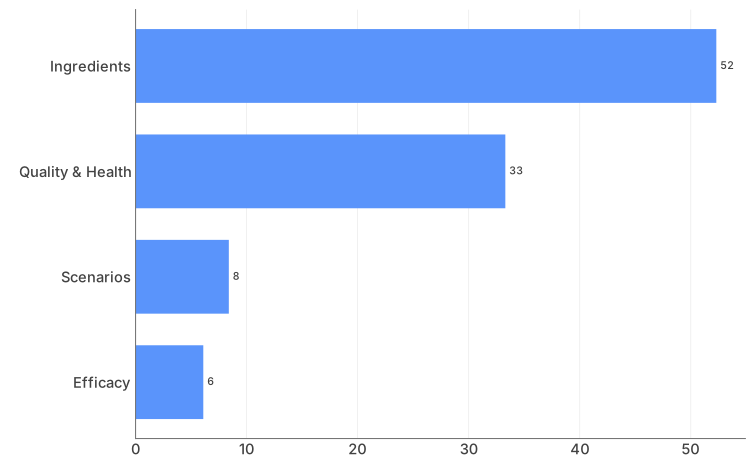
Ingredients and raw materials account for 52.3% of breakout product differentiation[1], which reflects how beverages compete, since consumers judge products first on what they contain. Quality and health positioning accounts for 33.3%, which covers claims around additive-free formulations, premium processing techniques, and organic certification.
Ingredients drive 52.3% of beverage breakout product differentiation, but scenarios and efficacy offer higher growth potential
Pricing and Specification Intelligence#
Prices and pack sizes matter for how a new product is positioned against competitors. The CN¥ 10-20 per bottle segment is the largest in the online beverage market with 39.5% of sales[2], which makes it the mass-market sweet spot. Combined with the CN¥ 0-10 segment (19.9%), products priced below CN¥ 20 account for 59.4% of total sales.
At the same time, the CN¥ 30+ segment holds 27.9% of sales, a substantial premium tier which suggests that consumers are willing to pay more for differentiated products. Brands seeking to enter the premium functional beverage space should target the CN¥ 30-50 range, where electrolyte and health-positioned products can justify price premiums through functional benefit claims.
By size, the 500-1000g segment is the largest with 53.6% of sales, which reflects the standard single-serve and two-serve bottle formats that consumers prefer online. The 2000g+ segment accounts for 12.0% of sales, made up of bulk-buy and family-size packs that sell well where shipping costs favour larger orders. The 1500-2000g segment holds only 1.4% of sales, which we believe marks a gap in the market, since a pack of that size is too large for an impulse purchase and too small to offer bulk-buy value.
Case Studies: Data Intelligence in Action#
Three client engagements show how brands and retailers apply Moojing's data-driven methodology to strategic product decisions in the food and beverage sector[3].
Retail chain product selection. A major supermarket chain worked with Moojing to speed up product selection with consumer feedback data, to adjust its category structure to consumption trends and to use e-commerce reviews in its decisions on brands. The engagement showed how online data can inform offline retail decisions in a systematic way:
- Filtered target categories by core claims using good-to-bad review ratios
- Analysed changes in category share against market consumption trends to guide adjustments to the assortment
- Analyzed brand and SKU-level quality dimensions for rapid listing and delisting decisions
Condiment brand category expansion. An internationally recognized Chinese sauce brand used Moojing's four-method analytical framework to identify expansion paths for steamed fish soy sauce. The analysis examined product application scenarios, functional attributes, substitution patterns, and market-associated category structures to deliver four distinct expansion paths, each supported by quantified market opportunity data.
Functional beverage strategy. A functional beverage brand engaged Moojing for planning with two objectives. The first was to stabilise the core business through competitive intelligence (analyzing five years of water beverage market data), and the second was to identify new category opportunities including electrolyte water, coconut water, and unsweetened tea. The strategic output covered market landscape analysis, brand competitive analysis, price band strategy, and social media buzz analysis.
Key Takeaways#
- The CN¥ 10-20 per bottle segment accounts for 39.5% of online beverage sales and is the mass-market pricing sweet spot
- Ingredients drive 52.3% of breakout differentiation, but scenario-based positioning (8.4%) and efficacy claims (6.1%) offer higher growth potential and price premiums
- Products priced at CN¥ 30+ hold 27.9% of sales, which shows that consumers are willing to pay for differentiated beverages
- Innovation that combines ingredient quality with specific usage scenarios gives a product a value proposition with several layers, which we believe competitors find harder to imitate
- Brands apply Moojing's four-stage methodology to integrate e-commerce transaction data with social listening for systematic product selection
More from This Report#
About the Data#
This analysis draws on Moojing Market Intelligence data covering 2023-2024. Moojing analyses brand and category performance across major Chinese e-commerce platforms. For full methodology and additional insights, see the complete Food & Beverages whitepaper.
This content adheres to Moojing's editorial standards .


