China Retail Sales Hit CN¥ 47.1T as Content Commerce Grows
 By Jotham Lim
4 min read
By Jotham Lim
4 min read
Executive Summary#
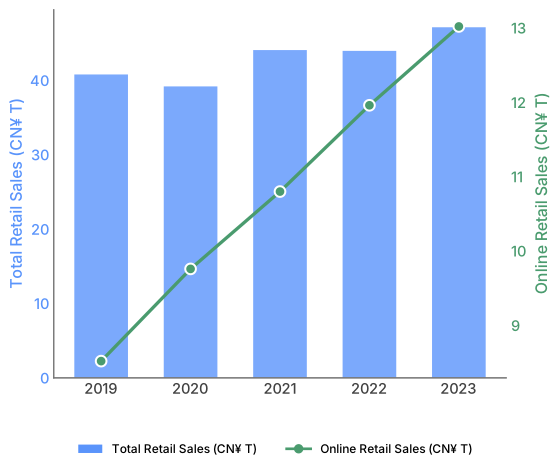
China's total retail sales of consumer goods reached CN¥ 47.1 trillion in 2023, with online retail accounting for 27.6% of the total, a share that continues to expand as content e-commerce platforms change the way consumers shop. On two leading Chinese marketplaces, health food grew 29.0% year-on-year (YoY) and alcoholic beverages grew 54.9% YoY, while convenience food came under pressure. This analysis looks at the wider consumption picture and the divergence between retail formats, and then at the rise of content e-commerce and at how food categories performed online.
Download Full Report#
Get the complete analysis with additional data, methodology details, and brand-level insights.
Consumer Market Recovery Reshapes Channel Mix#
Final consumption expenditure contributed 4.3 percentage points to GDP growth in 2023[1], an increase of 3.1 percentage points on the prior year, which reflects renewed consumer confidence as pandemic-era restrictions receded. The contribution rate of consumption to economic growth reached 82.5%, an increase of 43.1 percentage points that underlines the structural importance of domestic demand.
The recovery has been uneven across channels. Department stores rebounded visibly from a low base after negative growth during the 2022 pandemic disruptions, while supermarket growth continued to slow and turned negative for the first time in 2023. The online channel, meanwhile, maintained steady expansion, and China's internet user base reached 1.092 billion in 2023, an increase of 4.6 percentage points[2].
Key consumption drivers include:
- Offline near-field recovery, as small-format convenience stores (+7.5% growth) and specialized stores (+4.9% growth) grew faster than hypermarkets (-0.4% growth) and proximity-based shopping regained momentum
- The shift to content e-commerce, as the share of retail taken by content-driven platforms grew from 2% to 9% between 2021 and 2023 with the adoption of live commerce
- Quality-conscious consumption, as consumers showed bifurcated behavior, willing to pay premiums for health and experiential products while seeking value in commodity categories
China's total retail sales reached CN¥ 47.1 trillion in 2023, with online share expanding to 27.6%
Retail Format Divergence: Convenience Grows, Hypermarkets Decline#
Convenience stores grew 7.5% in offline retail, while hypermarkets recorded their first-ever decline, at -0.4%. We believe this divergence reflects a structural shift in consumer shopping behavior, in which proximity-based and experiential formats are growing faster than traditional large-format stores.
Content E-commerce Triples Its Share#
Content e-commerce's share expanded from 2.2% in 2021 to 9.3% by October 2023, which makes it one of the most significant structural shifts in China's retail landscape and reflects the wider adoption of live commerce.
Health Food and Alcoholic Beverages Lead Category Growth#
The food and beverage categories on two leading Chinese marketplaces grew at very different rates in 2023. Alcoholic beverages grew 54.9% YoY[3], and health food followed with growth of 29.0% YoY, while convenience food came under pressure.
Key Takeaways#
- China's total retail sales reached CN¥ 47.1 trillion in 2023, with online retail growing 8.8% YoY to CN¥ 13.0 trillion
- Content e-commerce's share tripled from 2% to 9% between 2021 and 2023, which is changing how consumers discover and buy food and beverages
- Health food grew 29.0% YoY and alcoholic beverages grew 54.9% YoY on two leading Chinese marketplaces
- Convenience stores (+7.5%) grew faster than hypermarkets (-0.4%), which points to a shift toward proximity-based retail
- Consumer behavior bifurcated, with premiums paid for health and experiential products and value sought in commodity categories
## About the Data
This analysis draws on Moojing Market Intelligence data covering 2023-2024, and its food and beverage category figures cover two leading Chinese marketplaces. Moojing analyses brand and category performance across major Chinese e-commerce platforms. For full methodology and additional insights, see the complete Food & Beverages whitepaper.
This content adheres to Moojing's editorial standards .


