Customer Acquisition Costs Doubled at Two Leading Chinese Marketplaces
 By Quan Wenjun
6 min read
By Quan Wenjun
6 min read
Executive Summary#
The cost of acquiring a new online customer at two leading Chinese marketplaces more than doubled in a single year, signaling the definitive end of China's e-commerce traffic dividend. With internet user growth plateauing and consumers becoming more selective, brands are pivoting from "creating viral products" to building sustainable "product power plus brand power" dual-engine growth models. This analysis examines the strategic implications of rising acquisition costs, the shift toward functional and ingredient-driven marketing, and the accelerating rise of domestic brands, which captured 57% preference in food and beverage in 2022.
Download Full Report#
Get the complete analysis covering 18 high-growth categories and 8 emerging themes reshaping China's consumer market.
The Traffic Dividend Has Ended#
The era of low-cost customer acquisition in China's e-commerce has definitively ended. New internet user growth continued to decelerate through 2022, shifting the market from an incremental growth model to stock-based competition where platforms and brands compete for existing users rather than recruiting new ones. The cost of acquiring a new online customer more than doubled in a single year. On FY2021 company disclosures, both of the two leading Chinese marketplaces covered in this analysis reported a cost per newly acquired customer more than twice their own FY2020 level.
This structural shift carries profound implications for brand strategy. When the cost of reaching new consumers doubles or triples in a single year, traffic-dependent growth models become unsustainable. Brands that relied on promotional spending and platform advertising to drive topline growth faced diminishing returns in 2022, forcing a fundamental rethink of how they create and capture value.
The re-rating of acquisition economics underscores why brands must shift from traffic-dependent growth to building intrinsic product and brand value. Acquisition spend buys a transaction; product and brand equity buy the second and third one. With online user growth plateauing and the pool of first-time shoppers no longer expanding, the cost of reaching a genuinely new consumer is unlikely to fall back to its earlier level. A growth plan that assumes it will is planning against the direction of the market.
From Viral Products to Sustainable Brand Building#
Brands are responding to the traffic cost squeeze by pivoting from short-term viral product strategies to building durable competitive advantages. The new playbook centers on a "product power plus brand power" dual-engine growth model that prioritizes long-term value creation over transient sales spikes.
Product power manifests through enhanced expertise and professional capabilities. Functional skincare built on ingredient-driven efficacy marketing has become a leading example of this approach. Rather than competing on novelty or aesthetics alone, successful brands demonstrate specific, measurable product benefits that justify premium pricing and encourage repeat purchases. Design aesthetics, stylized packaging, and intellectual property collaborations complement rather than replace functional differentiation.
Brand power requires a more deliberate market entry strategy:
- Brands enter underserved niche segments with lower competitive intensity
- They build outward through targeted marketing to establish mind share in the niche
- Channel expansion follows to unlock broader distribution and sales growth
- The niche-first approach creates defensible market positions before inviting competitive response
This strategic evolution reflects a maturing consumer market where sustainable growth depends on genuine product-market fit rather than marketing expenditure alone.
Consumer Sentiment Shifted Toward Caution and Rationality#
Consumer spending psychology shifted markedly toward caution in 2022, creating the demand-side conditions that rewarded product power over marketing power. The household savings rate rose to 36% by H1 2022, while nominal disposable income per capita grew only 5.3% in the first three quarters. According to McKinsey's 2023 China Consumer Report, safety and natural formulation, desired efficacy and design, and brand reliability ranked as the top three purchasing factors across both food and non-food categories.
This evolution signals that consumers are increasingly willing to pay for demonstrable quality and functionality rather than novelty or impulse-driven purchases. Brands offering clear, evidence-based value propositions gained ground, while those relying on trend-chasing and promotional pricing lost relevance.
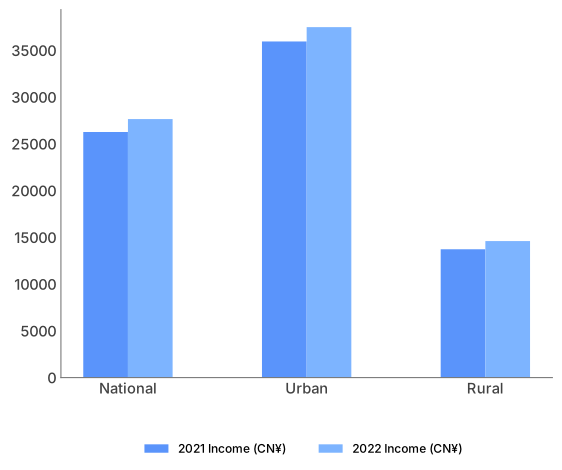
Disposable income grew 5.3% nationally amid cautious consumer sentiment
Domestic Brands Gained Ground on Cultural Confidence#
The rise of domestic Chinese brands represents one of the most consequential structural shifts in China's consumer market. Fueled by growing cultural confidence and the purchasing power of Gen Z consumers (known as Post-95s and Post-00s in China), domestic brands combining high aesthetic value with competitive pricing have gained significant ground. Historical parallels from Japan and South Korea suggest that once GDP per capita exceeds US$ 10,000, as China's did for the first time in 2019, consumer enthusiasm for local culture and brands accelerates substantially.
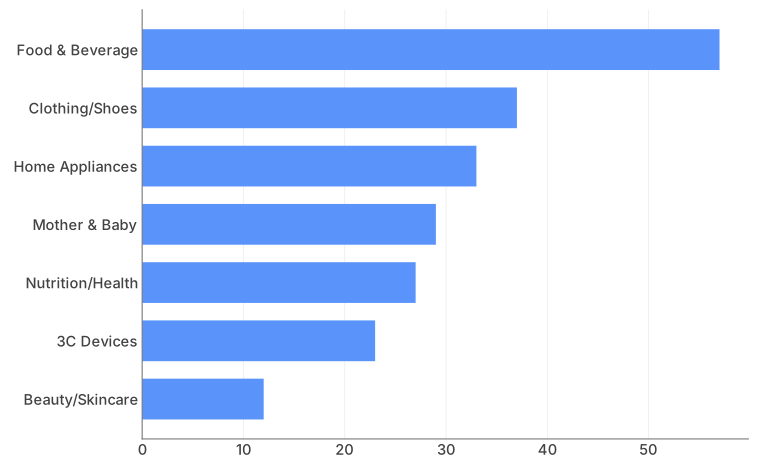
Food and beverage leads domestic brand preference at 57%, while clothing follows at 37%. However, beauty and skincare still lean heavily international, with only 12% of consumers favoring domestic brands. Nearly 80% of consumers who choose domestic brands cite cost-effectiveness as the primary driver, indicating that price-value perception remains the dominant purchase criterion rather than cultural loyalty alone.
Domestic brand preference by category, 2022
Rural Markets Offer a Growth Frontier#
Income data reveals an important geographic dimension to brand strategy. Rural disposable income grew 6.4% nominally compared to 4.3% for urban populations, with real growth at 4.3% versus 2.3%. This gap suggests that lower-tier markets are recovering faster and may offer more receptive consumer demand for brands that can adapt their product and pricing strategies for these audiences.
The combination of rising rural incomes, lower competitive intensity in Tier 3+ cities, and increasing digital connectivity creates a compelling case for downward market penetration. Brands that establish presence in these markets while acquisition costs remain lower than in saturated Tier 1 cities can build durable competitive positions.
Key Takeaways#
- The cost of acquiring a new online customer more than doubled in a single year at both of the leading Chinese marketplaces covered in this analysis
- Brands are pivoting from traffic-dependent growth to "product power plus brand power" dual-engine models
- The household savings rate reached 36% by H1 2022, driving cautious, quality-focused purchasing behavior
- Domestic brands capture 57% preference in food and beverage but only 12% in beauty and skincare
- Rural disposable income growth at +6.4% outpaced urban at +4.3%, reinforcing the case for lower-tier market expansion
More from This Report#
## About the Data
This analysis draws on Moojing Market Intelligence data covering January to November 2022. Moojing analyses brand and category performance across major Chinese e-commerce platforms. For full methodology and additional insights, see the complete H2 2022 Consumer Trends whitepaper.
This content adheres to Moojing's editorial standards .
Frequently Asked Questions
Cost. On FY2021 company disclosures, the cost of acquiring a new online customer at both of the two leading Chinese marketplaces covered in this analysis more than doubled from its FY2020 level. New internet user growth had also decelerated, which moved the market from incremental growth to stock-based competition, where platforms and brands compete for existing users rather than recruiting new ones. When the cost of reaching a new consumer doubles in a single year, traffic-dependent growth stops working, and that is the structural reason brand strategy changed.
A dual-engine model of product power plus brand power. Product power shows up as expertise and demonstrable capability. Functional skincare built on ingredient-driven efficacy is the clearest example, competing on specific measurable benefits rather than novelty, with design, packaging and IP collaboration complementing that rather than substituting for it. Brand power follows a deliberate sequence: enter an underserved niche with lower competitive intensity, build mind share there through targeted marketing, then expand channels to unlock distribution. The niche-first order matters, because it establishes a defensible position before inviting a competitive response, which is exactly what a brand cannot afford once acquisition costs are this high.
Toward caution and rationality, which is what made product power pay. The household savings rate rose to 36% by H1 2022 while nominal disposable income per capita grew only 5.3% over the first three quarters. Research over the same period ranked safety and natural formulation, desired efficacy and design, and brand reliability as the top three purchasing factors across both food and non-food categories. Consumers became willing to pay for demonstrable quality and function, and correspondingly less willing to pay for novelty or impulse. Brands with clear evidence-based value propositions gained ground; trend-chasing and promotional pricing lost relevance.
Ahead in some categories and well behind in others, and the reason is price-value rather than patriotism. Food and beverage leads domestic brand preference at 57% and clothing follows at 37%, but beauty and skincare still lean heavily international with only 12% favouring domestic brands. Nearly 80% of consumers who choose a domestic brand cite cost-effectiveness as the primary driver, so price-value, more than cultural confidence, decides the purchase. Geography adds a second opening: rural disposable income grew 6.4% nominally against 4.3% for urban populations, and 4.3% against 2.3% in real terms, so lower-tier markets are recovering faster and cost less to enter.


