China's Health Food Category Defied the 2022 Slowdown
 By Jotham Lim
4 min read
Executive Summary#
Health food and dietary supplements grew 21.5% YoY on two leading Chinese marketplaces in 2022, the strongest growth among their 20 largest categories, at a time when most other large categories on those marketplaces came under pressure. This analysis looks at the gap that opened between discretionary categories and essential wellness segments, and at how the different growth of total retail and online retail in 2022 shaped the way Chinese consumers spent.
Download Full Report#
Get the complete analysis covering 18 high-growth categories and 8 emerging themes reshaping China's consumer market.
Total Retail Sales Weakened in 2022 While Online Retail Grew#
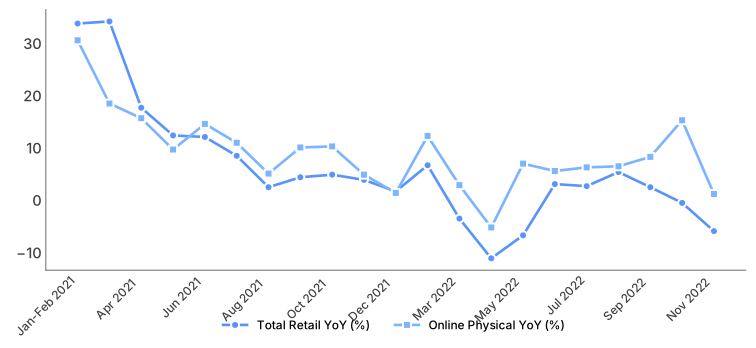
China's consumer goods market was under pressure from pandemic disruption and a cooling economy throughout 2022. From January to November, total retail sales of consumer goods reached CN¥ 39.91 trillion, a marginal 0.1% Year-over-Year (YoY) decline [1], and growth weakened sharply in November, when retail sales fell 5.9% YoY as pandemic restrictions tightened.
Online retail of physical goods held up better. After a difficult April, when it declined 5.2% YoY, the channel recovered quickly and stayed in positive territory for most of the year. By November 2022 cumulative online retail of physical goods had grown 6.4%, which we believe reflects the continued shift toward online shopping even in a weaker market.
Several factors explain why online retail held up better than retail as a whole:
- Pandemic lockdowns hit physical stores and foot traffic hardest
- Consumers moved online out of necessity, and many of the habits they formed have lasted
- Online platforms offered a wider choice of products and clearer prices during an uncertain period
- Logistics networks proved more resilient than the supply chains of physical stores
Online Retail Held Up Better Than Total Retail#
The gap between total retail and online retail widened through 2022. Total consumer goods growth turned negative in March and stayed volatile, while online retail of physical goods recovered more quickly, reaching double-digit growth of +15.3% in October 2022 before slowing to +1.2% in November. In 2021 the two had moved in broadly similar territory, so the gap between them was much wider in 2022.
Total retail and online retail of physical goods, YoY growth, 2021 to 2022
Health Food Led a Small Group of Growing Categories#
Among the 20 largest categories on two leading Chinese marketplaces, growth was confined to a few. Health food and dietary supplements posted the strongest growth, at +21.5% YoY, which reflects the greater attention consumers paid to their health during the pandemic. Residential home furnishings followed at +12.4%, and pet supplies (+1.6%) and laundry and cleaning products (+1.3%) completed the small group of categories that grew.
Discretionary categories, among them makeup and perfume, men's and women's clothing, beauty and skincare and cell phones, came under pressure, as consumer caution during the pandemic and weaker confidence weighed most heavily on optional spending.
Rising Savings Rates Reinforced Selective Spending#
The household savings rate climbed to 36% by H1 2022, while nominal disposable income per capita grew only 5.3% in the first three quarters. This combination of higher savings and moderate income growth made consumers cautious and rational, favouring essential purchases over discretionary ones. According to McKinsey's 2023 Chinese Consumer Report [2], safety, desired efficacy and brand reliability were the top three purchasing factors, which suggests that consumers were willing to pay for proven quality and function more than for novelty.
Key Takeaways#
- Health food and dietary supplements grew 21.5% YoY, the strongest growth among the 20 largest categories on two leading Chinese marketplaces
- Online retail of physical goods grew 6.4% cumulatively by November 2022, while total retail sales of consumer goods fell 5.9% in November
- Health food, residential home furnishings, pet supplies, and laundry and cleaning products were the categories among the 20 largest that grew
- Discretionary categories such as cosmetics and apparel came under the most pressure from consumer caution
More from This Report#
## About the Data
This analysis draws on Moojing Market Intelligence data for two leading Chinese marketplaces, covering January to November 2022, and on retail statistics from the National Bureau of Statistics. For full methodology and additional insights, see the complete H2 2022 Consumer Trends whitepaper.
This content adheres to Moojing's editorial standards .


