Ready-to-Eat Tonics and Gift Boxes Drive China's TCM Product Revolution
 By Quan Wenjun
5 min read
By Quan Wenjun
5 min read
Executive Summary#
China's food-medicine homology market is undergoing a product format revolution. Ready-to-eat tonic social media buzz volume surged 86.7% YoY in 2024, while gift box tonic sales grew 22.3% YoY, nearly triple the overall tonic market's 7.6% growth. Younger consumers demanding convenience, portability, and premium gifting options are driving this transformation. Cross-category fusions embedding TCM ingredients into bakery, tea beverages, and prepared meals expand the addressable market far beyond the traditional CN¥ 56.78 billion tonic category. Consumer ingredient awareness now dominates purchase decisions, with ingredient information commanding 62% of social media attention, surpassing efficacy (49%) and price (35%).
Download Full Report#
For the complete product trend analysis, consumer attention data, cross-category innovation case studies, and gift economy market sizing, download the full whitepaper.
Download the Full 2025 Food-Medicine Homology Whitepaper →
Consumer Ingredient Awareness: The New Purchase Driver#
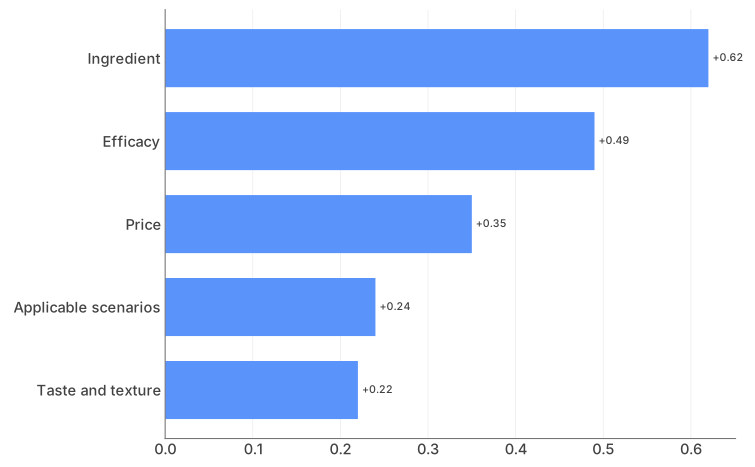
A fundamental shift in how consumers evaluate food-medicine homology products is reshaping marketing strategy. Ingredient information drives 62% of consumer attention on social media, establishing it as the primary decision factor. Efficacy ranks second at 49%, while price falls to third at 35%. Applicable scenarios (24%) and taste and texture (22%) trail significantly.
Ingredient information drives 62% of consumer attention, surpassing efficacy and price
Ready-to-Eat Formats: Convenience Meets Tradition#
The food-medicine homology market's consumer base is trending younger, and with this demographic shift comes a demand for convenience. Ready-to-eat and portable products have become market mainstream, matching consumers' dual expectations of health and convenience. TCM ingredients are now appearing in chocolate, gummies, candy, and other snack formats, accelerating the penetration of nourishing ingredients into everyday consumption occasions.
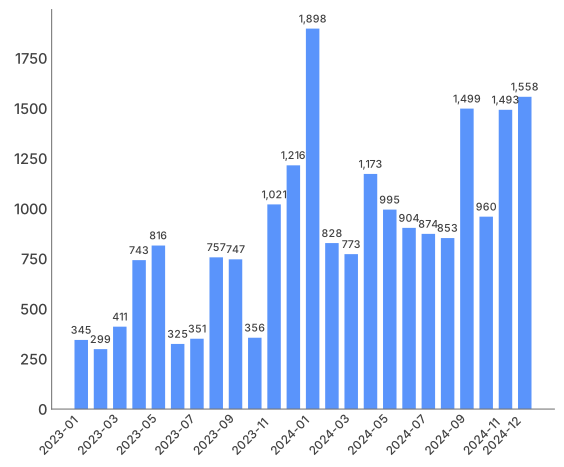
Ready-to-eat tonic buzz volume surges 86.7% YoY to 13,808 total interactions in 2024
Cross-Category Fusion: Expanding Beyond Traditional Tonics#
Food-medicine homology ingredients are breaking out of the traditional tonic category into modern food and beverage formats through three primary fusion pathways.
Food-medicine homology and bakery: Innovative stores such as "Medicine and Food" and "Medicine and Food Boundless Inspiration Bakery" have become viral check-in destinations through their Chinese medicine bread series, attracting social media attention and driving consumer trial.
Food-medicine homology and prepared meals: Beijing Tongrentang (同仁堂) has partnered with Hema (盒马) to launch products including breakfast porridge, dishes, and soups, bringing TCM ingredients into everyday meal occasions through established retail channels.
Food-medicine homology and tea beverages: Adding TCM ingredients to coffee, soymilk, and milk tea creates new flavors and functions, satisfying consumers' demand for a fusion of health and taste in daily beverage consumption.
These cross-category fusions dramatically expand the addressable market. TCM ingredients are moving into categories with much larger consumer bases, among them bakery (CN¥ 200+ billion), tea beverages (CN¥ 300+ billion) and prepared meals. By entering them, the food-medicine homology ingredient market could grow to several times its current size over the next five years. The Tongrentang-Hema partnership exemplifies the mutually beneficial model: TCM heritage combined with modern retail reach.
Gift Economy: Premiumization Drives Outsized Growth#
Tonic gift box products emerged as one of the strongest growth segments in 2024. Gift box sales grew 22.3% YoY, nearly triple the overall tonic market's 7.6% growth. Three gifting scenarios drive demand: meeting parents, visiting friends and relatives during Chinese New Year, and business gift-giving. Social media topics such as #GreatGifts (101,000 interactions), #MeetTheParents (77,000), and #HeartfeltGiftsForElders (60,000) attracted substantial engagement.
January 2024 recorded CN¥ 1.15 billion in gift box sales, representing approximately 33% of that month's total tonic revenue. The gift box share of total tonic sales increased throughout 2024, with months such as May (CN¥ 776 million, 20.9% of total) and September (CN¥ 871 million, 23.4% of total) showing substantially higher penetration than the corresponding 2023 periods.
Brands are investing in distinctive packaging that emphasizes premium aesthetics and cultural heritage. Dong'e Ejiao's (东阿阿胶) Taohua Ji series draws on the classical cultural IP "Classic of Mountains and Seas" (Shanhai Jing, 山海经) to create the "Mountains and Seas Peach Blossom Gift Box," positioning it as a premium gift choice that conveys cultural sophistication.
Strategic Takeaways for Brands#
The product trend data points to three actionable strategies. First, invest in ready-to-eat and portable formats that lower adoption barriers for first-time consumers and younger demographics. Second, pursue cross-category partnerships with established food and beverage brands that provide instant distribution while offering differentiated health positioning. Third, develop premium gift packaging with cultural storytelling for the high-margin, high-growth gifting segment, with seasonal campaigns concentrated in Q4 and Q1 around Chinese New Year and Mid-Autumn Festival.
The convergence of ingredient awareness, convenience demand, and premiumization creates a favorable environment for brands that combine TCM heritage with modern product innovation.
More from This Report#
- China's CN¥ 56.78 Billion Food-Medicine Homology Market in 2025
- Breakout Ingredients Reshaping China's Food-Medicine Homology Market
About the Data#
This analysis draws on Moojing Market Intelligence's proprietary transaction and social media data from major Chinese online platforms. Social media buzz volume metrics derive from analysis of consumer discussions across mainstream Chinese platforms. Gift box sales data reflects SKU-level analysis of products classified as gift packaging variants. All growth rates are calculated on a year-on-year basis using the 2022-2024 period.
For methodology details, data sourcing, and complete market analysis, download the full report.
This content adheres to Moojing's editorial standards .
Frequently Asked Questions
Food-medicine homology is the Chinese tradition of ingredients that function as both food and medicine, now being reformulated into modern consumer products. The change under way is one of format rather than of ingredient: traditional tonics are being re-presented as ready-to-eat, portable and giftable products aimed at a younger buyer. That shift is visible in the numbers: ready-to-eat tonic social buzz rose 86.7% YoY, and gift box sales grew 22.3% against the overall tonic market's 7.6%. The ingredients are old; the occasions, formats and buyers are new, and it is the occasions that are expanding the category.
Ingredient information, ahead of everything else. It accounts for 62% of consumer attention on social media, which puts it clearly above efficacy at 49% and price at 35%. Applicable scenarios (24%) and taste and texture (22%) trail well behind. The practical consequence for a brand is that ingredient transparency is doing the work that efficacy claims are usually assumed to do. Buyers research what is in the product before they assess what it promises, so a product whose ingredient story is thin is filtered out before its benefit claim is ever read.
Because they are where the premium sits and where the growth is concentrated. Gift box sales grew 22.3% YoY, nearly triple the overall tonic market's 7.6%. In January 2024 gift boxes accounted for CN¥ 1.15 billion, roughly 33% of that month's total tonic revenue. Three occasions drive it: meeting parents, visiting family during Chinese New Year, and business gifting. The strategic point is that gifting reframes the purchase entirely. The buyer is not the consumer, so presentation, brand reassurance and price signalling matter more than they would in a self-purchase, and the category's seasonality follows the social calendar rather than consumption.
Substantially larger than the tonic category itself, at CN¥ 56.78 billion. The expansion is happening through cross-category fusion, with food-medicine homology ingredients moving into bakery, tea beverages and prepared meals, each of which has a far larger consumer base than tonics do. Bakery and tea beverages are both multi-hundred-billion CN¥ categories, so even modest ingredient penetration represents a multiple of the current tonic market. The practical read for a brand is that the addressable market is defined by the occasions the ingredients can enter, not by the tonic shelf they historically occupied.


