China's Health & Wellness Market Hits CN¥ 304.4B in 2025
 By Jotham Lim
5 min read
By Jotham Lim
5 min read
Executive Summary#
China's online Health & Wellness market reached CN¥ 304.4 billion in 2025, growing 15.8% year-on-year (YoY) with approximately 2.90 billion units sold (+19.0% YoY). Dietary supplements were the largest category at CN¥ 124.5 billion, while prescription drugs posted the fastest growth at +34.0% YoY. We believe a shift from treating illness towards preventing it is changing what consumers buy and how brands compete for them [1].
Download Full Report#
Get the complete analysis with additional data on functional segments, brand-level competition, and emerging ingredient trends.
Market Overview: CN¥ 304.4 Billion and Accelerating#
China's Health & Wellness market has become a mainstream consumer category, with revenue up 15.8% YoY and unit sales up 19.0%. Volume grew slightly faster than revenue, which suggests that prices held broadly steady as the market expanded. Easier access to prescription drugs online has improved the management of chronic disease, because consumers can now complete a consultation and buy the medication in one place. This has lowered the barriers to buying health products with good information [2].
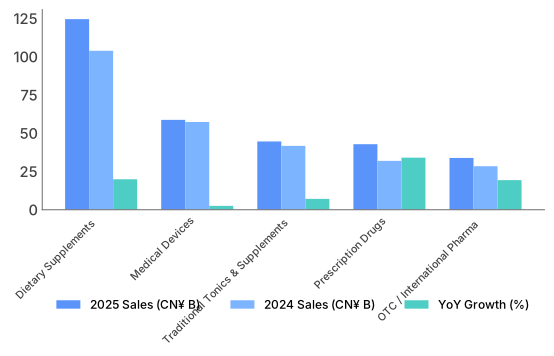
The market's five major categories grew at very different rates. Dietary supplements were the largest at CN¥ 124.5 billion (+19.9% YoY), followed by Medical Devices at CN¥ 58.7 billion (+2.5%) and Traditional Tonics & Supplements at CN¥ 44.6 billion (+7.1%). Prescription drugs posted the fastest growth at +34.0% YoY, reaching CN¥ 42.8 billion as telemedicine gave more patients access to online pharmaceutical channels.
Dietary supplements lead H&W market at CN¥ 124.5B while prescription drugs post fastest growth
Social Media Reveals Where Consumer Attention Concentrates#
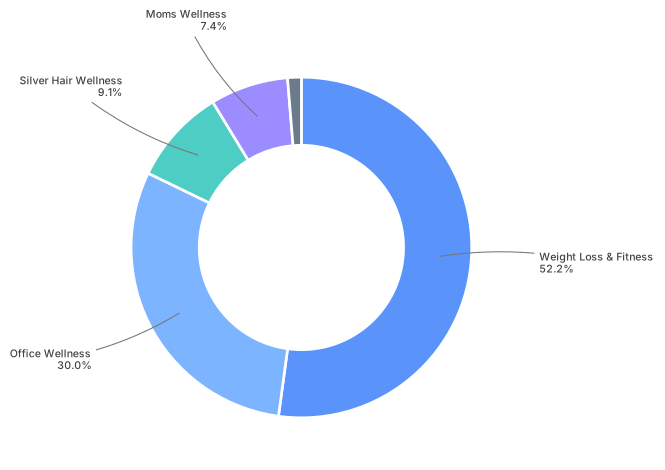
Weight management and fitness consumers accounted for 52.1% of Health & Wellness social media engagement, which makes body image and fitness culture the largest single driver of purchasing decisions. Office wellness users accounted for 30.0%, a sign of growing health consciousness among China's white-collar workers. Together these two groups account for 82.1% of total engagement, and we believe that concentration should shape how brands plan their content [4].
Weight management dominates H&W social media at 52.1% of audience engagement
Dietary Supplements: Brand Landscape and Channel Dynamics#
The dietary supplements market reached CN¥ 124.5 billion (+19.9% YoY) with approximately 740 million units sold. Established international and domestic brands remain well known to supplement buyers, while content-led commerce has become an important launch channel for challenger brands, many of them domestic brands founded within the past 3-5 years [5].
We believe this gives brands a choice between building on established marketplace channels and growing through social commerce, and many will need to invest in both, since the two reach consumers in different ways.
Functional Segments: Where Growth Is Fastest#
Immune Support was the largest dietary supplement segment in 2025 at over CN¥ 19.9 billion, but the fastest growth came from more specialised segments. Brain Nutrition grew 50.6% to CN¥ 11.9 billion, helped by a 303.4% rise in social media mentions, and Bone & Joint Health grew 40.9% to CN¥ 17.0 billion. Anemia Improvement grew fastest of all, at 81.4%, driven by snackable formats and the culture of giving gifts at festivals [6].
Key segment highlights include:
- Immune Support: CN¥ 19.9 billion (+22.1% YoY), the largest segment, with the broadest consumer base
- Brain Nutrition: CN¥ 11.9 billion (+50.6% YoY), where Omega-3 holds 71.9% of the segment
- Bone & Joint Health: CN¥ 17.0 billion (+40.9% YoY), driven by an ageing population
- Anemia Improvement: +81.4% YoY, the fastest-growing segment, where triple-digit growth was common among the segment's brands
- Weight Management: CN¥ 7.1 billion (-21.3% YoY), a decline across the market as consumers move towards more holistic approaches
Future Trends: Three Forces Reshaping Health & Wellness#
We expect three broad trends to shape China's Health & Wellness market through 2026 and beyond [7].
Synergistic formulations become the norm. Consumers expect multi-nutrient products designed for absorption and for ingredients that work together. Combinations of folic acid, vitamin C and heme iron in Anemia Improvement, and of GABA with minerals and vitamins in Brain Nutrition, have set the template for future product development. Simple single-ingredient supplements are giving ground to combinations marketed on clinical evidence.
Precision efficacy targeting accelerates. Products are moving away from broad "health maintenance" positioning towards specific functional claims, such as cognitive support for exam students, fatigue relief for office workers and iron for pregnant women. These claims give brands niches that are easier to defend. We believe brands that combine clinical validation with marketing built around specific situations will be able to charge premium prices.
Whole-lifecycle wellness management expands the addressable market. AI-assisted health consultation, online access to prescriptions and the wider use of preventive supplements are coming together into a continuous cycle of health management. Children's brain development, performance at work, maternal health and the prevention of cognitive decline in older people are distinct stages of life, and between them they take the market beyond the traditional supplement consumer.
Key Takeaways#
- China's online H&W market reached CN¥ 304.4 billion (+15.8% YoY) with 2.90 billion units sold
- Dietary supplements were the largest category at CN¥ 124.5 billion, while prescription drugs posted the fastest growth at +34.0%
- Content-led commerce has become an important launch channel for new domestic supplement brands
- Weight management and office wellness together account for 82.1% of social media engagement
- Synergistic formulations and precision efficacy targeting will define the next wave of product innovation
## About the Data
This analysis draws on Moojing Market Intelligence data covering China's online Health & Wellness market for the full calendar year 2025. Moojing analyses brand and category performance across major Chinese e-commerce platforms. Social media engagement data covers Weibo, Douyin, and Xiaohongshu. For full methodology and additional insights, see the complete Health & Wellness whitepaper.
This content adheres to Moojing's editorial standards .
Frequently Asked Questions
CN¥ 304.4 billion in 2025, up 15.8% year on year on roughly 2.90 billion units (+19.0%). Volume growing slightly faster than revenue indicates that prices held broadly steady as the market expanded. The five major categories diverge sharply: dietary supplements lead at CN¥ 124.5 billion (+19.9%), medical devices follow at CN¥ 58.7 billion (+2.5%) and traditional tonics at CN¥ 44.6 billion (+7.1%). Prescription drugs post the fastest growth at +34.0% to CN¥ 42.8 billion as telemedicine widened access to online pharmaceutical channels.
Overwhelmingly in two segments. Weight management and fitness consumers account for 52.1% of health and wellness social engagement, making body image and fitness culture the single largest driver of purchase decisions, and office wellness users add 30.0%. Together those two are 82.1% of total engagement. That concentration should shape content strategy directly, because a brand spreading effort evenly across every wellness need is spending most of it outside where the conversation actually is. One tension is worth planning around: attention concentrates on weight management while the weight management product segment itself contracted 21.3% as consumers moved toward more holistic approaches.
Anaemia improvement leads on rate at +81.4% to CN¥ 4.1 billion, driven by snackable formats and festival gift-giving culture, with every leading brand in it achieving triple-digit growth. Brain nutrition grew 50.6% to CN¥ 11.9 billion, catalysed by a +303.4% surge in social mentions, and Omega-3 holds 71.9% of that segment. Bone and joint health grew 40.9% to CN¥ 17.0 billion on ageing demographics. Immune support remains the largest at CN¥ 19.9 billion (+22.1%) with the broadest consumer base. Weight management is the outlier, contracting 21.3% despite dominating the conversation.
Three forces. Synergistic formulations are becoming the norm, as consumers now expect multi-nutrient products designed for absorption and for ingredients that work together. The templates already exist in folic acid with vitamin C and heme iron for anaemia, and GABA with mineral and vitamin complexes for brain nutrition, and simple single-ingredient supplements are giving up ground to combinations marketed on clinical evidence. Precision efficacy targeting is accelerating, moving from broad health maintenance toward specific claims tied to a person and a moment: cognitive support for exam students, fatigue relief for office workers, iron optimisation in pregnancy. And whole-lifecycle wellness management expands the addressable market as AI-assisted consultation, online prescription access and preventive supplement adoption combine into a continuous health management loop.


