China's Sportswear Market Q2 2024: A CN¥ 385.8B Category Reshaped by Content Commerce
 By Jessie Wang
6 min read
By Jessie Wang
6 min read
Executive Summary#
China's sportswear market reached CN¥ 385.8 billion in 2023, a scale that places it among the world's most significant consumer categories, yet the structure beneath that headline is shifting in ways that demand strategic attention. Online sportswear sales hit CN¥ 143.46 billion (+5.0% YoY) across 570 million units, with growth moderating in H2 2023 as pandemic-era tailwinds faded. The most consequential development is the redistribution of demand across the brand set and the channel mix. Six of the ten largest online brands outgrew the market, the fastest of them growing 38.4% YoY to reach CN¥ 10.2 billion in online sales, while content-driven commerce lifted its share of the online channel from 20.8% to 27.4%.
Market Overview: CN¥ 385.8 Billion and Structurally Underserved#
China's sportswear industry combines substantial scale with significant untapped potential. The market reached CN¥ 385.8 billion in 2023, sustained by rising health awareness, the guochao (domestic brand pride) cultural movement, and steadily increasing sports participation rates. Per-capita sportswear consumption of US$ 38.3 in 2022 grew 164% from 2010 levels, the fastest rate among major markets, yet remains a fraction of developed-nation benchmarks set by the U.S., U.K., and South Korea.
The penetration gap quantifies the structural opportunity. China's sportswear penetration rose from 9% in 2015 to 14% in 2022, but trails the 20-25% range maintained by Japan, South Korea, and Western Europe. Even modest convergence toward mature-market norms would translate into substantial incremental demand. This is not a saturated market approaching its ceiling -- it is a market still in the early-to-mid stages of category integration into consumers' everyday wardrobes.
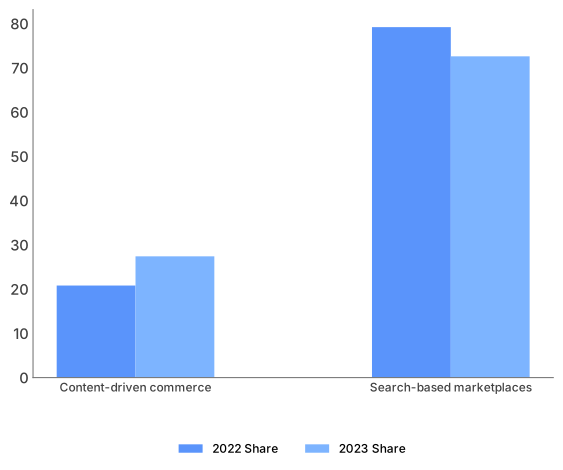
The online-offline channel split stood at 38.2% versus 61.8% in 2023, suggesting the market is approaching digital equilibrium. Within the online channel, however, a structural migration is underway: content-driven commerce expanded from 20.8% to 27.4% of online sportswear sales, while the search-based marketplace channel moved from 79.2% to 72.6%. The shift favours brands that can execute content-led selling alongside traditional search-based retail.
Brand Landscape: A Growing Market, Unevenly Shared#
The market grew; its leading tier did not grow with it uniformly. Concentration among the largest brands is moderate and essentially unchanged year on year. The story of 2023 is therefore a spread of growth rates inside the leading set, wide enough to separate what is working from what is not.
Six of the ten largest online brands outgrew the market in 2023
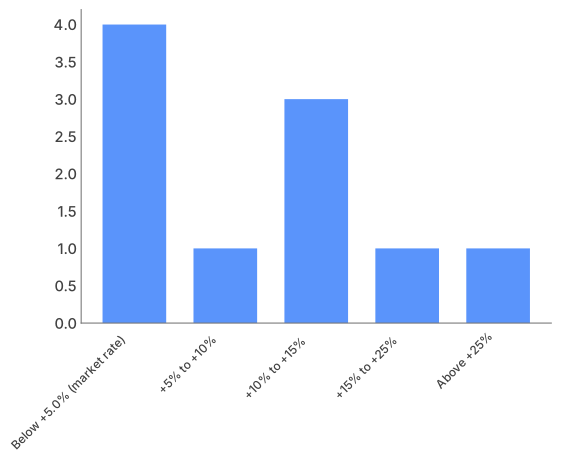
Six of the ten largest brands grew ahead of the market's +5.0% rate, with growth in that group running from +6.6% to +38.4%. The distribution matters as much as the count: three of the six landed between +10% and +15%, one between +15% and +25%, one between +5% and +10%, and a single brand cleared +25%. The remaining four came in below the +5.0% market rate.
What separates the two groups is not scale. The outperforming cohort spans international and domestic brands and both premium and value price positions -- there is no single winning archetype in this data. Two domestic value brands gained ground on accessible pricing and a running-shoe focus, growing 12.2% and 10.2%, while the fastest grower in the set paired a premium price position with an aggressive channel build-out.
Channel Migration: Content Commerce Takes Share#
The e-commerce channel shift is the single most important structural change in China's sportswear distribution. Content-driven commerce expanded from 20.8% to 27.4% of the online channel, growing 38.2% YoY on a discovery-and-conversion model that search-based retail does not replicate.
Content-driven commerce lifted its share of online sportswear from 20.8% to 27.4%
Flagship-storefront results show how much of that growth is actually available to brands that commit to the channel: two of the ten largest brands grew their content-commerce flagship stores by 109.9% and 155% YoY. What separated the two was breadth -- one of them also grew across the established marketplace channels (+30.0% and +37.4%) in the same year. Growing on the content channel and the marketplace channels at once, rather than riding one of them, is what distinguishes the strongest competitive positions.
Methodology: the online channel measured here comprises one leading content-commerce platform and two leading marketplace ecosystems. "Content-driven commerce" and "search-based marketplaces" refer to those groupings, not to the whole of China's online retail.
Key Trends Reshaping the Market#
Three structural forces are redefining how brands must compete in China's sportswear market.
Women's sportswear outpaces men's. Women's dedicated sportswear reached CN¥ 29.80 billion in online sales (+8.4% YoY), with growth outpacing men's in every quarter of 2023. The mix rebalanced alongside it: unisex products expanded from 37.9% to 41.5% of the category, while men's dedicated moved from 41.9% to 39.4%. Female consumers are the market's primary growth engine, and sizing and comfort remain the recurring pain points large brands have yet to resolve.
Category divergence intensifies. Growth is highly uneven at sub-category level. Running shoes grew 12.2% YoY, chunky sneakers surged 142% to CN¥ 2.5 billion, and walking shoes grew 76.2%, the latter on elderly-focused marketing through livestream channels. The spread between the fastest-growing silhouettes and the category average was wide enough in 2023 that a portfolio concentrated in any single silhouette carries real exposure to a shift in taste.
Premiumisation is not a ceiling. Two of the ten largest brands carry average prices above CN¥ 600, while domestic brands generally sit around CN¥ 200. Across the leading set, implied average transaction values span roughly CN¥ 241 to CN¥ 655 -- a spread of more than 2.5x -- and the highest-priced position in that range is also the fastest-growing, at +38.4%. Premium pricing is coinciding with volume growth in this category, not constraining it.
Key Takeaways#
- China's CN¥ 385.8 billion sportswear market retains significant growth potential, with per-capita consumption and penetration rates still well below developed-nation benchmarks.
- Six of the ten largest online brands outgrew the +5.0% market rate in 2023, and that cohort spans international and domestic brands at both premium and value price points -- execution, not scale, is the dividing line.
- Content-driven commerce grew 38.2% to 27.4% of the online channel; brands that treat it as a secondary channel are ceding share in the fastest-growing part of the market.
- Multi-channel growth beats single-channel dependence: flagship growth of +109.9% and +155% on the content channel was matched across marketplace channels (+30.0% and +37.4%) by only one of the two brands that achieved it.
- Women's sportswear is the market's growth engine, and unresolved sizing and comfort issues are a clear product-development priority.
- Sub-category growth diverged sharply in 2023, so portfolio breadth has become a defensive requirement rather than a merchandising preference.
About the Data#
This analysis is based on Moojing Market Intelligence (魔镜洞察) data covering China's mainstream e-commerce platforms. The online channel measured here comprises one leading content-commerce platform and two leading marketplace ecosystems; brand-level results are reported as anonymised cohorts of the ten largest online brands rather than as a named ranking. Data covers full-year 2023 with year-on-year comparisons.
Download the Full Report#
This content adheres to Moojing's editorial standards .


