China's USD 11.9B Pet Economy: How Babies Became Pets in 24 Months
 By Jessie Wang
7 min read
By Jessie Wang
7 min read
Executive Summary#
Get the Full Report: Download the complete analysis for detailed data, methodology, and pages of insights.
China's multi-platform pet e-commerce category reached USD 11.9 billion in 2025, expanding +17.5% YoY as consumer conversation reallocated from baby and maternity content to pet content at a pace not seen in any adjacent China consumer category. Across nine quarters of social listening, the pet-to-baby conversation ratio moved from 1.13× to 3.00×. Seven of seven Chinese FMCG parents with reportable trajectories are pivoting strategic capital into pet subsidiaries — and at USD 95 in per-pet annual spend versus the United States' USD 961, the category still carries a decade-plus runway in premiumisation alone.
A Category at Inflection#
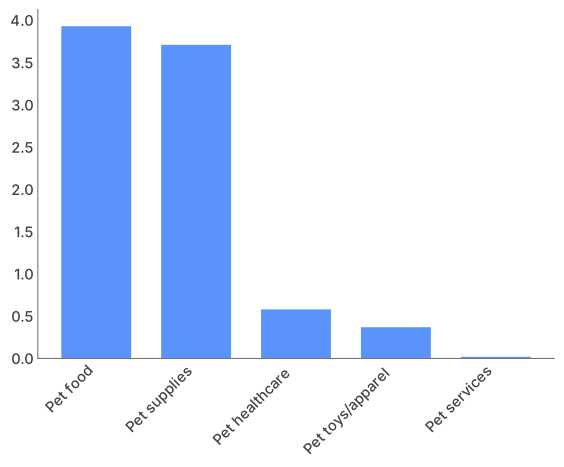
China's pet category has crossed an inflection point. Multi-platform e-commerce GMV reached USD 11.9 billion in 2025, up from USD 10.35 billion in 2024 — a +17.5% YoY expansion that outpaces nearly every adjacent China consumer category over the same period. The headline number matters less than the composition behind it: pet food now accounts for 45.7% of category revenue, pet supplies sits at 43.1%, and healthcare and accessories are the fastest-growing higher-margin segments.
Average pet-food prices climbed from CN¥ 61 in 2024 to CN¥ 91 in 2025, a +49% step-up that reflects deliberate consumer trade-up rather than inflationary drift. The 2024 entry-tier flush gave way to a 2025 mid-tier upgrade cycle, with mid-tier domestic brands in the CN¥ 50-150 band capturing the largest share of new revenue. Premium imported brands held their share at higher absolute price points. The trajectory rhymes with China beauty and infant formula in their respective premiumisation cycles.
Pet food and supplies dominate, with healthcare emerging
The Conversation Reallocation#
The single most important data point in this report is the multi-quarter trajectory of pet versus baby and maternity conversation share. Across multi-platform social listening, the ratio of pet posts to baby posts has expanded from 1.13× in 2024-Q1 to 3.00× in 2026-Q1 — a structural reallocation of consumer attention across two of China's most emotionally invested consumer categories. Each successive quarter expands the ratio with one mid-cycle exception (2025-Q1's 1.16×, attributable to Spring Festival timing), and the directional consistency removes the easy explanation that any single quarter is a seasonal artefact.
The most defensible signal sits inside the 2024-Q4 to 2025-Q4 window: 1.44× to 1.62×, a 12.5% expansion across the most comparable like-for-like period. The 2026-Q1 step-change to 3.00× includes both a structural reallocation and a partial methodology effect from baby-keyword coverage drift, which the report explicitly discloses. Either way, the direction is unambiguous, and the cultural framing — pets as 毛孩子 (furry children) and 它经济 (the it-economy) — has converted what was once a discretionary category into a pillar of household identity for the post-1995 and post-2000 cohorts most active on multi-platform social.
The macro context is well-rehearsed. China's birth rate has eased for nine consecutive years, and Goldman Sachs projects that urban pets will outnumber young children two-to-one by 2030 — a threshold already crossed in major tier-1 cities. For brand and investment teams who have historically allocated emerging-market growth budgets to baby and infant care, the trajectory is the prompt for portfolio recalibration. The cultural conditions that built China's modern baby category over two decades — emotional investment, premium positioning, gift-giving rituals, generational anxiety — are now expressing themselves through the pet category at a meaningfully higher growth rate.
The Corporate Signal#
Ten of China's largest FMCG groups have launched or acquired pet category subsidiaries between 2017 and 2024. Of the seven with reportable parent-trajectory data, every single one shows a softening core category alongside accelerating pet-line growth. The pattern is not opportunistic adjacency; it is documented portfolio rebalancing by the most established China consumer-goods institutions.
Want Want's pet snack line grew +67.4% YoY in 2025 while its rice-cracker core eased -4.7%. Mengniu's pet line grew +44.2% while its dairy core moved -2.9%. Tongwei is the most instructive lens on the pivot: both its animal-feed core (+2.1%) and its pet subsidiary (+27.3%) grew, reflecting natural adjacency rather than substitution. Three additional pet subsidiaries — Wahaha, Junlebao, and Feihe — launched too recently for YoY comparison, and their parent core categories all moved into rebalancing territory. Negative core-category YoY appears here as evidence of capital-allocation context, not as a brand performance indictment.
The structural significance of the pattern is that it converts the cross-vertical conversation migration into a board-level capital-allocation signal. The same parent groups that built China's modern infant-formula, dairy, and snack categories are now redirecting strategic investment into pet sub-brands — and disclosing the pivot in their 2025 results. For investors, the implication is to value pet sub-brands inside FMCG portfolios on growth multiples rather than parent-group multiples.
The Runway#
China's per-pet annual spend reached USD 95 in 2025, up from USD 83 in 2024, but still represents only one-tenth of the United States' USD 961 per-pet level. Hong Kong sits at USD 122 per-pet, with strong YoY momentum following category expansion onto its principal e-commerce platform. The China-US gap is the working definition of the China pet opportunity: a category large enough to be strategically material, growing fast enough to compress timelines, and structurally underspent on a per-pet basis relative to mature peer markets.
Both markets are growing at comparable rates — China at +17.5% YoY value growth versus the United States at +19.7% — on bases roughly twelve times apart. That combination leaves substantial premiumisation headroom. Each of the per-pet gaps is closeable, and each is closing: China pet healthcare, services, and accessory sub-segments are growing at rates that imply convergence over a five-to-seven-year window for the per-pet spend benchmark. Even with no incremental pet-population growth, premiumisation alone could roughly triple per-pet spend toward the Hong Kong benchmark over a five-to-seven-year window, and US-level spend remains the asymptotic ceiling.
Domestic Chinese brands command an estimated 65-70% of category share — the inverse of the US, where domestic brands hold roughly 5-8% category share for non-acquired brands. Domestic players have effectively secured the value tier and the mid-tier; the next contested boundary is the CN¥ 150-400 premium band, where domestic brands have moved from sub-1% share in 2020-2021 to a 10.9% combined top-five share in 2025. The five-year arc mirrors the trajectory of domestic brands in beauty and dairy through their respective premiumisation cycles.
Key Takeaways#
- China's multi-platform pet e-commerce category reached USD 11.9 billion in 2025, expanding +17.5% YoY from USD 10.35 billion in 2024.
- The pet-to-baby conversation ratio expanded from 1.13× to 3.00× across nine quarters; the defensible 2024-Q4 to 2025-Q4 progression alone moved from 1.44× to 1.62×.
- Pet food average selling price climbed from CN¥ 61 in 2024 to CN¥ 91 in 2025, a +49% step-up driven by mid-tier consumer trade-up rather than inflation.
- Seven of seven Chinese FMCG parents with reportable trajectories are reallocating capital into pet subsidiaries growing in the +18% to +67% range while core categories rebalance.
- China's per-pet annual spend of USD 95 sits at one-tenth of the US's USD 961, implying a decade-plus premiumisation runway even before pet-population growth.
About the Data#
This analysis draws on Moojing Market Intelligence proprietary research across mainstream e-commerce and social listening platforms, covering a nine-quarter window from 2024-Q1 to 2026-Q1. Category sizing is aggregated across mainstream e-commerce platforms; cross-vertical conversation analysis applies a category CID for pet content and a keyword set (母婴 * 婴儿奶粉 * 纸尿裤 / 宝宝) for baby and maternity content, with full methodology caveats disclosed in the source whitepaper. Cross-country benchmarking pairs China data with United States, Hong Kong, and Japan figures from comparable e-commerce datasets to support like-for-like per-pet spend comparisons.
Download the Full Report#
Get the complete analysis with detailed data, methodology, and additional insights.
This content adheres to Moojing's editorial standards .


