China Probiotics E-Commerce Q1 2024: Condition-Led Growth
 By Quan Wenjun
5 min read
By Quan Wenjun
5 min read
Newer data: China GI Health Supplements Reach CN¥ 3.88B in 2025
Executive Summary#
Probiotics sales on two leading Chinese marketplaces reached CN¥ 1.92B in Q1 2024. The category came under pressure in the quarter as market saturation, the spread of probiotic ingredients into other product categories and broader consumer caution weighed on demand. Health supplements took the largest share of revenue at 41.0% and came under the most pressure, while dairy products held almost flat. Beneath the headline, three condition-specific segments of the supplement market grew strongly, adjuvant therapy by 101.9%, oral health by 80.2% and mood regulation by 64.1%. We believe their growth comes from positioning each product against a specific health condition and selling it through social commerce.
A Market in Transition as Probiotics Spread Across Categories#
Over the two years before this quarter, probiotics gained broad recognition among consumers for their gut health and immune support benefits, and the category expanded quickly. That phase of growth has since slowed, because probiotic ingredients have spread across food, beverage, personal care and supplement formats, which has fragmented demand and intensified price competition.
Monthly sales from April 2022 to March 2024 follow the promotional calendar, with pronounced peaks around the 618 Festival in June and Double 11 in November and quieter months after each event. Sales peaked at CN¥ 1.29B in November 2023 and were followed by quieter months from December to February, which shows how much demand the promotions pull forward. Sales came under pressure in each of the three months of Q1 2024, so the pressure was sustained across the quarter and did not come from a single weak month.
How Revenue Splits Across Three Categories#
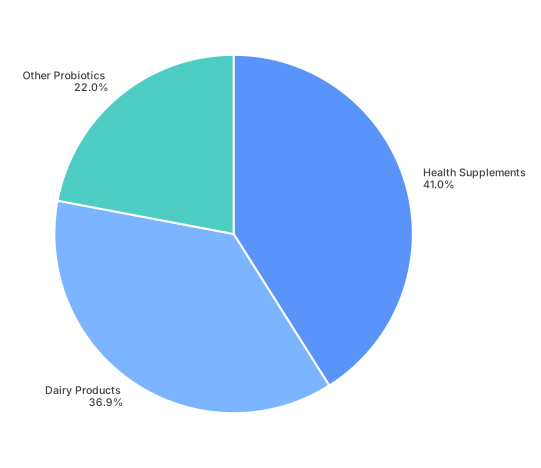
Health supplements accounted for CN¥ 790M of the quarter's revenue, dairy products for CN¥ 710M and other probiotic products for CN¥ 420M, and while supplements came under the most pressure, dairy and the other probiotic products were almost flat.
Health supplements account for 41% of probiotics revenue
Health Supplements: Growth Moves to Condition-Specific Segments#
Within the CN¥ 790M health supplements market, the eight functional segments moved in two directions. The established segments, gut health with 55.9% of supplement sales, immune regulation with 10.6% and women's intimate care with 6.8%, came under pressure as the surge of consumer interest in probiotics after the pandemic eased. Three newer segments that each address a specific condition grew by more than 50%.
Emerging Segment Highlights#
-
Adjuvant therapy (+101.9% YoY, CN¥ 6.69M): Imported specialist brands such as Lifesflora (舒伯特), PrecisionBiotics (普葆) and Morinaga (森永) position their products for IBS and inflammatory bowel conditions. An average selling price of CN¥ 296 makes this a premium segment.
-
Oral health (+80.2% YoY, CN¥ 24.1M): Volume grew 147.0%, well ahead of revenue, which shows that the segment is acquiring new consumers at lower price points. Much of its growth came through social commerce, in creator campaigns built around the social embarrassment of bad breath.
-
Mood regulation (+64.1% YoY, CN¥ 5.5M): Products aimed at children, students and adults with sleep difficulties use messaging about anxiety, concentration and sleep quality, which supports an average selling price of CN¥ 341.7, the second highest of any segment.
What This Means for Brands#
We believe the Q1 2024 data describes a market that is under pressure overall but still growing where products address a specific condition, and it points brand teams to three priorities.
-
Differentiate by the condition a product addresses. Adjuvant therapy grew 101.9% while generic gut health probiotics came under pressure, which shows consumers moving beyond general claims such as "good for digestion" towards specific health outcomes.
-
Invest in social-commerce infrastructure. The growth of the oral health segment came largely from content commerce. Earth Park (地球乐园), for example, has worked with content creators over a sustained period on campaigns about the social embarrassment of bad breath. We believe the loop from content to purchase had become a major source of growth for the newer probiotics segments by 2024.
-
Watch dairy for volume signals. While health supplements came under pressure, dairy probiotics gained share through habitual, everyday consumption, with probiotic yoghurt growing approximately 57% and March 2024 setting the highest monthly dairy volume in two years. This suggests that consumers may be moving part of their probiotic intake from premium supplement formats to more affordable dairy products.
Key Takeaways#
- Probiotics sales on two leading Chinese marketplaces reached CN¥ 1.92B in Q1 2024, in a quarter when the category came under pressure
- Health supplements: CN¥ 790M; dairy: CN¥ 710M, almost flat; other probiotics: CN¥ 420M, almost flat
- Gut health accounts for 55.9% of health supplement sales
- Three condition-specific segments grew by more than 50%: adjuvant therapy (+101.9%), oral health (+80.2%) and mood regulation (+64.1%)
- Probiotic yoghurt grew approximately 57%, and March 2024 set the highest monthly dairy volume in two years
- Oral care probiotics within the "other" category grew 19.8%, as the oral microbiome becomes a mainstream idea among consumers
About the Data#
This analysis is based on Moojing Market Intelligence data covering Q1 2024 (January to March 2024), compared with Q1 2023, and on monthly data from April 2022 to March 2024. The data covers two leading Chinese marketplaces[1].
Download the Full Report#
Download the full China Probiotics E-Commerce Q2 2024 report
This content adheres to Moojing's editorial standards .
Frequently Asked Questions
The spread of the ingredient itself. Probiotics sales on two leading marketplaces reached CN¥ 1.92 billion in Q1 2024. As probiotics have moved across food, beverage, personal care and supplement formats, demand has fragmented and price competition has intensified, weighing most on the established supplement formats. Health supplements led revenue share at 41.0% and CN¥ 790 million, while dairy held steady at CN¥ 710 million. The monthly pattern shows heavy promotional dependence, with a November 2023 peak of CN¥ 1.29 billion followed by a December-to-February trough, so any single quarter is best read against the promotional calendar.
Three, all condition-specific and all growing more than 50%. Adjuvant therapy grew 101.9% to CN¥ 6.69 million, positioned by imported specialists for IBS and inflammatory bowel conditions, in a premium market where sales are concentrated among a few brands at an average price of CN¥ 296. Oral health grew 80.2% to CN¥ 24.1 million, with volume up 147.0%, so it is acquiring new consumers at lower price points instead of selling more to existing ones. Mood regulation grew 64.1% to CN¥ 5.5 million, aimed at children, students and adults with sleep difficulties, sustaining a CN¥ 341.7 average price on anxiety-framed messaging about concentration and sleep quality.
Whether the claim names a condition. Generic gut health still accounts for 55.9% of the supplement category, but momentum has moved away from it and from broad immune regulation and women's intimate care claims, while every segment tied to a specific health outcome grew more than 50%. Consumers have moved past "good for digestion" toward a named problem they recognise in themselves, and the brands that sell the outcome rather than the ingredient are the ones gaining ground. That is the most actionable line in the dataset, and it tells a brand to differentiate by condition rather than by ingredient.
In social-commerce infrastructure and in dairy volume signals. The oral health story is fundamentally a content-commerce one, in which the segment's fastest growth came from sustained creator collaborations built around the social embarrassment of bad breath, which is a scenario rather than a specification. By 2024 the content-to-commerce loop had become a major growth engine for emerging probiotics segments. Separately, watch dairy: probiotic yoghurt grew roughly 57% and March 2024 set the highest monthly dairy volume in two years, which suggests consumers may be shifting their probiotic intake from premium supplement formats into cheaper everyday dairy. If that is what is happening, part of the shift in supplements is a channel migration into dairy rather than a loss of demand.


