Gut-Health Claims Move Into Cat Food in China, Not the US
 By Jessie Wang
6 min read
By Jessie Wang
6 min read
Executive Summary#
Get the Full Report: Download the complete analysis for detailed data, methodology, and pages of insights.
Between 2022 and 2025, probiotic and digestive claims gave up 5.24 and 7.34 percentage points of the pet supplements shelf on a leading Chinese marketplace, and gained 2.66 and 2.70 points of the cat staple-food shelf over the same four years. The sellers moved with the claim: probiotic-titled food listings grew from 518 to 1,466 and digestive-titled from 570 to 1,684. On a leading United States marketplace the same two claims added 4.06 and 7.49 points of the supplements shelf instead. "The pet microbiome is a major trend" is true in both markets and implies contradictory action in each.
The Trend Statements Leave Out the Shelf#
Four pet-health trends are reported as current across the trade press: pet longevity, pet humanisation, the pet microbiome, and precision nutrition. Each arrives as a category-level assertion, without a market or a shelf attached.
A shelf, throughout this article, means one marketplace category — the group of products a shopper browses within. Two of them matter here: cat staple food, and pet supplements.
That omission is where the commercial value sits. A trend statement that does not name a shelf cannot be acted on. The action it implies — formulate a staple food, or build a supplement — is a different action on each shelf, and the same sentence sends a brand to two different factories depending on which market reads it.
So we measured. Every claim below is expressed as a share of its own shelf's revenue in the same year, on one leading marketplace per market, across the four complete years 2022 to 2025.
Both Microbiome Claims Moved the Same Way#
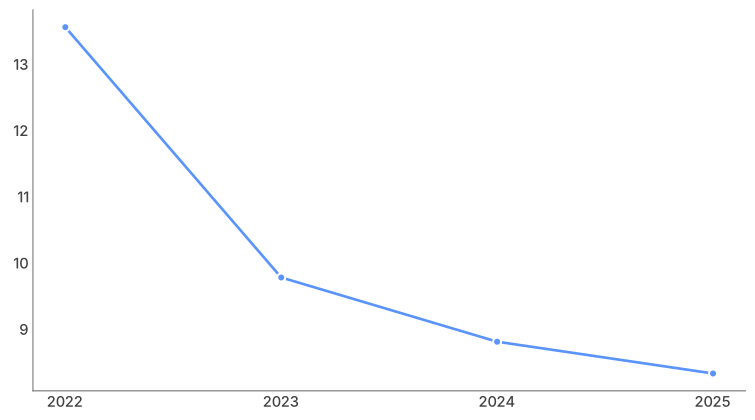
On the Chinese food shelf, probiotic claims rose from 1.61% to 4.27% of shelf revenue. Digestive claims rose from 1.28% to 3.98%. On the supplements shelf the same two claims went from 13.56% to 8.33% and from 18.07% to 10.74%.
All four paths move in the same direction in every intermediate year. Neither side of the story rests on a single-year move.
The claim moves shelf rather than shrinking
Supply Moved With the Claim#
Revenue share alone would leave open the possibility that a handful of large listings carried the move. The supply side closes it.
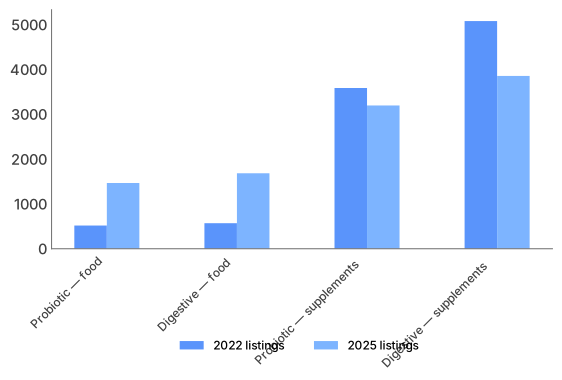
On the food shelf, probiotic-titled listings grew from 518 to 1,466 and the sellers carrying them from 224 to 431. Digestive-titled listings grew from 570 to 1,684, across 248 to 492 sellers. The food shelf as a whole added about 9% more listings over the same four years, so these two claims grew roughly twenty times faster than the shelf carrying them.
The supplements shelf added some 5,740 listings between 2022 and 2025, and none of them went to these two claims. Probiotic stood at 3,196 listings on that shelf in 2025 and digestive at 3,855. Sellers moved with the shoppers.
Sellers moved with the shoppers
Why a Young Shelf Can Absorb a Claim a Settled One Cannot#
What follows is a reading of the data, not a finding in it. What we measured is the movement. What comes next is the explanation we are offering for it, and an auditor should press on it. On that reading, a staple-food shelf that is still taking shape can absorb a health claim that a settled shelf cannot. China's cat staple-food shelf is the younger of the two and is still being formed, so a claim that shoppers already recognise can go straight onto the bag.
Where a shelf's categories are already settled, the claim has to be sold beside the food instead. That is what the American data shows. Over the same four years, probiotic claims went from 34.59% to 38.65% of the United States supplements shelf and digestive claims from 14.42% to 21.91%, while both stayed near 2% of the food shelf. American pet food organised itself decades ago around a different set of claims. Grain content is the one of them this study measures, and it is already receding; those slots are taken.
At 38.65% of shelf revenue, two dollars in every five, the probiotic word defines that shelf.
What This Changes#
A brand selling probiotics in China as a standalone supplement should treat the food shelf, not the supplements shelf, as its real competitive set. What the data supports is a staple-food listing that carries the claim. Broadening the supplement range instead means investing in the one shelf the claim is leaving.
For a brand planning a probiotic line extension in the United States, the claim already accounts for two dollars in every five on the shelf it would enter. The defensible position is the second claim on the label: strain specificity, delivery format, life stage.
The reading behind both recommendations can be tested. If probiotic claims in China stall below 4.27% of the food shelf while the supplements figures stop reallocating, then nothing is migrating between the shelves — and this recommendation goes with it.
Key Takeaways#
- Probiotic and digestive claims gave up 5.24 and 7.34 points of the Chinese supplements shelf, 2022-2025, and gained 2.66 and 2.70 points of the cat staple-food shelf.
- Supply followed: food-shelf listings for the two claims roughly tripled, while the supplements shelf grew 5,740 listings without adding to either claim.
- The same two claims added 4.06 and 7.49 points of the United States supplements shelf over the identical window.
- At 38.65% of that shelf, probiotic no longer differentiates a product.
- A trend statement without a market and a shelf attached implies contradictory action in the two markets measured here.
About the Data#
This article summarises findings from the Moojing report Pet Brands Are Selling Gut Health as Food in China and as a Supplement in the US. Data covers complete calendar years 2022 to 2025 on one leading Chinese marketplace and one leading United States marketplace. On the United States shelf, dog products carry about twelve times the 2025 revenue of cat products, so the United States supplements movements reported here are predominantly dog behaviour. The Chinese supplements shelf also covers both species, though this data cannot split it by species. Neither market is represented by a cat-only shelf while the other uses a combined one. A claim is counted when its keyword appears in the product title, and is then expressed as a share of that shelf's own revenue in the same year; no absolute revenue is compared across markets, because currencies, price bases and data versions differ. Claim groups are independent, overlapping selections and are never summed — a senior-cat food that also claims probiotic content appears in both. This analysis measures what products claim and where those claims sell. It makes no assessment of whether any ingredient or formulation works.
Download the Full Report#
This content adheres to Moojing's editorial standards .


