How Midea Won Germany: Inside the PortaSplit Sell-Out
 By Jessie Wang
5 min read
By Jessie Wang
5 min read
Executive Summary#
Get the Full Report: Download the complete analysis for detailed data, methodology, and pages of insights.
When Europe's June 2026 heatwave sold out portable air conditioners, the headline wrote itself: "Chinese air conditioners conquered Europe." The Amazon marketplace data tells a sharper story. Midea did not conquer a continent — it won a country. On Amazon DE it is the No. 1 portable-AC brand at 19.0% share, a €476 average price and +56.7% year-on-year growth, leading from the premium tier. Elsewhere in Europe the category boomed too, but incumbent De'Longhi still leads. The replicable insight is a two-brand, regulation-aware playbook.
Germany Is Midea's Premium Fortress#
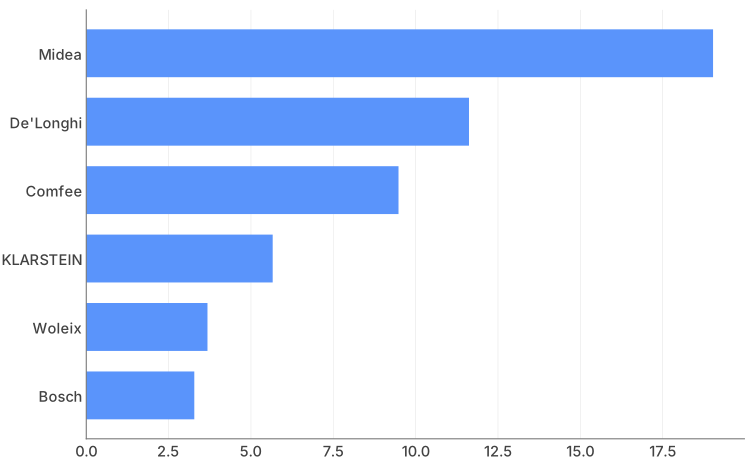
Midea leads Germany's portable-AC market the way few would predict for a Chinese appliance brand: from above the incumbents on price. It holds 19.0% brand share at a €476 average selling price, growing +56.7% year-on-year, while pricing above the two established Western names in the top tier — De'Longhi (€546) and Bosch (€488) — and at roughly double the monobloc value field below it.
That premium leadership is what separates a durable position from a heat-driven spike. Premium share is far harder to assemble in a single season than value share bought on price. Midea's German lead rests on a narrow, high-value product base: two "PortaSplit" SKUs — a €899.99 heat-pump model and a €999 variant — together delivered about €8.7 million and 9,007 units over the measured window, roughly two-thirds of Midea's German revenue.
Midea leads Germany at 19.0% share — from above the incumbents on price
One Boom, Four Markets — And the Win Is German#
The 2026 demand shock was genuinely category-wide. Across the four Amazon marketplaces we analysed, the French portable-AC category grew +95% and the UK category +134% year-on-year, lifting every capable supplier — Western incumbents and Chinese entrants alike. Trade data reinforces the scale: EU air-conditioner exports reached US$3.76 billion in H1 2026, up +43.2%.
Yet Midea's own brand is No. 1 only in Germany. It ranks fifth in France, sixteenth in Italy, and far down the field in the United Kingdom, where incumbent De'Longhi still leads. The same brand, the same heatwave, four very different outcomes. Reading a Germany-specific fortress as a continent-wide sweep is the single most common error in the popular coverage; the disciplined view separates a demand shock that lifted everyone from a product-and-position win that is, so far, German.
The Two-Brand, Regulation-Aware Playbook#
The replicable pattern sits at the group level. Comfee is a Midea Group value sub-brand, and counting the two brands together, Midea Group is the No. 1 portable-AC group in both Germany (28.5% combined share) and France (26.6%). The two markets are won in opposite ways: Germany is a premium Midea win with a Comfee value flank, while France inverts — Comfee leads the whole market and Midea's own brand is a modest premium presence. One parent, two brands, each localised to a market's price ladder.
The product is engineered to Europe's rules rather than around them. Contrary to the popular "F-gas loophole" story, the PortaSplit uses R32 refrigerant at a 0.62 kg charge and runs at 39 dB in silent mode. Its real edge is architectural: a movable-bracket form factor that delivers split-system cooling with no drilling or façade alteration — the changes that trigger permission and professional-installer rules across Europe — while staying under France's inspection threshold and within German night-noise limits. The value it sells is access for renters, not a saved installation bill: household air-conditioning penetration is only about 19% across Europe and roughly 3% in Germany, so a no-install product reaches demand that fixed splits legally cannot.
How the Story Travelled#
The European sell-out registered as a real event back home. Conversation about the PortaSplit and the European cooling story jumped from about 114 posts in a baseline week to roughly 76,320 in the event week on mainstream social platforms — an increase of around 670×. We report that intensity as an observed phenomenon rather than an endorsed narrative; whether the attention feeds back into brand equity or premium pricing is a plausible hypothesis, not a measured effect.
Key Takeaways#
- Midea is Germany's No. 1 portable-AC brand at 19.0% share, €476 average price, +56.7% YoY — a premium leadership, not a value one.
- The heatwave lifted every market (France +95%, UK +134% YoY), but Midea's own-brand strength is concentrated in Germany; De'Longhi still leads France, Italy and the UK.
- Counting value sub-brand Comfee, Midea Group is the No. 1 group in Germany (28.5%) and France (26.6%) — a two-brand playbook, localised market by market.
- The product wins on a movable-bracket, no-drill form factor (39 dB, R32 / 0.62 kg) designed to European installation and noise rules — access for renters, not a cheaper install.
About the Data#
This analysis is based on Moojing Market Intelligence proprietary research across Amazon marketplace activity in Germany, France, Italy and the United Kingdom, alongside mainstream Chinese e-commerce and social evidence. The Amazon data horizon is April 2026; the late-June sell-out peak is carried by dated third-party news citations (Caixin Global, heise.de, EqualOcean, WMO). Product facts follow Midea UK/NL spec sheets; air-conditioning penetration figures follow WRI / IEA.
Download the Full Report#
Get the complete analysis — the four-market breakdown, the Midea Group two-brand tables, the regulation-aware product teardown, and the domestic-market mirror.
This content adheres to Moojing's editorial standards .
Frequently Asked Questions
No — the marketplace data supports a country win, not a continental one. The demand shock was genuinely category-wide: the French portable-AC category grew +95% and the UK category +134% year on year, lifting every capable supplier, and EU air-conditioner exports reached US$3.76 billion in H1 2026, up +43.2%. But the Chinese challenger that leads Germany ranks fifth in France, sixteenth in Italy, and far down the field in the UK, where the Western incumbent still leads. Same brand, same heatwave, four different outcomes — and reading a Germany-specific position as a European sweep is the most common error in the popular coverage.
It was won from above on price, not from below. The leading challenger sells at a €476 average, above the two established Western names in the top tier at €546 and €488, and at roughly double the value monobloc field beneath it. Premium share is far harder to assemble in a single season than value share bought on discount, which is exactly what separates a durable position from a spike. The base is narrow and high-value: two movable-bracket SKUs at €899.99 and €999 delivered about €8.7 million and 9,007 units over the measured window, roughly two-thirds of that brand's German revenue.
European installation and noise rules, rather than a way around them. Contrary to the popular "F-gas loophole" story, the unit uses R32 refrigerant at a 0.62 kg charge and runs at 39 dB in silent mode. Its real edge is architectural: a movable-bracket form factor delivering split-system cooling with no drilling and no façade alteration — precisely the changes that trigger permission requirements and professional-installer rules across Europe — while staying under France's inspection threshold and within German night-noise limits. What it sells is access for renters, not a saved installation bill. Household air-conditioning penetration is only about 19% across Europe and roughly 3% in Germany, so a no-install product reaches demand that fixed splits legally cannot.
Two brands under one parent, each localised to a market's price ladder. Counting the group's value sub-brand alongside its premium brand, the same parent is the leading portable-AC group in both Germany at 28.5% and France at 26.6% — but the two markets are won in opposite ways. Germany is a premium win with a value flank; France inverts it, with the value brand leading the whole market and the premium brand a modest presence. One parent, two positions, chosen per market rather than exported from home. Group-level strength can be built without a single brand having to win everywhere on the same terms.


