Southeast Asia Beauty 2026: Skincare Anchors, Singapore Premiums, Indonesia Volumes
 By Jessie Wang
6 min read
By Jessie Wang
6 min read
Executive Summary#
Get the Full Report: Download the complete analysis for detailed data, methodology, and pages of insights.
Southeast Asia's online beauty and skincare market reached CN¥ 40.45 billion in 2025, up +23.8% year-over-year, with skincare carrying twice the absolute size of cosmetics across the region. Indonesia anchors scale at CN¥ 12.97 billion. Singapore leads growth at +62.8% YoY despite the smallest absolute size. Men's skincare grew above 100% region-wide and nearly 200% in Indonesia. The structural anchor of SEA beauty is now unambiguously skincare — and the country playbooks diverge sharply enough to require per-country brand strategy.
Skincare Carries the Region#
The 2025 split between skincare and color cosmetics is no longer close. Skincare reached CN¥ 27.15 billion across the six SEA countries — more than double the CN¥ 13.29 billion in cosmetics. The two categories grew at similar rates (skincare slightly faster at ~24% YoY), but the absolute gap has structural implications: any category playbook that treats SEA beauty as a balanced skincare-cosmetics market is mispriced.
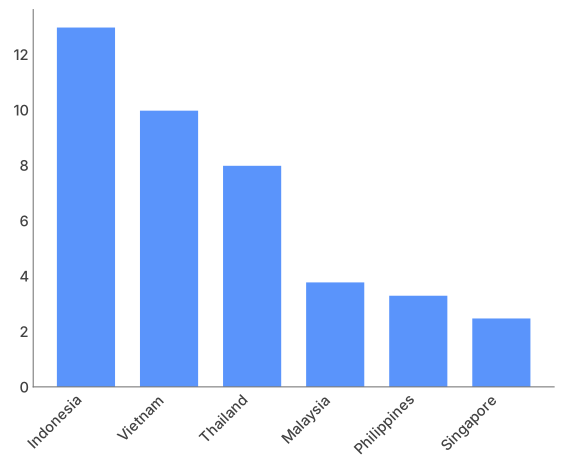
Indonesia anchors CN¥ 13B; Singapore grows +62.8%
Indonesia: The Volume Gate#
Indonesia is the volume gate for SEA beauty. The CN¥ 12.97 billion figure is larger than Thailand, Malaysia, the Philippines, and Singapore combined. Year-over-year growth was a measured +15.5% — slower than the regional outliers, but on a much larger base.
The Indonesian skincare market is led by local brands, which hold six of the ten highest-volume positions. Skintific (a Chinese-origin brand that has localised heavily) remains the top seller. Local brands GLAD2GLOW and Kahf have each grown above 90% YoY. Among the leading 100 brands, local brands hold 60% of the volume pool, with Korean brands at 13% — driven by K-culture diffusion and social media circulation.
In Indonesian cosmetics, the structure is broadly similar. Local brands lead the most-purchased cohort with 54% aggregate share among the highest-volume brands. Chinese brands hold 16%. Maybelline (US) leads outright. Among local brands, Oh My Glam (+98.8% YoY) and Glad2Glow (+453.8%) led growth — both unambiguously in the high-growth tier per the partner brand-level data.
Category drivers in Indonesia are reallocating. Skincare sets and moisturizers form the structural demand foundation. Men's skincare grew nearly +200% YoY — the highest growth rate of any sub-category, driving demand for shaving products, cleansers, and after-sun repair. In cosmetics, face base and lip products lead absolute volume. Lip liner grew +100% YoY in Indonesia specifically.
Singapore: The Premium Gate#
Singapore is the premium gate. At CN¥ 2.47 billion absolute size, Singapore is the smallest SEA beauty market — but it is the country where premium positioning translates most cleanly into measurable consumer pull. Singapore's skincare market is 80%+ of beauty. Premium imported brands (Korean K-beauty, Western prestige, niche Japanese) hold meaningful share without the price compression seen in volume markets.
For brands testing a premium proposition before regional scale-up, Singapore is the natural pilot. Three reasons:
First, the consumer signal is cleaner. Singapore's beauty market is more concentrated in mid-to-high-end pricing, with less reliance on flash-sale and live-commerce volume mechanics. A premium pull-through that holds in Singapore is more likely to indicate genuine brand equity than the same signal from Indonesia or Vietnam, where promotional density is higher.
Second, regulatory speed is unmatched. The HSA (Health Sciences Authority) reporting system clears in 1-2 weeks — the fastest beauty market entry route in SEA. Indonesia's BPOM cycle runs 3-4 months. Thailand's TFDA runs 3-4 months. Vietnam's DAV runs 1-3 months. Malaysia's NPRA runs 2-4 weeks.
Third, the test signal extrapolates. Singapore's premium share growth historically leads Malaysia's by 12-18 months. If a brand demonstrates measurable premium pull in Singapore in Q1, the prudent next test is Malaysia in Q3-Q4 of the same year, then Thailand and Indonesia at premium-tier sub-segments through the following year.
Vietnam, Thailand, and Malaysia — The Steady Middle#
The three mid-tier markets carry meaningful absolute size with steady growth profiles. Vietnam reached CN¥ 9.97 billion (+32.2% YoY) — the second-largest beauty market in SEA after Indonesia, with growth fast enough to close the absolute gap by 2027 on current trajectories. Thailand sits at CN¥ 7.98 billion (+21.7%), a mature market with consumer habits closer to Japan/Korea than to the Indonesia mass-market template. Malaysia at CN¥ 3.77 billion (+37.2%) is the fastest-growing mid-tier market with a balanced price-band structure.
Sub-category preferences vary by country in the mid-tier. Sunscreen is prominent in Vietnam — driven by climate and increasing UV-awareness in consumer education. Lip products are prominent in the Philippines. Across the region, facial serums, moisturizers, and skincare sets emerge as common hotspots — these are the categories where a single regional product launch can translate efficiently across multiple markets.
Regulatory Backdrop — Indonesia's October 2026 Deadline#
The single most consequential regulatory date for SEA beauty is October 2026: Indonesia mandatory halal certification. Any brand without halal certification will not legally sell in Indonesia's beauty category from that date forward. Halal is now a category gate, not a marketing point.
Brands without current Indonesia presence should sequence the certification work into their 2026 H1 planning. Brands with existing Indonesia presence should validate their existing supplier and manufacturing chains against the BPJPH (Halal Product Assurance Agency) requirements before Q3 2026.
The other regulatory cycles are unchanged but worth refreshing for any brand teams planning entry: BPOM (Indonesia, 3-4 months), HSA (Singapore, 1-2 weeks), TFDA (Thailand, 3-4 months), FDA (Philippines, 2-4 months), NPRA (Malaysia, 2-4 weeks), DAV (Vietnam, 1-3 months). Local agent requirements are mandatory across all six markets.
What This Means for 2026 Brand Strategy#
Three implications for SEA beauty brand teams planning the next 12-18 months:
-
Lead with skincare anchors. Moisturizers, facial serums, and skincare sets form the demand backbone in every market. A skincare-first regional product brief travels better than a cosmetics-first brief.
-
Indonesia is the volume gate; Singapore is the premium gate. These are not interchangeable. The product positioning that wins Indonesia (accessible price, local-cultural fit, halal-certified) is not the positioning that wins Singapore (premium tier, function-forward, K-beauty / prestige adjacencies).
-
Plan a six-month regulatory runway. The Indonesia halal deadline alone justifies starting certification work in Q1 2026 for brands planning Q4 2026 or 2027 launches. Use Singapore as the fastest pilot route in the meantime.
About the Data#
Data spans 2025 full-year online consumer e-commerce sales across six SEA countries. Brand cohort shares reference Moojing's proprietary coverage of the highest-volume brand pool per category per country.
More from This Report#
This article is part of our Southeast Asia 2026 series:
Download the Full Report#
Get the complete analysis with detailed data, methodology, and additional insights.
This content adheres to Moojing's editorial standards .
Frequently Asked Questions
CN¥ 40.45 billion in 2025, up +23.8% year on year — and the internal split is what changes strategy. Skincare reached CN¥ 27.15 billion, more than double the CN¥ 13.29 billion in colour cosmetics, with both growing at similar rates near 24%. The absolute gap has structural consequences: any regional playbook that treats Southeast Asian beauty as a balanced skincare-cosmetics market is mispriced. A skincare-first product brief travels across these markets considerably better than a cosmetics-first one.
Indonesia is the volume gate at CN¥ 12.97 billion — larger than Thailand, Malaysia, the Philippines and Singapore combined — growing a measured +15.5% off that base. Vietnam is second at CN¥ 9.97 billion (+32.2%), fast enough to close the absolute gap by 2027 on current trajectories. Thailand at CN¥ 7.98 billion (+21.7%) is mature, with consumer habits closer to Japan and Korea than to the Indonesian mass-market template. Malaysia at CN¥ 3.77 billion (+37.2%) is the fastest-growing mid-tier market. Singapore is the smallest at CN¥ 2.47 billion but the fastest overall at +62.8%.
Three reasons, and only one is about size. The consumer signal is cleaner — Singapore's beauty market concentrates in mid-to-high-end pricing with less reliance on flash-sale and live-commerce volume mechanics, so premium pull-through there is more likely to indicate real brand equity than the same signal from a promotion-dense market. Regulatory speed is unmatched: HSA reporting clears in 1-2 weeks against 3-4 months for Indonesia and Thailand, 1-3 months for Vietnam and 2-4 weeks for Malaysia. And the signal extrapolates — Singapore's premium share growth historically leads Malaysia's by 12-18 months, so a Q1 result there points to a Q3-Q4 Malaysian test. Skincare is 80%+ of the market, so a premium test should be a skincare test.
Men's skincare above all — it grew over 100% region-wide and nearly 200% in Indonesia, the highest growth of any sub-category there, pulling demand for shaving products, cleansers and after-sun repair. Around it, skincare sets and moisturisers form the structural demand foundation in every market, and facial serums join them as the categories where one regional launch translates efficiently across borders. Country-specific pockets matter too: sunscreen is prominent in Vietnam on climate and rising UV awareness, lip products in the Philippines, and lip liner grew +100% in Indonesia specifically. The one hard date to plan against is October 2026, when Indonesian halal certification becomes mandatory — a category gate, not a marketing point.


