Vietnam and Indonesia Drive SE Asia's Hygiene Surge
 By Jotham Lim
4 min read
By Jotham Lim
4 min read
Executive Summary#
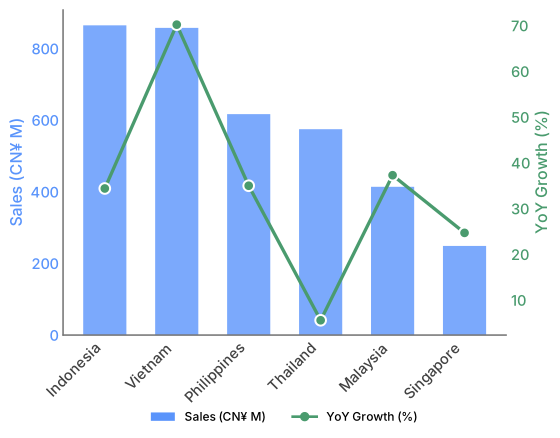
Online disposable hygiene sales across Southeast Asia reached CN¥ 3.6 billion in January-July 2025, and Vietnam grew 70.2% year on year (YoY) to come close to Indonesia, the region's largest market at CN¥ 865 million, which grew 34.4%.
Download Full Report#
Get the complete analysis with additional data on global e-commerce trends, China domestic market dynamics, brand-level rankings, and consumer feedback metrics.
Vietnam Emerges as the Region's Growth Leader#
Vietnam's online disposable hygiene market has grown faster than any other in Southeast Asia. At CN¥ 858 million, up 70.2% YoY, in January-July 2025, Vietnam nearly matches Indonesia's CN¥ 865 million while growing at more than twice Indonesia's rate. The Philippines (+35.0%), Malaysia (+37.3%) and Singapore (+24.7%) also grew by double digits, which shows that the opportunity extends well beyond the two largest markets.
At the growth rates of January-July 2025, we believe Vietnam could reach parity with Indonesia within 12-18 months. Thailand grew a more modest 5.6%, which likely reflects a more mature market and the effect of an ageing population on baby diaper demand. Thailand also has the region's largest adult diaper sales, at CN¥ 173 million, which reflects the oldest population in Southeast Asia, according to World Bank data.
Vietnam leads Southeast Asia growth at +70.2% YoY while Indonesia maintains largest market volume at CN¥ 865 million
How Southeast Asian Shoppers Buy Hygiene Products Online#
The leading marketplaces in the region are built around the way Southeast Asian consumers shop for everyday consumables. Gamified features, a busy promotional calendar and integrated payments keep shoppers engaged in categories they buy as often as diapers and sanitary pads.
MAKUKU Shows How a Chinese Brand Can Enter Indonesia#
The Chinese brand MAKUKU's progress in Indonesia's baby diaper market shows that an internationalisation strategy driven by social media can work in an established category. In Indonesia, Japanese brands such as MamyPoko and Merries and the American-backed Sweety have long been established.
MAKUKU's strategy rests on two pillars. The first is a diversified product range, split across the Comfort Fit, Dry Care and Slim Care series, which targets different groups of consumers according to their product needs and price preferences. The second is a localised social media strategy, with official accounts on TikTok, Instagram and YouTube that build the brand's influence and convert it into sales through content made for Indonesian consumers.
Vietnam's Premium Shift Signals Market Maturation#
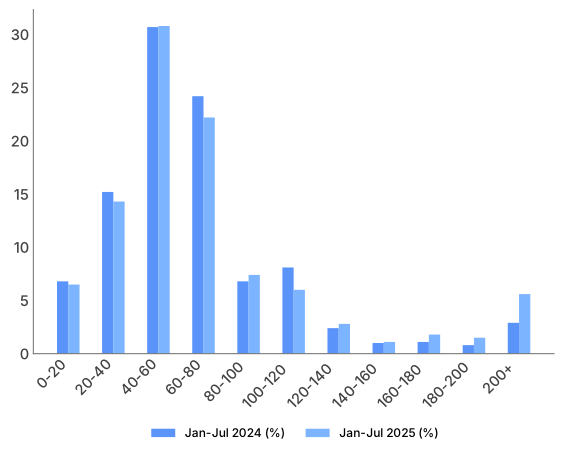
Vietnam's baby diaper market is moving towards premium products in a way that sets it apart from the rest of the region. The CN¥ 200+ price segment nearly doubled its share from 2.9% to 5.6% between January-July 2024 and the same period in 2025, while the mid-range segments (CN¥ 60-120) together lost ground. The core CN¥ 40-60 band held steady at approximately 31% of sales, which confirms it as the market's anchor price tier.
Huggies supports its position in Vietnam with premium pricing. Newcomers such as Gooby, Bebeboo and Kitin Natural have also entered the market at premium price points, which suggests that Vietnamese consumers increasingly look for products that are clearly better in quality.
Vietnam baby diaper demand shifts toward premium: segments above CN¥ 120 gain share while mid-range contracts
Market Entry Priorities#
For brands evaluating expansion in Southeast Asia, the data points to the following priorities:
- Indonesia first for scale. Indonesia is the largest market in the region, and MAKUKU's experience shows that a brand built on social media can win a place there.
- Vietnam for premium positioning. Fast growth and the shift towards premium products favour brands entering at higher price points, and differentiation through raw materials, including organic wood pulp and rice extract for skin care, is increasingly how leading brands compete.
- Thailand for adult diapers. With the region's oldest population and its largest adult diaper sales, Thailand is a specialised entry point for brands focused on products for an ageing population.
More from This Report#
About the Data#
This analysis draws on Moojing Market Intelligence's proprietary e-commerce transaction data from leading Southeast Asian marketplaces in Indonesia, Vietnam, the Philippines, Thailand, Malaysia and Singapore. Transaction data is analysed at SKU level. Year-on-year comparisons use consistent category definitions across disposable hygiene product segments (baby diapers, sanitary pads, adult diapers). The data covers January to July 2025. For methodology details, see the full whitepaper.
This content adheres to Moojing's editorial standards .
Frequently Asked Questions
The region reached CN¥ 3.6 billion in January–July 2025, and the growth is broad rather than concentrated. Vietnam is the standout at CN¥ 858 million and +70.2%, growing at more than twice Indonesia's rate of 34.4% while nearly matching its CN¥ 865 million in absolute size. At those growth rates, we believe the two could reach parity within 12-18 months of July 2025. The Philippines (+35.0%), Malaysia (+37.3%) and Singapore (+24.7%) all grew by double digits. Thailand is the exception at 5.6%, which likely reflects a more mature market and an ageing population.
Thailand's growth of 5.6% is the region's slowest, but it has the region's largest adult diaper sales, at CN¥ 173 million, which reflects the oldest population in Southeast Asia, according to World Bank data. That makes Thailand a better fit for a brand that makes products for an ageing population than for a baby diaper brand.
According to Moojing's H1 2025 whitepaper, overseas warehouses in Southeast Asia reached 136 in 2022, up 91.6% from 71 in 2021, with total warehouse area above 1 million square feet. The whitepaper finds that this buildout cuts delivery times from weeks to days, which matters for disposable hygiene products because shoppers usually buy them when they need them.
A market moving up while keeping its anchor. The above-CN¥ 200 price segment nearly doubled its share from 2.9% to 5.6% between the same periods of 2024 and 2025, while mid-range bands collectively gave up ground and the core CN¥ 40-60 band held steady at roughly 31%. The value anchor is intact, and a premium tier is forming above it. The competitive evidence points the same way: newcomers have entered at premium price points instead of undercutting, and raw-material differentiation such as organic wood pulp and rice extract is increasingly how leading brands compete.


