China's Online F&B Sales Reached CN¥ 593.7B in 2025, Up 7.8%
 By Jotham Lim
5 min read
Executive Summary#
China's online food and beverage market reached CN¥ 593.7 billion in 2025, growing 7.8% year-on-year (YoY), with volume up 6.3% and average prices up a modest 1.4%. Snack foods were the largest category at CN¥ 132.8 billion, while the fastest-growing categories, Grains, Oils & Cereals (+14.5%) and Instant Mixes (+13.8%), point to rising consumer demand for pantry staples and convenient nutrition. Sub-category breakouts such as fresh cakes (+154.2%) and high-protein snacks (CN¥ 12.5 billion) show a market that rewards health innovation and indulgence at the same time.
Download Full Report#
Get the complete analysis with nine-category breakdowns, brand-level performance, selling-point trends, and beverage market deep-dives.
Market Sizing: Volume-Led Growth Across Nine Categories#
China's online F&B growth was driven by demand, with volume expansion accounting for more than 80% of the total revenue increase. Volume grew 6.3% while the average price rose 1.4%, which shows that consumers are buying more often and across more categories, and are not simply trading up. We believe this broad-based pattern reflects a market that has moved beyond its post-pandemic recovery into sustained expansion.
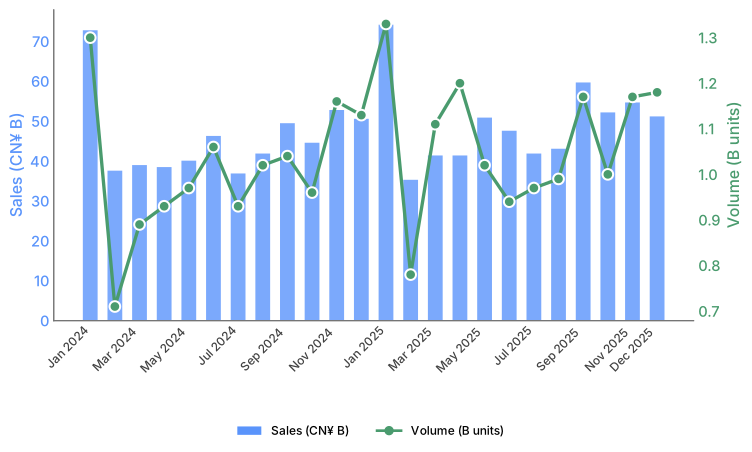
Monthly sales show a clear seasonal pattern that brands can plan around. Sales peaked in January on Chinese New Year gifting, reaching CN¥ 74.2 billion in 2025, and spending stayed high from September to November through the Mid-Autumn Festival and Double 11 promotions. The mid-year months (May-June 2025) grew faster against their 2024 counterparts than the holiday months did, which suggests that everyday consumption is strengthening as a growth driver alongside promotional spending.
F&B online market sustains broad-based growth through volume and price
Category Breakdown: Scale and Growth Sit in Different Categories#
The largest categories by sales are not the ones growing fastest. Snacks held the largest share at CN¥ 132.8 billion (+5.8% YoY), followed by Alcoholic Beverages at CN¥ 118.4 billion (+1.4%) and Dairy Products at CN¥ 92.4 billion (+9.0%), while mid-sized categories driven by convenience and health trends grew well above the market average.
Sub-Category Highlights: Where Innovation Meets Demand#
The highest-growth sub-categories are those where health trends and convenience demand meet premiumisation.
- Fresh cakes and chilled pastries grew 154.2% YoY, the breakout sub-category of 2025, helped by better cold-chain logistics and a consumer preference for short-shelf-life products
- High-protein snacks reached CN¥ 12.5 billion (+12.5% YoY), more than double the +5.8% growth of the overall snack market
- Beef jerky, pork floss and braised snacks grew 13.5% YoY, the fastest in snacks, as demand for high-protein options rose
- Tea powder and instant tea posted significant gains as consumers looked for convenient health beverages that sit between ready-to-drink and traditional preparation
- Tangerine peel tea benefited from the neo-Chinese wellness trend, as herbal ingredients gained mainstream acceptance
Premiumisation and value-seeking are happening at the same time: premium wellness alcohol (above CN¥ 100 per unit) and affordable everyday staples are growing in parallel, because they serve distinct consumer segments with different priorities.
Five Trends Reshaping F&B Through 2026#
The forces behind 2025 performance point to five trends that we believe will shape competition through 2026.
1. From health claims to precision nutrition. The market has moved past broad labels such as sugar-free and low-fat toward products that target specific conditions, including gut health, sleep quality and dampness relief. We expect these products to take a growing share of growth as consumers look for measurable outcomes in place of generic health signals.
2. Emotional selling points as a growth driver. Sales of snack products with emotional selling points grew 30.9% in 2025, faster than any other concept category in snack foods. We believe this shows that brand storytelling, collaborations with licensed characters and other intellectual property (IP), and cultural resonance are becoming primary purchase drivers.
3. Brand fragmentation deepens. Sales in most sub-categories are spread across many brands, and we expect this fragmentation to deepen as niche brands with clear scenario positioning continue to gain share from broad-portfolio incumbents. Brands that combine emotional resonance with functional credibility at scale, such as Genki Forest (元气森林) in wellness beverages, show the kind of positioning we expect the next generation of successful brands to share.
4. Traditional Chinese medicine (TCM) ingredients go mainstream. Herbal ingredients such as tangerine peel, chrysanthemum, astragalus and honeysuckle are moving from traditional health stores into mass-market beverage and snack formats, as China's domestic consumers increasingly value traditional ingredients in modern, convenient formats.
5. Social buzz decouples from sales. Social media mentions fell across snack and beverage categories even as sales continued to grow. We read this as a sign of a maturing market in which repeat purchases and established habits drive revenue, so marketing needs to shift from building awareness toward building loyalty and activating specific consumption scenarios.
About the Data#
This analysis draws on Moojing Market Intelligence data covering China's online food and beverage market for the full calendar year 2025. Moojing analyses brand and category performance across major Chinese e-commerce platforms. Sales figures reflect online channel sell-through and do not include offline retail. YoY comparisons are calculated against the corresponding 2024 period. For full methodology and additional category insights, see the complete Food & Beverage 2025 whitepaper.
This content adheres to Moojing's editorial standards .
Frequently Asked Questions
China's online food and beverage sales reached CN¥ 593.7 billion in 2025, up 7.8% year on year, and the growth came from demand more than from price. Volume grew 6.3% while the average price rose 1.4%, so volume accounts for more than 80% of the revenue increase, which means consumers bought more often and across more categories. Sales peaked in January on Chinese New Year gifting at CN¥ 74.2 billion and stayed high from September to November, while May and June grew faster against 2024 than the holiday months did, which suggests that everyday consumption is strengthening alongside promotional spending.
Scale and growth sit in different categories. Snacks are the largest at CN¥ 132.8 billion (+5.8%), followed by alcoholic beverages at CN¥ 118.4 billion (+1.4%) and dairy at CN¥ 92.4 billion (+9.0%). The fastest growth came from mid-sized categories driven by convenience and health, with grains, oils and cereals up 14.5% and instant mixes up 13.8%, close to twice the market's rate, so a portfolio weighted only to the largest categories will grow at about the market average.
Fresh cakes and chilled pastries grew fastest, by 154.2%, helped by better cold-chain logistics and a consumer preference for short-shelf-life products. High-protein snacks reached CN¥ 12.5 billion, up 12.5% and more than double the 5.8% growth of the overall snack market, with beef jerky, pork floss and braised snacks leading at 13.5%. Tea powder and instant tea gained as consumers looked for convenient health drinks that sit between ready-to-drink and traditional preparation, and tangerine peel tea benefited from the neo-Chinese wellness trend. Premium wellness alcohol above CN¥ 100 per unit and affordable everyday staples grew at the same time, because they serve two distinct groups of consumers.
We expect five shifts. Health claims are moving from broad labels to products that target specific needs such as gut health, sleep quality and dampness relief, where consumers expect measurable outcomes. Sales of snacks with emotional selling points grew 30.9%, the fastest of any concept dimension in snacks, so storytelling, collaborations with licensed characters and cultural resonance now act as primary purchase drivers. Brand fragmentation is deepening as niche brands with clear scenario positioning take share from broad-portfolio incumbents. Traditional Chinese medicine ingredients such as tangerine peel, chrysanthemum, astragalus and honeysuckle are moving from health stores into mass-market formats. Social media mentions are falling while sales grow, so marketing has to shift from building awareness toward building loyalty and scenario-based activation.


