Wellness Beverages Surge 32.7% as China Shifts to Function
 By Jotham Lim
5 min read
By Jotham Lim
5 min read
Executive Summary#
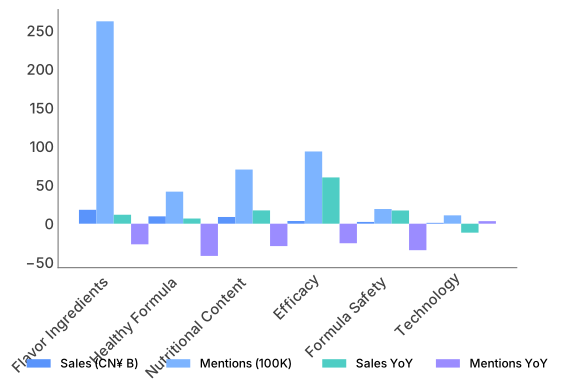
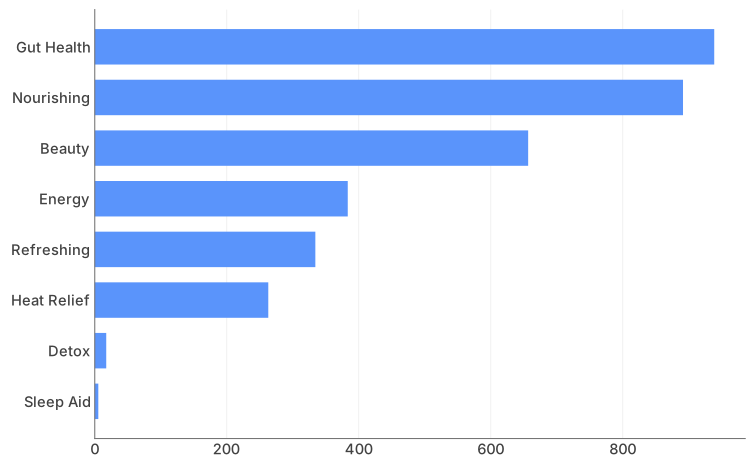
China's beverage market is moving towards health and function. Sales of beverages carrying efficacy concepts grew 59.9% year-on-year (YoY) to CN¥ 3.5 billion in 2025, even as social media mentions of efficacy fell 25.3%. We believe this shows that functional health claims have moved beyond early adopters into mainstream purchasing. Within this shift, wellness beverages were the fastest-growing segment at +32.7% YoY, and brands such as Genki Forest (元气森林) have built their positioning on neo-Chinese herbal ingredients. Gut health leads the functional efficacy claims at CN¥ 938.5 million, followed by nourishing claims at CN¥ 891.2 million, which suggests that digestive health and general wellness are where Chinese consumers begin buying functional beverages.
Download Full Report#
Get the complete analysis with additional data on all Food & Beverage segments, methodology details, and brand-level insights.
From Flavor to Function: The Selling Point Shift#
The clearest structural change in China's beverage market is that social media mentions fell in every major concept dimension except technology, while sales in those dimensions continued to grow. Flavor Ingredients still lead by sales at CN¥ 18.0 billion (+11.6% YoY), although their social media mentions fell 26.7%, and the same pattern appears in Healthy Formula (-41.7%), Nutritional Content (-29.0%) and Efficacy (-25.3%). When a product attribute keeps growing in sales while it receives less attention on social media, it usually means that consumers have come to expect the attribute and no longer treat it as a novelty worth discussing.
Efficacy concepts surge 59.9% while flavor ingredients maintain volume dominance
Gut Health Leads Functional Efficacy at CN¥ 938.5 Million#
Gut health is the largest functional efficacy claim in beverages at CN¥ 938.5 million, followed closely by nourishing claims at CN¥ 891.2 million. Together these two claims account for more than half of all functional efficacy beverage sales, which makes digestive health and general wellness the main entry points for consumers of functional beverages in China.
Gut health leads functional beverage efficacy with CN¥ 938.5 million in sales
Herbal Ingredients Bridge TCM and Modern Beverages#
Consumers are increasingly choosing beverages made with herbal ingredients, and birch sap, astragalus, honeysuckle and kale all posted significant YoY gains, with herbal ingredients growing by more than 80% YoY. We believe this growth reflects consumer interest in the principles of traditional Chinese medicine (TCM) applied to everyday drinks.
Brands that combine the credibility of TCM with the convenience of a modern beverage are winning a large part of the growth in a flavor category that is otherwise mature. Their products appeal both to consumers' trust in traditional health practice and to their demand for convenient formats. Products such as red bean barley water, birch sap drinks and honeysuckle grapefruit juice show how traditional ingredients are being reformulated for a mass market.
Wellness Beverages Grew 32.7% in 2025#
Wellness beverages grew 32.7% YoY in 2025, as consumer demand moved on from basic sugar reduction towards products that target specific functions. The segment supports a CN¥ 29.49-75.22 price range across five distinct positioning tiers, from accessible daily wellness drinks to premium products for targeted supplementation.
From "Light Wellness" to "Professional-Grade": The 2023-2025 Evolution#
The best-selling beverage products have changed over three distinct phases in line with the wider move towards health. In 2023 the best sellers were oolong tea, jasmine tea and sugar-free sparkling water, products whose appeal lay in avoiding sugar, fat and calories. The best sellers of 2024 and 2025, red bean barley water, birch sap, high-fiber drinks and honeysuckle grapefruit juice, show consumers moving from "passively avoiding unhealthy" ingredients to "actively obtaining nutrition".
Innovation in 2025 centers on specific functions matched to specific consumption scenarios. Wellness water is moving from "light wellness" to "professional-grade" positioning, with everyday ingredients giving way to medicinal herbs, while functional beverages are developing towards more precise functions for more clearly defined scenarios. Carbonated beverages are extending zero-sugar technology while adding functional ingredients and covering a wider range of scenarios. We believe this move from general to targeted wellness shows that by 2025 consumers expected specific health benefits from the beverages they chose.
More from This Report#
About the Data#
This analysis draws on Moojing Market Intelligence data covering China's online Food & Beverage market for the full calendar year 2025 (January-December 2025). Moojing Market Intelligence (魔镜洞察) analyses market dynamics across consumer categories and brands on major Chinese e-commerce platforms. Social media engagement data covers Weibo (微博), Douyin, and Xiaohongshu (小红书). For full methodology and additional category analyses, see the complete Food & Beverage whitepaper.
This content adheres to Moojing's editorial standards .


