China's Online Snack Sales Reach CN¥ 132.8B, Up 5.8% in 2025
 By Jotham Lim
5 min read
By Jotham Lim
5 min read
Executive Summary#
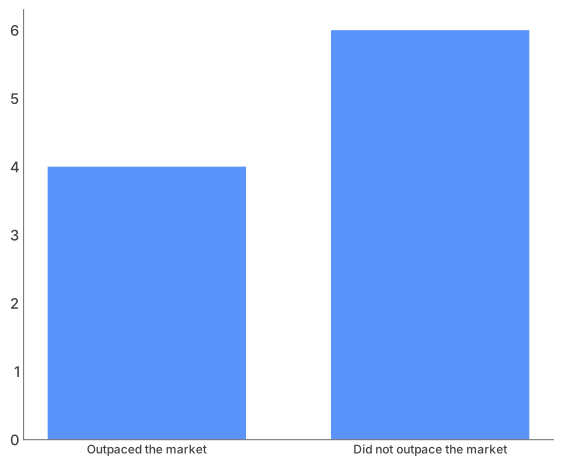
China's online snack food market reached CN¥ 132.8 billion in 2025, up 5.8% year on year (YoY), and it fragmented as growth moved away from its largest brands. Only four of the ten largest brands outpaced the market, and the growth that did occur clustered around narrowly positioned products that own a single consumption occasion, flavour territory or nutritional benefit. Emotional selling points, such as tie-ins with licensed characters (IP collaborations), novelty and sensory stimulation, grew 30.9% YoY, the fastest of the five concept dimensions, which suggests that brand storytelling and cultural resonance increasingly outweigh scale and assortment breadth. The high-protein snack segment reached CN¥ 12.5 billion (+12.5% YoY), more than double the pace of the market as a whole, and remains a long-tail structure with no established leader.
Download Full Report#
Get the complete analysis with additional data across Food & Beverage categories, beverage market trends, and innovation directions.
The Market Rewards Identity Over Scale#
In 2025 the market grew 5.8% YoY, yet only four of the ten largest brands grew faster than that. The playbook that built the largest online snack businesses, which paired platform-native distribution with very broad product assortments, faced diminishing returns in 2025 as consumers fragmented across channels, occasions and content formats.
Where growth did appear, it clustered around sharp positioning rather than breadth. Roasted-duck snacks built on strong brand storytelling, flavour innovation inside traditional Chinese snack formats, and heritage Chinese pastry riding renewed consumer interest in provenance were among the category's most dynamic territories in 2025.
The same logic shows up in how the category's fastest-growing products are named. Bestsellers name a consumption scenario rather than relying on generic product descriptions. "Binge-watching essential," "beer snack," "late night work," and "meal replacement" appeared alongside product names in 2025, positioning snacks as solutions to specific life moments rather than commodities competing on flavour alone.
Four of the ten largest snack brands outpaced the market
Five Concept Dimensions Reveal Where Growth Is Heading#
Snack food selling points cluster into five concept dimensions, and in 2025 the smallest grew fastest. Personalized concepts (flavor, form, regional features) anchor the market at CN¥ 23.5 billion but grew only 3.8%. Emotional concepts, despite commanding just CN¥ 2.8 billion, grew 30.9% in sales and 29.2% in volume, more than eight times the growth rate of the largest concept dimension.
The five concept dimensions ranked by sales and growth:
- Personalized (CN¥ 23.5B, +3.8%): the established revenue base
- Ingredient-based (CN¥ 12.2B, +8.8%): Premium ingredients driving quality perception
- Scenario-based (CN¥ 9.9B, +6.1% sales / +10.6% volume): Occasion-specific positioning
- Health-focused (CN¥ 4.9B, +3.8%): Health claims becoming table stakes rather than a differentiator
- Emotional (CN¥ 2.8B, +30.9%): IP collaborations, novelty, and cultural resonance, the fastest-growing dimension
Emotional selling points grew 30.9%, the fastest of the five concept dimensions
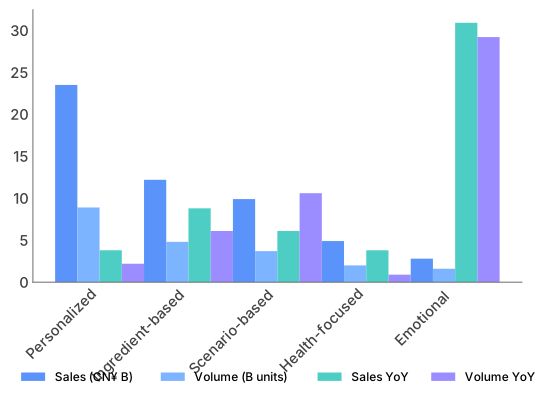
Scenario-based concepts show an important divergence: volume growth (+10.6%) significantly outpaces sales growth (+6.1%), suggesting that scenario-positioned products are gaining penetration at accessible price points. Health-focused concepts grew a modest 3.8%, which suggests that consumers expect health credentials but decide on emotional or scenario-based grounds.
High-Protein Snacks: A CN¥ 12.5 Billion Segment Outpacing the Market#
The high-protein snack segment reached CN¥ 12.5 billion (+12.5% YoY), more than double the overall snack market's 5.8% growth. Three defining trends characterise this segment: scenario-based consumption positioning (meal replacement, fitness snacking), ingredient upgrading toward premium protein sources, and healthy processing methods that eliminate frying.
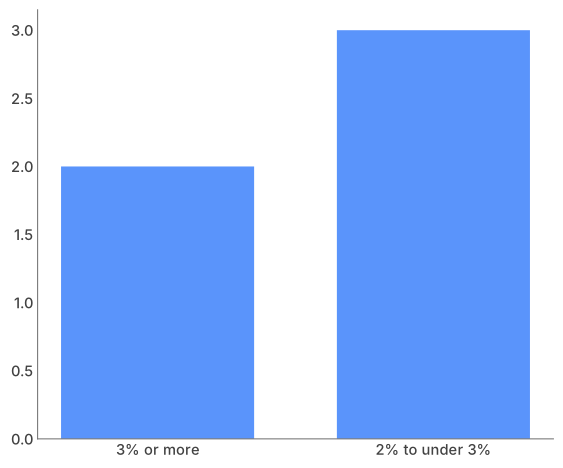
No brand dominates the segment: the five largest players all hold low-single-digit shares, two of them at or above 3% and the other three between 2% and 3%. That leaves an unusually long tail, and the tail is where the segment's most distinctive positioning is being built, with beef-based meal replacement and fitness-snacking occasions proving more productive than shelf breadth.
High-protein snacks remain a long-tail segment with no dominant brand
Innovation Shifts from Broad Health Claims to Precision Targeting#
Snack food innovation has evolved through three phases from 2023 to 2025, progressing from broad health claims to precision functional targeting. In 2023, health meal replacements and classic snacks grew together as "healthification" went mainstream. By 2024, categories upgraded to premium quality and scenario-based themes. In 2025, the frontier moved to precision health and functional segmentation, with products like black sesame balls and whole-wheat bread aimed at specific groups such as office workers, fitness enthusiasts and exam-preparing students.
Dual-use substances, meaning ingredients approved for both food and traditional Chinese medicine (TCM) applications, are driving innovation across the major sub-categories. Black sesame, yam, goji berries, and tangerine peel deliver both taste satisfaction and perceived health benefits, bridging the gap between indulgence and nutrition. The most successful new products adopt a "one product, multiple scenarios" design, marketed simultaneously as breakfast options, office snacks, fitness companions, and children's nutritional supplements.
More from This Report#
About the Data#
This analysis draws on Moojing Market Intelligence data covering China's online snack food market for the full calendar year 2025 (January-December 2025). Moojing Market Intelligence (魔镜洞察) analyses market dynamics across consumer categories and brands. The category and brand figures here are drawn from several leading Chinese online retail platforms, not from every platform in the market; social engagement figures are drawn from major Chinese social platforms. For full methodology and additional category analyses, see the complete Food & Beverage whitepaper.
This content adheres to Moojing's editorial standards .
Frequently Asked Questions
Growth moved away from the largest brands. Online snack sales reached CN¥ 132.8 billion in 2025, up 5.8%, but only four of the ten largest brands grew faster than the market. Those brands built their positions on platform-native distribution and broad assortment, and both were producing diminishing returns as consumers fragmented across channels and occasions. The strongest growth came from sharply positioned challengers instead, among them one built around a single product type with strong brand storytelling, which grew 68.6%, another built on flavour innovation in traditional snacks, which grew 32.5%, and a heritage pastry brand, which grew 19.3%.
Five dimensions, with a wide gap between the base and the frontier. Personalised concepts, meaning flavour, form and regional features, anchor the market at CN¥ 23.5 billion but grew only 3.8%. Ingredient-based concepts sit at CN¥ 12.2 billion (+8.8%), scenario-based at CN¥ 9.9 billion with +6.1% in sales and +10.6% in volume, and health-focused at CN¥ 4.9 billion (+3.8%), which suggests health claims have become table stakes rather than a differentiator. Emotional concepts, such as IP collaborations, novelty and cultural resonance, are the smallest at CN¥ 2.8 billion but grew 30.9% in sales and 29.2% in volume, more than eight times the rate of the largest dimension.
A large segment with an unusually open structure. It reached CN¥ 12.5 billion in 2025, up 12.5%, more than double the overall snack market's 5.8%, on three trends: scenario-based positioning for meal replacement and fitness snacking, ingredient upgrading toward premium protein sources, and processing methods that eliminate frying. No brand dominates: the five largest each hold a low-single-digit share, and a challenger positioned around beef-based meal replacement and fitness occasions grew 93.2%, nearly doubling its sales in a long-tail market where no brand has taken the lead.
Through three phases in as many years, from broad claims to precision. In 2023 health meal replacements and classic snacks grew together as healthification went mainstream. By 2024 categories upgraded on premium quality and scenario-based themes. In 2025 the frontier moved to precision health and functional segmentation, meaning products aimed specifically at office workers, fitness enthusiasts or exam-preparing students. Dual-use substances approved for both food and traditional Chinese medicine are driving that across sub-categories: black sesame, yam, goji berries and tangerine peel deliver taste and perceived health benefit together, bridging indulgence and nutrition. The most successful new products then use one-product-multiple-scenarios design, marketed simultaneously as breakfast, office snack, fitness companion and children's supplement.


