China Jewelry Market Q1 2024: Gold Turns to Self-Expression
 By Jotham Lim
5 min read
Newer data: China Jewelry Market: Online Gold Sales Up 50% in Early 2026
Executive Summary#
Jewelry and accessories sales on a leading Chinese marketplace reached CN¥ 65.9 billion in Q1 2024, up 18.8% year-on-year (YoY), and gold jewelry was the main source of that growth, supported by both investment demand and design innovation. Online gold jewelry sales grew 27.3% YoY, well ahead of the wider market. We believe the main driver is a change in how consumers aged 26 to 35 relate to gold, as they move away from buying it mainly for weddings and towards buying it for self-expression, personal investment and cultural identity. As a result, self-wearing demand accounted for 31.6% of Q1 2024 social media discussion of gold jewelry.
Download Full Report#
Get the complete analysis with sub-category breakdowns, brand-level performance data, and craft trend deep dives.
Download the Full Q1 2024 Jewelry & Accessories Whitepaper →
China's Recovery Lifts Jewelry Above Broader Retail#
China's macro environment continued to recover in Q1 2024. The Qingming holiday alone generated 119 million domestic trips, up 11.5% on 2019 on a comparable basis, while domestic tourism spending reached CN¥ 53.95 billion (+12.7% on 2019). Jewelry is one of the categories that have passed pre-pandemic levels, alongside travel, sports and entertainment, which places it among the categories of emotional and experiential spending that have held up well.
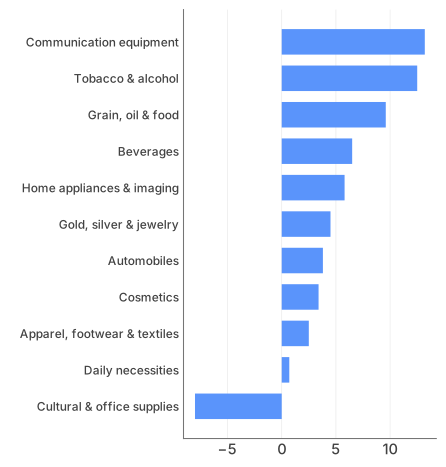
Gold, silver and jewelry retail grew 4.5% YoY in Q1 2024, a return to a more normal rate after the exceptional +29.4% of Q4 2023. That still shows steady demand for the category, although the recovery has differed from one category to another.
The chart below shows where jewelry sits within the broader Q1 2024 retail picture:
Communication equipment and tobacco & alcohol lead retail in Q1 2024
Six Gold Concepts Account for Much of the Category's Growth#
Within jewelry and accessories, growth in Q1 2024 was concentrated in gold sub-segments that combine cultural identity with new ways of buying and wearing gold, such as DIY, minimalist everyday pieces and heritage craftsmanship. The report identifies six gold concepts with the most potential on the basis of their gross merchandise value (GMV) and growth: ancient craft (古法) gold, gold DIY accessories, plain gold rings (素圈), plain gold chains (素链), small gold bead jewelry and filigree (花丝). Ancient-craft gold grew 73.7% in Q1 2024, as buyers responded to heritage techniques applied to pieces designed for everyday wear.
Competition Moves Towards Design#
Online jewelry sales in China are concentrated on a small number of leading marketplaces, and demand there splits between two kinds of gold. Investment-grade gold, such as bars and bullion, is bought on weight, purity and transparent pricing, and fashion-forward gold jewelry on motif, story and wearability.
Among the best-selling products online, a growing share are themed and design-led pieces, and sugar-cube motifs, four-leaf clover designs and rose flower pendants were among the stock keeping units (SKUs) with the highest sales in Q1 2024. We believe this shows consumers moving away from generic gold priced by weight and towards pieces that offer personalisation, symbolic meaning and a distinctive look.
Young Consumers Are Changing Why People Buy Gold#
Social media discussion of gold jewelry comes mainly from consumers aged 26 to 35 in tier-1 and new tier-1 cities, and three types of consumer stand out in the gold jewelry market:
- Gen Z buyers treat gold as an expression of personal style and as a store of value at the same time, so that one purchase serves both their taste and their finances.
- Career professionals use premium gold jewelry to signal taste and social standing, while giving priority to investment value and long-term asset retention.
- Mature women look for quality craftsmanship and timeless design, and buy mainly as a reward to themselves and as personal adornment.
The largest change is in the purchase occasion. Self-wearing demand accounted for 31.6% of Q1 2024 social media discussion of gold jewelry, which makes it the largest single occasion and places it ahead of wedding demand, which used to be the main reason to buy. Wedding-related demand is still the second-largest occasion, since gold is a cultural necessity at Chinese weddings, and gifts to family members make up a third important occasion.
Beyond finished products, gold DIY accessories and materials grew several times faster than ancient-craft gold in Q1 2024, as consumers who are no longer satisfied with buying finished pieces design and make their own. For brands, we believe this creates a new way to engage consumers, which strengthens their attachment to the brand and leads to additional purchases.
Key Takeaways#
- Jewelry sales on a leading marketplace reached CN¥ 65.9 billion in Q1 2024, up 18.8% YoY, well ahead of the +4.5% growth in national gold, silver and jewelry retail.
- Online gold jewelry grew 27.3% YoY, on the strength of investment demand and design innovation.
- Ancient-craft (古法) gold grew 73.7%, and gold DIY accessories and materials grew several times faster.
- Self-wearing demand accounted for 31.6% of Q1 2024 social media discussion of gold jewelry, ahead of wedding demand, which used to be the main reason to buy.
- Themed, design-led pieces are taking a growing share of the best-selling products, as consumers move away from generic gold priced by weight.
About the Data#
This analysis draws on Moojing Market Intelligence (魔镜洞察) data covering Q1 2024 (January to March 2024), with comparative data from Q1 2023 and Q4 2023 as indicated. Online sales data is drawn from leading Chinese marketplaces, and social media discussion and sentiment data from leading Chinese social platforms. Retail category data is from the National Bureau of Statistics (NBS).
Moojing Market Intelligence analyses brand and category performance across major Chinese e-commerce platforms. For inquiries, contact info@moojing-global.com.
This content adheres to Moojing's editorial standards .
Frequently Asked Questions
CN¥ 65.9 billion on a leading marketplace in Q1 2024, up 18.8% year on year, with online channels growing considerably faster than physical retail. The national gold, silver and jewellery retail line grew 4.5% in the same quarter, normalising from an exceptional +29.4% in Q4 2023. Gold jewellery is the engine inside it, up 27.3%. Jewellery sits alongside travel, sport and entertainment among the categories that have passed pre-pandemic levels, which places it in the emotional and experiential spending group rather than with ordinary discretionary goods.
The occasion. Self-wearing demand accounted for 31.6% of Q1 2024 gold jewellery social discussion, the single largest occasion segment, displacing wedding necessity as the primary driver. Wedding demand remains second, since gold is culturally embedded in Chinese weddings, with family gifting third. The buyers driving the shift are aged 26-35 in tier-1 and new tier-1 cities, and they split into three archetypes: younger buyers treating gold as style expression and value preservation at once; career professionals signalling taste while prioritising long-term asset retention; and mature women buying craftsmanship and timeless design as self-reward.
A move from weight-priced generic gold toward design, symbolism and participation. The highest-grossing SKUs are increasingly themed, such as sugar-cube motifs, four-leaf clover designs and rose flower pendants, where the buyer is paying for meaning rather than for grams. Ancient-craft gold grew 73.7%, pairing heritage technique with contemporary wear. And gold DIY accessories and materials grew several times faster still, as consumers moved from buying finished pieces to designing their own. That last one is not merely a product line; it is an engagement layer that deepens attachment and drives incremental purchases.
By transaction value and by intent. One major channel skews toward investment-grade gold, such as bars and bullion, with markedly higher average transaction values and a more concentrated brand structure. The other carries a broader consumer base with lower average transaction values and a stronger mix of fashion-forward gold jewellery, which makes it more fragmented and more design-competitive. The implication for a brand is that one SKU range will not perform equally in both: the investment-oriented channel rewards weight, purity and price transparency, while the fashion-oriented one rewards motif, story and wearability.


