China's Pet Market: CN¥ 17bn as Men Become Majority Owners
 By Quan Wenjun
6 min read
Newer data: China's USD 11.9B Pet Economy: How Babies Became Pets in 24 Months
Executive Summary#
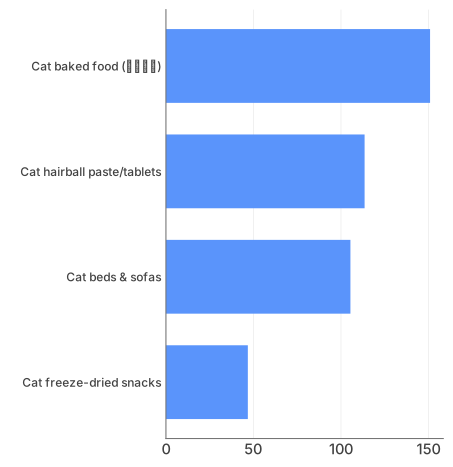
China's online pet market reached CN¥ 17.04 billion in Q1 2024 (+0.4% YoY), while unit volume grew to 320 million units (+24.8% YoY), and we believe the gap between the two reflects intense price competition as supply chains scaled up. Male pet owners became the majority for the first time, at 55.5% of the owner base. Cat complete food was the largest category at CN¥ 4.22 billion (+12.8% YoY), and baked cat food was the fastest-growing sub-category at +150.9% YoY.
Download Full Report#
Get the complete analysis with competitive analysis, consumer demographics, category deep-dives, and brand case studies.
A Market Growing in Volume, Not Price#
China's online pet market held steady in Q1 2024, although the headline sales figure says little about the change underneath it. Total sales of CN¥ 17.04 billion (+0.4% YoY) came with unit volume growth of +24.8% YoY to 320 million units, which shows that consumer demand for pet products is accelerating even as average selling prices fall. The average price per unit fell to CN¥ 53.4, as supply chain expansion, particularly for chicken-based protein sources, put sustained downward pressure on prices across the market.
The long-term drivers of demand remain in place. China's single-person households continue to grow, driven by urbanisation, rising marriage ages and changing lifestyle preferences. For people who live alone, urban young adults and the elderly, companion animals increasingly fill a social and emotional role that traditional family structures no longer provide. Multi-pet households are also becoming more common, as owners see pets as bringing joy and wellbeing to the family.
Cat baked food leads pet growth with +150.9% YoY; freeze-dried snacks and beds also surging
Brand Positioning: Distribution Breadth and Premium Nutrition#
Two strategies stand out among pet food brands. Myfoodie (麦富迪) has built its business on breadth of distribution, selling across the three major marketplaces in our data. Royal Canin (皇家), by contrast, keeps its premium positioning, which appeals to consumers who prioritise veterinary-endorsed, scientifically formulated nutrition and are willing to pay for it.
The "Cat Economy" Extends Its Lead#
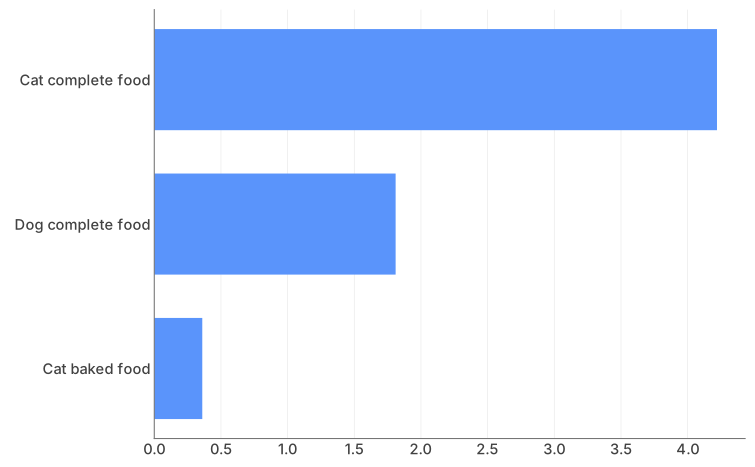
Cat complete food (全价猫主粮) is by far China's largest online pet staple food category, with sales of CN¥ 4.22 billion in Q1 2024 and YoY growth of +12.8%. Dog complete food (全价狗主粮) was second at CN¥ 1.81 billion (+8.2% YoY), and the gap between cat and dog food continues to widen.
Cat complete food leads at CN¥ 4.22bn; baked food growing fastest at +150.9%
A Landmark Demographic Shift: Male Owners Became the Majority in Q1 2024#
One of the most notable changes in China's pet market in recent years is the rapid rise in male pet ownership. In Q1 2023, male pet owners accounted for 30.3% of the total, and by Q1 2024 this proportion had risen to 55.5%, crossing the 50% threshold for the first time and making men the majority of owners.
The shift is mainly attributed to falling marriage rates and to growing spending by men on companionship-oriented categories, as more men live alone and look to pets to meet social and emotional needs. We believe this has significant implications for product strategy, since marketing content in the category has historically been aimed at female consumers, with emotional lifestyle imagery and nurturing themes, and it will need to be recalibrated.
The broader consumer base falls into three main groups:
- Urban single young adults who keep pets as companions while living alone
- Multi-pet families for whom pets add joy and warmth to household life
- The silver economy (seniors), an increasingly important and under-served segment as China's population ages
Each segment has its own needs in product format, price point and communication style, which gives brands that are willing to invest in precise positioning a different opportunity in each.
Three Trends Shaping the Next Phase of Growth#
We believe three connected trends will shape China's pet market over the coming years, and together they reflect a change in how Chinese consumers see their companion animals, relate to them and spend on them.
Trend 1: Anthropomorphization. Owners increasingly treat their pets as family members and friends, and this change in mindset is moving entire product categories from the human consumer market into the pet market. Snacks, health supplements and grooming products that mirror their human equivalents are selling well, and brands that can credibly occupy this emotional positioning are likely to build lasting consumer loyalty.
Trend 2: Scientific and Refined Pet Care. As knowledge about pet care spreads and is shared on social platforms, pet owners are becoming more discerning. They expect transparency on nutritional composition, read ingredient lists closely and evaluate production processes, down to baking temperature, meat powder content and allergen profiles. Functional needs are also diversifying, with growth in external benefits (coat care, cheek plumping, skin health), internal health benefits (gut care, joint support) and category innovations such as prescription diets and wet food formulated for palatability. Brands with strong R&D and credible scientific credentials are well placed in this market.
Trend 3: The Dual Perspective. The pet market shares a structural feature with the infant and toddler market, which is that the buyer and the end user are different, so a successful pet product has to satisfy two parties at once. For the owner, what matters is aesthetics, emotional value, how shareable the product is on social media and how convenient it is to use. For the pet, palatability and nutritional balance are essential. Brands that design for both perspectives will have a durable competitive advantage.
Key Takeaways#
- China's online pet market reached CN¥ 17.04 billion in Q1 2024 (+0.4% YoY), with volume growing +24.8% YoY to 320 million units as price competition intensified.
- Male pet owners became the majority for the first time, rising from 30.3% in Q1 2023 to 55.5% in Q1 2024, a structural demographic shift driven by falling marriage rates.
- Cat complete food is the largest category at CN¥ 4.22 billion (+12.8% YoY), and cat baked food is the fastest-growing sub-category at +150.9% YoY, approaching 10% of cat staple food sales.
- Myfoodie (麦富迪) has built its business on breadth of distribution across the major marketplaces, while Royal Canin (皇家) keeps its premium positioning around scientifically formulated nutrition.
- We believe three structural trends, anthropomorphization, scientific pet care and the dual perspective of owner and pet, will shape competition in the market through 2025 and beyond.
About the Data#
This analysis draws on Moojing Market Intelligence (魔镜洞察) proprietary e-commerce data covering three leading Chinese marketplaces for the period January–March 2024 (Q1 2024), with year-on-year comparisons against Q1 2023. Social media data is drawn from major Chinese social platforms.
Moojing Market Intelligence analyses brand and category performance across major e-commerce platforms internationally. For the full dataset and methodology, download the complete report. Contact: info@moojing-global.com | moojing-global.com.
This content adheres to Moojing's editorial standards .
Frequently Asked Questions
Growing in volume, not in price. Q1 2024 sales reached CN¥ 17.04 billion at just +0.4% year on year, while unit volume surged 24.8% to 320 million units and the average price per unit fell to CN¥ 53.4. Supply chain expansion, particularly in chicken-based protein sources, has exerted sustained downward pressure across the market. Demand for pet products is clearly accelerating; the value captured per unit is not. That divergence is the number a brand should measure itself against before reading its own volume growth as success.
Male owners becoming the majority. In Q1 2023 men accounted for 30.3% of pet owners; by Q1 2024 that had risen to 55.5%, crossing 50% for the first time. The drivers are falling marriage rates and growing male spending on companionship categories as more men live alone. The consequence for brands is concrete and often missed: marketing in this category has historically skewed toward female consumers through emotional lifestyle imagery and nurturing themes, and by Q1 2024 that creative direction addressed a minority of the owner base. Recalibration is a media and creative question, not a product one.
In cats, and inside cats in new formats. Cat complete food is by far the largest online staple food category at CN¥ 4.22 billion (+12.8%), against dog complete food at CN¥ 1.81 billion (+8.2%), and the gap keeps widening. The breakout is baked cat food at +150.9%, which was approaching 10% of cat staple food sales in Q1 2024 although it did not meaningfully exist as a category a few years earlier. That fits the wider pattern in this market: growth comes from a new processing or format proposition an owner can evaluate, not from incremental recipe improvement.
Three, and they interlock. Anthropomorphisation is migrating whole product categories out of the human market into the pet one, and snacks, health supplements and grooming products that mirror their human equivalents are thriving because pets are treated as family. Scientific and refined care is making owners discerning: they scrutinise nutritional composition, ingredient lists and production processes down to baking temperature and meat powder content, which rewards brands with genuine R&D. And the dual perspective ties the two together. As in the infant market, the buyer and the end user are different, so a product must satisfy the owner on aesthetics, emotional value and convenience while satisfying the pet on palatability and nutrition. Failing either one fails the purchase.


