China Pet Staple Food 2026: Precision Nutrition Splits the Cat and Dog Playbooks
 By Jotham Lim
6 min read
By Jotham Lim
6 min read
Executive Summary#
Get the Full Report: Download the complete analysis for detailed data, methodology, and pages of insights.
China's online pet staple food market reached CN¥ 29.51 billion in MAT 2025 (December 2024–November 2025), and the two species inside it now follow visibly different precision-nutrition playbooks. Cat staple is the core pillar and growth engine at CN¥ 20.81 billion (+9.5% YoY); dog staple sits at CN¥ 8.70 billion (+4.6% YoY). Puffed and extruded grains still hold the base, but prescription diets, staple freeze-dried, and lunch-box formats grow fastest. Beneath the totals, cats and dogs buy nutrition for different reasons — cats for long-term internal conditioning, dogs for visible efficacy — and that split is the single most useful planning lens in the category.
A CN¥ 29.51 Billion Base That Cats Now Carry#
Staple food remains the structural anchor of China's pet diet, and within it cat staple does the heavy lifting. At CN¥ 20.81 billion and +9.5% year-over-year, cat staple is both the largest pool and the faster-growing one; dog staple, at CN¥ 8.70 billion and +4.6%, grows at roughly half the rate. The base format — puffed and extruded grain — still holds the bulk of volume, but the energy sits at the edges: prescription diets, staple freeze-dried, and lunch-box formats are the fastest-rising formats in the mix. For category planners, that pattern matters more than the headline. A staple base growing at single digits can look mature; a base whose fastest-rising formats are medical, fresh-format, and portion-controlled is a base actively re-segmenting toward higher-value, health-led demand.
Functional selling points lead the broad market. Across staple food, coat and skin health grew +63.2%, oral health +43.3%, and immune-system support +41.3% — proof that owners now read a bag of food as a health instrument. On the ingredient-and-process side, traditional Chinese herbal ingredients grew +51.8%, refined processing technology +46.2%, and premium animal protein +15.6%. The category is being rebuilt around what a formula does and what goes into it, not how much it fills the bowl.
Two Species, Two Buying Logics#
The clearest finding in MAT 2025 is that cat and dog owners are not buying the same thing for different animals — they are buying for different goals. Cats focus on long-term internal conditioning and dietary prevention: the cat owner is managing a system over years. Dogs focus on quality upgrade and visible efficacy: the dog owner wants a result they can see, often in coat condition or body shape.
That difference resolves into a structural rule. Cats scale on ingredient technology — the route to growth runs through what is in the formula and how it is processed. Dogs scale on pet-characteristic fit — the route runs through matching breed, size, and life-stage needs. Product functionality is the shared growth engine underneath both, but the levers that move each species sit in different places. The new and hit products confirm it: new and hit cat staples anchor on coat and skin health, while new and hit dog staples concentrate on weight and body-condition management.
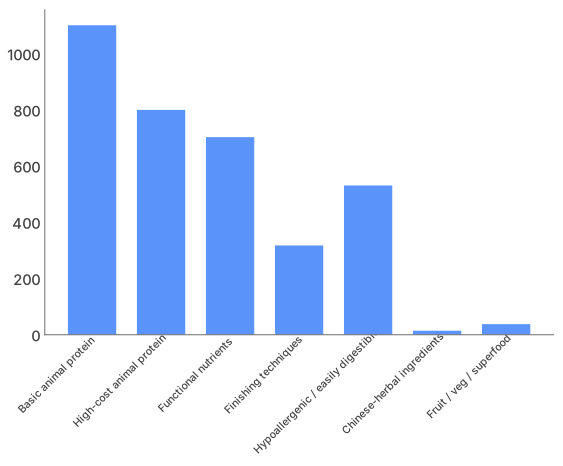
Where cat and dog staple money concentrates
Reading the Cat Playbook#
Cats anchor on basic animal protein at CN¥ 1,101.4 (ten-million units), the largest single dimension, growing a steady +9.5%. But the momentum is above it. High-cost animal protein grew +17.5% to CN¥ 800.3, functional nutrients grew +22.3% to CN¥ 703.3, and finishing techniques grew a category-leading +48.8% to CN¥ 317.8 — owners are paying for better raw material and better process, not just more of it.
The standout signal is Chinese-herbal ingredients: small in absolute terms at CN¥ 14.1, but the fastest-growing cat dimension at +83.1%. It is the purest expression of the cat owner's "internal conditioning" instinct — a bet on long-horizon wellness rather than an immediate fix. Hypoallergenic and easily-digestible formulas, at CN¥ 531.3, show demand reallocating toward these protein-quality, functional, and herbal dimensions rather than away from the category — cat owners are shifting their spend toward conditioning and premium-protein claims.
Reading the Dog Playbook#
The dog mix is leaner and tilts toward visible results. Basic animal protein leads at CN¥ 458.7 (+5.4%), but the growth sits in functional nutrients, up +24.2% to CN¥ 165.3 — even ahead of the cat figure on rate — and in finishing techniques, the fastest dog dimension at +36.3% to CN¥ 75.0. High-cost animal protein is comparatively modest at CN¥ 128.3 (+5.3%), reflecting a dog owner who upgrades quality selectively rather than across the board.
Hypoallergenic formulas, at CN¥ 163.9, again show demand reallocating toward functional and finishing dimensions, where efficacy is easier to see and feel. With new and hit dog staples concentrating on weight and body-condition management, the dog playbook reads as quality-upgrade-plus-visible-outcome — the mirror image of the cat owner's patient, systemic approach.
Concentration Rises and Agile Domestic Brands Take the Space#
The staple category is concentrating around brands that read demand precisely. The leading-brand cohort grew sales +12.7% year-over-year and lifted its share by +8.0 percentage points — well ahead of the overall market's +7.6% growth and CN¥ 101.53 average price. International brands are ceding ground through slower strategy adjustment, and agile domestic brands are growing into the space they leave.
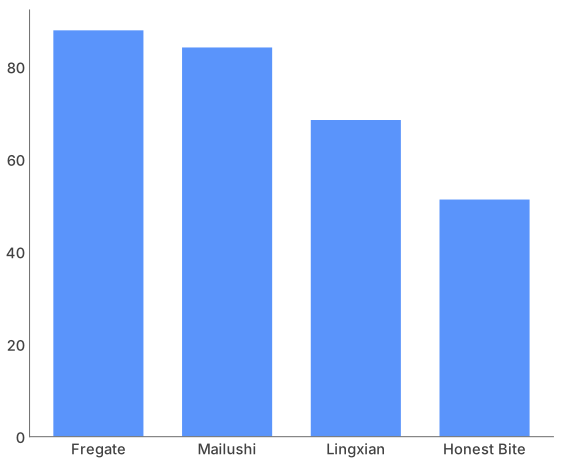
The high-growth names make the pattern concrete: Fregate grew +87.9% at an average price of CN¥ 74.0, Mailushi +84.2% at CN¥ 29.6, Lingxian +68.5% at CN¥ 71.2, and Honest Bite +51.3% at CN¥ 72.9. The spread of price points — from value to premium — shows the growth is not a single price story; it is a precision story. Each of these brands matches a specific owner intent, whether that is herbal conditioning for cats or body-condition management for dogs, and converts the species-level buying logic into a focused product line. The takeaway for any brand planning the next cycle is direct: build the cat line around protein quality, functional nutrients, and herbal conditioning, and build the dog line around visible efficacy and body-condition fit. The market is rewarding precision over breadth, and the +8.0-percentage-point share gain in the leading cohort is what that reward looks like.
Agile brands grow across the price ladder
About the Data#
This article summarises findings from the Moojing China Pet Food Market Trends 2026 report. Data covers MAT 2025 (December 2024–November 2025) online consumer sales across China's mainstream e-commerce platforms, benchmarked against MAT 2024. Brand cohort shares reference Moojing's proprietary coverage of the highest-volume brand pool per category — not a full census.
Download the Full Report#
Get the complete analysis with detailed data, methodology, and additional insights.
This content adheres to Moojing's editorial standards .


