Two Playbooks, Both Winning: The Export-Challenger Strategy in US and UK Hairdryers
 By Quan Wenjun
6 min read
By Quan Wenjun
6 min read
Executive Summary#
Get the Full Report: Download the complete analysis for detailed data, methodology, and pages of insights.
Export challengers in the US and UK hairdryer category have converged on two distinct strategies, and both are working at the same time. Moojing's analysis of a leading US marketplace and a leading UK marketplace across June 2024 – May 2026 shows a volume strategy at $35–$43 (CN¥ 251–314) generating roughly $41M in combined two-year US revenue and growing +27% to +190%, alongside a specification-parity strategy at $120 (CN¥ 870)** on roughly **$13M over the same two years** at **+7%**. A fifth challenger runs the parity play in the UK at **$113 (CN¥ 821), growing above +50%. The enabling technology is the same on both sides: a high-speed brushless motor at 110,000 RPM delivering premium-comparable specification at roughly a third of the premium benchmark's price. Two strategies coexisting suggests the opening is structural — and it moves the binding constraint off the hardware and onto brand awareness.
Two Strategies, One Cohort#
Export challengers hold roughly 6.0% of US category revenue across the brands the analysis breaks out individually, with the wider cohort estimated at 7–8%. Their growth is reported per brand rather than as a cohort, and the range is wide — they get there by two routes that share few tactics.
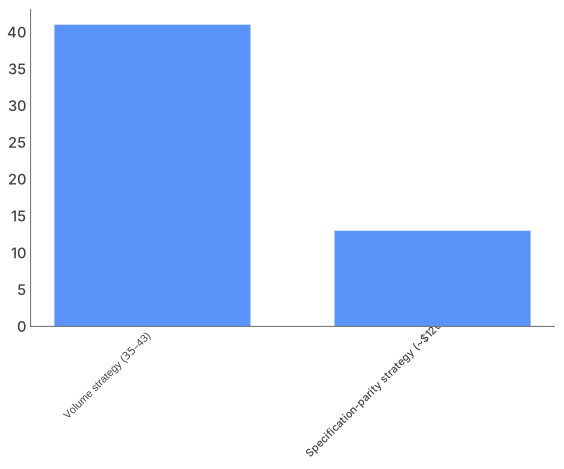
The volume strategy sits at $35–$43 (CN¥ 251–314), sells on strong power, low noise and multi-attachment sets, and leads on value. Its combined two-year US revenue is around $41M, with growth across its brands running from +27% to +190%. The specification-parity strategy sits at ~$120 (CN¥ 870), sells premium-equivalent specification at roughly a third of premium price, and leans on professional positioning and deliberate brand building. Its combined two-year US revenue is around $13M, growing +7%.
The volume play buys growth rate; the parity play buys price. Each is internally consistent — pricing, proposition, differentiators and risk line up — and each carries its own exposure: the volume route risks price competition compressing margin, while the parity route is capped by how many buyers have heard of the brand.
Volume at $35–$43 carries ~$41M; parity at ~$120 carries ~$13M
The 110,000 RPM Motor Is What Makes Parity Possible#
Parity is claimable because the component that defined the premium tier is now available to challengers. The high-speed brushless motor spinning at 110,000 RPM is identified in the analysis as the core differentiator for the export cohort: premium-comparable specification at roughly a third of the price. It sits in the differentiator set of both strategies, paired with ionic treatment and recycled-material certification on the volume side and professional positioning on the parity side.
Three technology directions define the 2025–2026 category: heat-free drying, the high-speed brushless motor, and the multi-styler all-in-one format that converges drying, straightening and curling into one device. Heat-free has moved from premium differentiator to baseline expectation, hair-health framing now outperforms power framing, and the all-in-one is the fastest-growing product form. A launch carrying one or two of these three claims has something measurable to argue; a launch without them is asking buyers to choose on price. Hence the recommendation to lead on measurable specification rather than on price: parity with the premium benchmark at 30–40% of its price is the entry path the data shows working.
Awareness Is the Constraint, Not Capability#
The specification gap between challenger and premium benchmark has largely closed. The reputation gap has not — and that asymmetry is what should redirect a challenger's spend.
The demand context supports it. With the premium-technology tier reaching around $412 (CN¥ 2,985), price-sensitive buyers are moving to specification-comparable alternatives around $120–$160 (CN¥ 870–1,159) rather than abandoning the premium proposition. Those buyers shop on stated specification and social proof, so a challenger that already matches on motor speed and heat management wins them through review depth and social content rather than another hardware revision.
The corridor where the export cohort operates and grows fastest is $35–$120 (CN¥ 250–870); the contested ground begins above it, at $97–$193 (CN¥ 700–1,400). Entering inside the corridor with a parity specification and an awareness budget is a different plan from entering the contested band with a hardware roadmap.
Which Market First — and Why It Is Not the UK#
The intuitive answer is the UK: smaller, cheaper to enter, and the fifth challenger running parity there at ~$113 (CN¥ 821) is growing above +50%. That is a real signal, worth acting on eventually.
It is not the first move. The UK is the more consolidated market — its top two archetypes take 49.7% of revenue against 34.8% in the US — and roughly one-seventh the size, at $127M (CN¥ 920M) against $889M (CN¥ 6.44B). The US is also where the challenger cohort's revenue and growth are broken out. The UK's case rests on being smaller and cheaper to enter, neither of which this dataset measures.
Lead with the US; treat the UK as a second step. In either, target an underserved band: the UK's upper-mid tier at $89–$134 (CN¥ 645–968) holds 3.6% of listings against 6.5% of revenue, which is the shape to look for.
One further export brand in the analysis follows neither strategy and sits outside this framing.
Key Takeaways#
- Two playbooks are live at once. Volume at $35–$43 (CN¥ 251–314) on
**$41M** of two-year US revenue growing **+27% to +190%**; specification parity at **$120 (CN¥ 870)** on ~$13M growing +7%. Pick one and run it consistently. - The 110,000 RPM brushless motor is the enabling component, delivering premium-comparable specification at roughly a third of the premium price across both strategies.
- Carry one or two of the three technology claims — heat-free, high-speed motor, all-in-one multi-styler — or expect thin differentiation.
- Test the awareness hypothesis before funding it. The specification gap has closed; that awareness now limits share is the likeliest explanation and the cohort's own stated risk, but nothing here measures it.
- Lead with the US; treat the UK as a second step. It is ~7× the size and less consolidated (34.8% against 49.7% in the top two archetypes). In either, target an underserved tier.
About the Data#
This analysis draws on Moojing CMI proprietary overseas e-commerce research covering a leading US marketplace and a leading UK marketplace in the Hair Dryers & Accessories category, across June 2024 – May 2026. Revenue figures are two-year totals for that window rather than annual figures. Monetary values are converted from CN¥ at CN¥ 1 = $0.138, with CN¥ in brackets; growth figures are year-on-year. Findings describe the US and UK and should not be generalised to other European markets without separate analysis.
Download the Full Report#
Get the complete analysis: the two-year market and growth spine, the archetype view of both competitive fields, the full US and UK price ladder, the technology direction, and the export-challenger playbook in detail.
This content adheres to Moojing's editorial standards .


