Inside Midea's Home Advantage: Why a Domestic Leader Globalises
 By Quan Wenjun
5 min read
By Quan Wenjun
5 min read
Executive Summary#
Get the Full Report: Download the complete analysis for detailed data, methodology, and pages of insights.
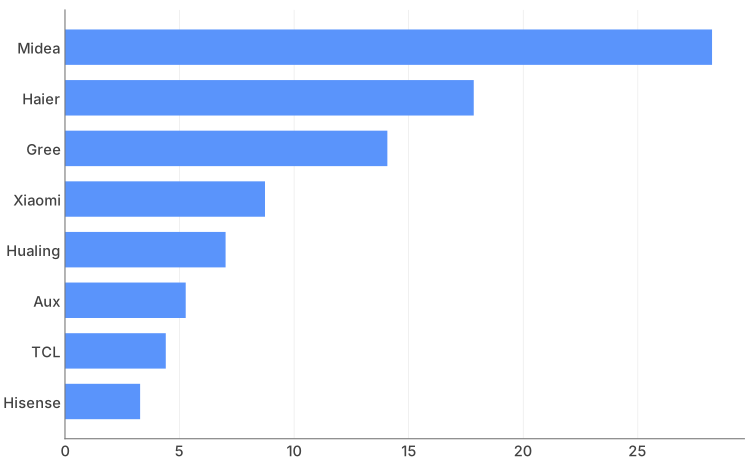
Midea globalises from strength, not weakness. In its mature home household-AC market it is the clear No. 1 brand at roughly 28% share on mainstream e-commerce platforms — roughly 1.6× the next-largest brand — and it runs the same premium-plus-value two-brand structure at home that it deploys in Europe. A leader in a saturated home category grows its next increment abroad; that home advantage is what makes the European premium push durable rather than opportunistic.
A Domestic Leader, Not a Domestic Escapee#
Midea's European premium play is launched from a position of clear domestic leadership. In its home household-AC market, Midea is the leading brand at roughly 28% share on mainstream e-commerce platforms — roughly 1.6× the next-largest brand — with the eight leading brands together accounting for the large majority of the market. Counting its Hualing value sub-brand, Midea Group's domestic position is stronger still. This is a company extending from a position of home strength, not one hedging against home weakness.
That distinction matters for durability. An overseas premium push funded from category leadership at home carries the scale, supply chain and brand system to sustain it; a push driven by a shrinking core does not. Midea's globalisation reads clearly as the former — the domestic market supplies the engine, and Europe supplies the growth headroom. Read as a structural snapshot rather than a performance ranking, the home market is a picture of an established leader with a wide gap to the field.
In its mature home market, Midea leads household AC — roughly 1.6× the next brand
The Two-Brand Model Is Native, Not an Export Improvisation#
The domestic structure mirrors the European playbook almost exactly. At home, Midea pairs a premium flagship brand with the value-tier Hualing sub-brand to cover the mass market from both ends — the same premium-plus-value architecture it runs abroad as premium Midea plus value Comfee. The two-brand model is not something invented for export; it is the company's native operating structure, transplanted.
The parallel is precise, brand for brand. In Europe, premium Midea and value Comfee together make Midea Group the No. 1 portable-AC group in Germany and France; at home, premium Midea and value Hualing cover the household-AC mass market the same way. A single parent runs two distinct brands rather than stretching one across incompatible price points — the discipline that lets it anchor a premium tier abroad without conceding the value field, and that already covers both ends of its home market.
For a Western reader trying to read the globalisation, the implication is that the two-brand playbook seen in Europe is not a bespoke market-entry tactic to be reverse-engineered. It is how Midea Group is built. The premium flagship and the value sub-brand are the company's standing architecture, and Europe is simply the newest theatre in which that architecture operates.
A Mass-Priced Home Market Is the Reason to Go Premium Abroad#
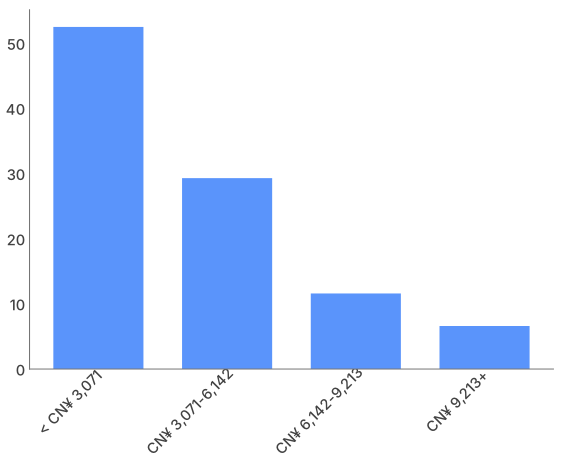
The domestic market is mass-priced, and that is precisely why the premium form monetises in Europe first. More than half of domestic household-AC units — 52.5% — sell below CN¥ 3,071, and the CN¥ 3,071-6,142 mid band adds most of the rest at 29.3%. The upper bands are comparatively thin: 11.6% of units fall in the CN¥ 6,142-9,213 band and 6.6% above CN¥ 9,213. This is a large, mature market that clears its volume at mass-market prices.
The domestic AC market is mass-priced — premium monetises abroad first
Key Takeaways#
- In its mature home market, Midea is the clear No. 1 household-AC brand at roughly 28% share on mainstream e-commerce platforms — roughly 1.6× the next-largest brand, with the eight leading brands together holding the large majority of the market.
- The domestic structure mirrors the European playbook: premium Midea plus value-tier Hualing at home is the same architecture as premium Midea plus value Comfee abroad — a native operating model, transplanted.
- The home market is mass-priced: 52.5% of household-AC units sell below CN¥ 3,071 and the CN¥ 3,071-6,142 mid band adds 29.3%, so the premium no-install form monetises in Europe first.
- Maturity is the reason to globalise: European household-AC penetration is only about 19% — roughly 3% in Germany — against roughly 77% in China, leaving the growth headroom overseas.
- Midea's globalisation is backed by domestic leadership, not a hedge against home weakness — a more durable footing for an overseas premium push.
About the Data#
This analysis is based on Moojing Market Intelligence proprietary research across mainstream Chinese e-commerce platforms, presented as a structural market snapshot for context rather than a brand-performance ranking, and shown without platform-level attribution. The domestic figures reflect the seasonal June 2026 high point of a large, mature market. Air-conditioning penetration figures follow WRI / IEA estimates; Comfee and Hualing are identified as Midea Group brands per Midea corporate disclosures. All figures were validated on 9-10 July 2026 against the project source tables.
Download the Full Report#
Get the complete analysis — the four-market European breakdown, the Midea Group two-brand tables, the regulation-aware product teardown, and the full domestic-market mirror.
More from This Report#
- How Midea won Germany: inside the PortaSplit sell-out
- The no-install AC: cheap niche at home, premium hit abroad
- Who really leads Europe's portable-AC boom
This content adheres to Moojing's editorial standards .


