Europe's Portable-AC Boom Was Four Markets, Not One
 By Jessie Wang
8 min read
By Jessie Wang
8 min read
Executive Summary#
Get the Full Report: Download the complete analysis for detailed data, methodology, and pages of insights.
Europe's 2026 portable-AC boom was one demand shock landing on four separate markets. The June heatwave lifted every European market we analysed, but it lifted them at very different speeds and from very different starting points, and the positions built during the boom were assembled market by market rather than across the continent. The transferable lesson is architectural: a portfolio built from two complementary brands met the surge differently in each market. It is also a separate story from the trade-level air-conditioner export figures the news coverage described.
One Boom, Four Very Different Markets#
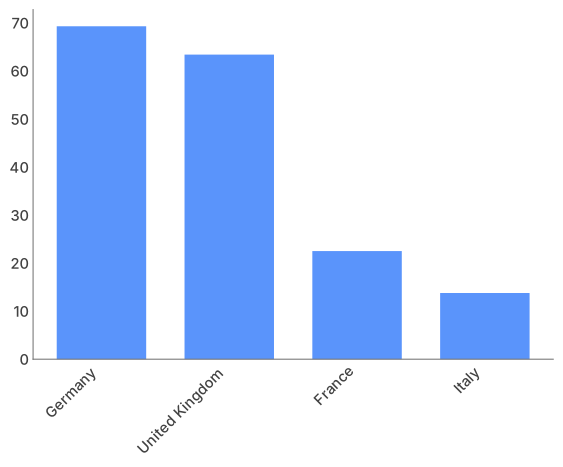
The 2026 heat lifted the whole category, but the four European markets are not one market. Germany (€69.3M, +12.8% year on year) and the United Kingdom (€63.4M) are the two largest of the four, while France grew +95% and the UK +134% year on year — the steepest climbs of the group. Italy, at €13.8M, is the smallest of the four; its year-on-year figure is not available on this data horizon. The demand shock was genuinely category-wide, but its scale, its speed and its starting point differ market by market, and that variation is the first clue that "Europe" is not a single addressable market for portable AC.
When an entire category grows this fast in a single season, strong absolute growth is available to every capable supplier — European incumbents and recent entrants alike. That is exactly why growth rates alone say little about who captured the surge. A rising tide of +95% or +134% carries the whole field upward; separating that tide from a genuine competitive gain means looking past the headline growth to how positions were actually built in each market. And on that question, the four markets diverge sharply.
A category-wide boom across four European markets
Category Growth Is Not Competitive Gain#
Read across the four markets, the boom did not produce a single European winner. No brand held the leading position in all four; the front of the field changed from country to country. The same category, the same heatwave, four different competitive outcomes — which is why reading a single-market result as a continent-wide sweep is the most common error in the popular coverage.
That divergence is not random. Where a category has been served for decades by familiar European household-appliance names, a heatwave sends demand toward the brands consumers already recognise, and a recent entrant has to earn its way onto the consideration list before it can convert a demand spike into anything durable. Where the category is younger, thinner on incumbent equity, or bought mainly on price and availability during a shortage, the same spike is far easier for a newcomer to capture. Brand familiarity and position on the price ladder — not the size of the heatwave — decide which suppliers a boom actually rewards.
The honest reading, then, is not one brand displacing another across a continent. It is four separate contests running at the same time, under one weather event. For a Western B2B reader, that reframes the question from "who is being pushed out" to "what does it take to build a position in each of these markets" — a far more useful question than the sweep the headlines implied.
The Transferable Play Lives at the Portfolio Level#
The pattern worth copying sits at the portfolio level, not at the single brand. One supplier enters these markets on two rungs of the price ladder at once — a premium brand and a value sub-brand, sold side by side under the same corporate parent. Looking at either brand on its own describes only part of what the parent is doing, which is why single-brand readings of this category so often miss the point.
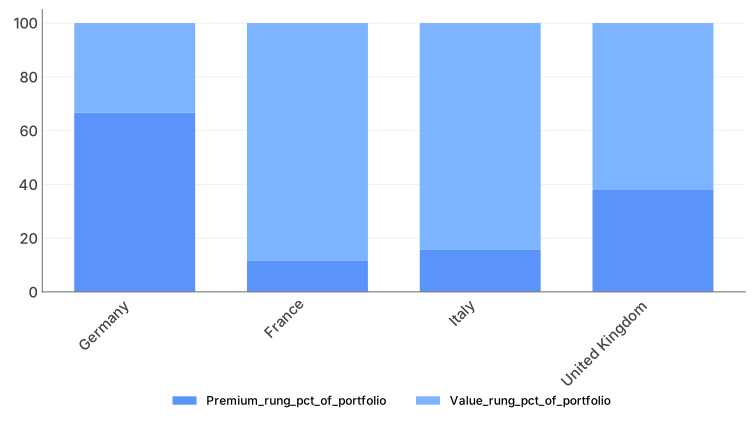
The instructive part is that the balance between the two rungs inverts from market to market. In Germany, the premium brand carries two thirds of the portfolio's combined portable-AC position (66.7%). In France the position rests almost entirely on the value sub-brand (88.5%), and Italy looks similar (84.4%); in the United Kingdom the split is closer to even, with the value sub-brand at 62.1%. The same corporate parent works one market from the top of the price ladder and another from the value rungs, running two brands rather than stretching one across incompatible price points. Portfolio architecture, not brand stretch, is what lets a supplier meet a booming category wherever the demand actually sits.
What that composition does not tell you is how large the resulting position is in any given market. A mix is a mix, not a share, and the two should not be read as the same thing. Four markets are also a thin evidence base for a general rule: the two-rung architecture is visible in all four, but whether a mix that worked in one market transfers to the next is not settled by this data.
One portfolio, two price rungs — and the mix inverts by market
The Export Surge Is a Separate Spine#
The marketplace story and the broader air-conditioner export surge are two different spines, and conflating them is how a single-market result becomes "China conquered Europe." Trade coverage through mid-2026 described Chinese manufacturers selling fast into Europe (Caixin Global), alongside EU air-conditioner exports rising 43.2% in H1 2026 (EqualOcean). Those figures are real, and they describe genuine momentum in the wider category.
But they sit in a different dataset from the one measured here, and the mismatch is not a detail. Trade statistics cover the whole air-conditioner category — fixed split systems included — across every channel it is sold through. The data behind this article covers one product format, portable units, on one leading marketplace in each of four countries. Different product scope, different channel footprint, different unit of measurement. Neither is evidence for the other, and a reader who treats a trade-level surge as proof of marketplace-level position has changed the subject without noticing.
Keeping the two spines separate is the disciplined close. The category-wide demand shock is one story: a heatwave that lifted every capable supplier and shows up in trade-level export growth. Building a durable position in a specific market is another, and on the marketplace data that is a country-by-country job — done here through a two-rung portfolio rather than a single flagship brand. The path from one good market result to the next runs through that architecture. It is a credible path, and still an unproven one.
Key Takeaways#
- The 2026 heatwave lifted the category across all four European markets — Germany (€69.3M, +12.8% year on year), the UK (€63.4M, +134%), France (+95%) and a smaller Italy (€13.8M) — but category growth is not the same thing as competitive gain.
- No single brand held the leading position across all four markets; the front of the field changed from country to country, so a result in one market is not a result across Europe.
- The transferable pattern is portfolio architecture: entering on two rungs of the price ladder at once, with a premium brand and a value sub-brand, rather than stretching one brand across incompatible price points.
- The balance between those two rungs inverts by market — the premium brand carries 66.7% of the portfolio's combined position in Germany, while the value sub-brand carries 88.5% in France, 84.4% in Italy and 62.1% in the UK. That is composition, not market share.
- Trade-level export growth (EU air-conditioner exports +43.2% in H1 2026) and marketplace-level positions are measured on different product scopes and different channels; neither is evidence for the other.
About the Data#
This analysis is based on Moojing Market Intelligence proprietary research covering a leading marketplace in each of Germany, France, Italy and the United Kingdom — category revenue, year-on-year growth and brand-portfolio composition. Coverage is one leading marketplace per market, not the whole national appliance market, and the figures should be read at that scope. The data horizon is April 2026; the late-June demand peak and the trade-level export figures are carried by dated third-party citations (Caixin Global and EqualOcean, June and July 2026). UK brand-level figures are interpolated and flagged approximate.
Download the Full Report#
Get the complete four-market breakdown — category scale and growth in each market, the portfolio composition behind the two-rung architecture, and the separation of marketplace-level positions from the wider trade-level export surge.
More from This Report#
- Inside a premium-first entry into Germany's portable-AC market (pillar article)
- Why a mature domestic appliance maker globalises
- The no-install AC: a cheap niche at home, a premium product abroad
This content adheres to Moojing's editorial standards .
Frequently Asked Questions
No — one demand shock produced four different winners. The 2026 heatwave lifted every marketplace analysed, but they are not one market: Germany at €69.3M (+12.8%) and the UK at €63.4M are the two largest, France grew +95% and the UK +134% — the steepest climbs — while Italy at €13.8M is the smallest and most mature, growing roughly flat. When a whole category grows this fast in a season, strong absolute growth is available to every capable supplier, so growth rates alone say very little about who is actually winning.
Germany, and only Germany. Its own brand is the leading portable-AC brand there at 19.0% share, but it ranks fifth in France at 3.1%, sixteenth in Italy at 1.1% and far down the field in the UK at 0.5%. The same brand, the same heatwave, four very different outcomes. Meanwhile the established European climate-appliance incumbent anchors most of the map — leading Italy at 8.8% and the UK at 8.6%, second in Germany at 11.6% and fourth in France at 3.4%. Where a challenger has not assembled a German-style position, the market defaults to the name European consumers already recognise.
Group-level portfolio architecture, not brand stretch. Counting the parent's value sub-brand alongside its premium brand changes the map entirely: the group leads portable AC in Germany at 28.5% combined and in France at 26.6%. The contrast between those two is the whole lesson — in Germany the premium brand does the heavy lifting at 19.0% with the value brand adding a 9.5% flank, while in France the roles invert and the value brand leads the entire market at 23.5% with the premium brand a modest 3.1% presence. One parent leads one market from the top of the price ladder and the other from the value rungs, using two brands rather than stretching one across incompatible price points.
Two of four markets, stated honestly. Group share is 6.9% in Italy and 1.2% in the UK, where the incumbent leads and the group's brands are still challengers building presence. So the two-brand play is executed to leadership in half the markets and early in the other half; replicating the German result elsewhere is credible but unproven on current data. It is also worth keeping separate from the wider export story: reported growth of +50%, +13% and +27% among other Chinese makers, and EU air-conditioner exports up +43.2%, describe the whole air-conditioner market including fixed splits and channels far beyond these marketplaces. None of those names appears among the leading brands in any of the four. Reading one as evidence for the other overstates both.


